place

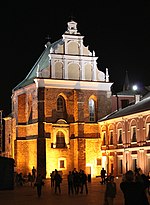
Cathedral of the Transfiguration, Lublin

History of the Ukrainian Greek Catholic ChurchLublinPolish Orthodox cathedrals
A227 zespół cerkwi par. p.w. Przemienienia Pańskiego ul. Ruska 40 Lublin 3s

Cathedral of the Transfiguration is an Orthodox cathedral in Lublin, and the main church of the Diocese of Lublin and Chełm of the Polish Orthodox Church. It also serves as the seat of the Lublin Parish of the Transfiguration (in the Lublin Deanery). The cathedral is located on Ruska Street. The currently existing building was constructed between 1607 and 1633 on the site of two older churches. It was dedicated in 1633 by Metropolitan Petro Mohyla of Kyiv. During construction and for several decades afterwards, the church's ownership was fiercely contested between the Orthodox and the Uniates, who finally took permanent control of the building in 1695. The Lublin parish returned to the Orthodox church in 1875, following the abolition of the Uniate Eparchy of Chełm by the tsarist administration and military. The cathedral is particularly revered for housing copies of the Jerusalem and Lublin icons of the Mother of God. The temple was registered as a historical monument on 21 January 1960 and 21 February 1967 under number A/227.

Excerpt from the Wikipedia article Cathedral of the Transfiguration, Lublin (License: CC BY-SA 3.0, Authors, Images).

Cathedral of the Transfiguration, Lublin
Ruska, Lublin Śródmieście

Geographical coordinates (GPS) Address Phone number External links Nearby Places
placeShow on map

Wikipedia: Cathedral of the Transfiguration, LublinContinue reading on Wikipedia

Geographical coordinates (GPS)

Latitude Longitude
N 51.25225 ° E 22.573861111111 °
placeShow on map

Address

Cerkiew Przemienienia Pańskiego (Prawosławna Diecezja Lubelsko - Chełmska)

Ruska 15
20-126 Lublin, Śródmieście
Lublin Voivodeship, Poland
mapOpen on Google Maps

Phone number

call+48817477438

linkWikiData (Q1278716)
linkOpenStreetMap (66264148)

A227 zespół cerkwi par. p.w. Przemienienia Pańskiego ul. Ruska 40 Lublin 3s
Share experience

Nearby Places

Old Jewish Cemetery, Lublin

The Old Jewish Cemetery (Polish: Stary Cmentarz Żydowski w Lublinie), in Lublin, Poland, is located on a hill between Kalinowszczyzna and Sienna Streets. The cemetery overlooks the Old Town and is entirely surrounded by a high, seventeenth-century wall. It is located on the site of a former medieval fortress, and was once surrounded by numerous backwaters. The cemetery was probably founded in 1541, although some sources give a much earlier date. The first written mention of the cemetery dates from 1555, when a privilege was issued to Polish Jews permitting burial in the area. Many distinguished representatives of the Lublin Jewish community are buried there. Many of them have monumental and richly decorated matzevot headstones, but there are also matzevot without ornaments, which are evidence of modesty. In 1939 the cemetery probably held up to 3,000 matzevot. During the German occupation of Poland in 1939 and the start of the Holocaust, many of the matzevot were demolished or were used for street paving. The matzevot of several significant figures, however, remain. In the 1980s, the Association for the Preservation of the Jewish Heritage in Lublin (Towarzystwo Opieki nad Pamiątkami Kultury Żydowskiej) began to put the cemetery in order and to make a detailed inventory. Between 1988 and 1991 several antisemitic acts of vandalism took place, as a result of which 40 further matzevot (Macewy) were destroyed.  Currently, the Old Jewish Cemetery in Lublin provides some of the last surviving physical evidence of the centuries-old presence of Jews in the city.

Lublin
Lublin

Lublin is the ninth-largest city in Poland and the second-largest city of historical Lesser Poland. It is the capital and the centre of Lublin Voivodeship with a population of 336,339 (December 2021). Lublin is the largest Polish city east of the Vistula River and is about 170 km (106 mi) to the southeast of Warsaw by road. One of the events that greatly contributed to the city's development was the Polish-Lithuanian Union of Krewo in 1385. Lublin thrived as a centre of trade and commerce due to its strategic location on the route between Vilnius and Kraków; the inhabitants had the privilege of free trade in the Grand Duchy of Lithuania. The Lublin Parliament session of 1569 led to the creation of a real union between the Crown of the Kingdom of Poland and the Grand Duchy of Lithuania, thus creating the Polish–Lithuanian Commonwealth. Lublin witnessed the early stages of Reformation in the 16th century. A Calvinist congregation was founded and groups of radical Arians appeared in the city, making it an important global centre of Arianism.Until the partitions at the end of the 18th century, Lublin was a royal city of the Crown Kingdom of Poland. Its delegates and nobles had the right to participate in the royal election. In 1578, Lublin was chosen as the seat of the Crown Tribunal, the highest appeal court in the Polish–Lithuanian Commonwealth, and for centuries, the city has been flourishing as a centre of culture and higher learning. In 2011, the analytical Financial Times Group found Lublin to be one of the best cities for business in Poland. The Foreign Direct Investment ranking placed Lublin second among larger Polish cities in the cost-effectiveness category. Lublin is noted for its green spaces and a high standard of living; the city has been selected as the 2023 European Youth Capital. Its historical Old Town is one of Poland's national monuments (Pomnik historii) tracked by the National Heritage Board of Poland.