place

Fairfield School, Dunedin

1872 establishments in New ZealandEducational institutions established in 1872Intermediate schools in New ZealandNew Zealand school stubsPrimary schools in New Zealand
Schools in Dunedin
Fairfield School
Fairfield School

Fairfield School is a Primary and Intermediate school in Dunedin, New Zealand. The school was established during the late 19th century in the suburb of Fairfield by William Martin. It is situated on Sickels Street near the Dunedin Southern Motorway. The school has restricted enrolment to a limited geographical zone to reduce class sizes.

Excerpt from the Wikipedia article Fairfield School, Dunedin (License: CC BY-SA 3.0, Authors, Images).

Fairfield School, Dunedin
Sickels Street, Dunedin Fairfield

Geographical coordinates (GPS) Address Phone number Website External links Nearby Places
placeShow on map

Wikipedia: Fairfield School, DunedinContinue reading on Wikipedia

Geographical coordinates (GPS)

Latitude Longitude
N -45.900647 ° E 170.391515 °
placeShow on map

Address

Fairfield School

Sickels Street 10
9018 Dunedin, Fairfield
Otago, New Zealand
mapOpen on Google Maps

Phone number

call+6434882040

Website
fairfield.school.nz

linkVisit website

linkWikiData (Q5430342)
linkOpenStreetMap (133016496)

Fairfield School
Fairfield School
Share experience

Nearby Places

Waldronville

Waldronville is a coastal settlement on the Pacific Ocean coast of the South Island of New Zealand. Established in the 1950s as a commuter settlement, it is located 13 kilometres (8.1 mi) to the southwest of Dunedin city centre, and lies within the city's limits. Waldronville was developed by Bill Waldron, when he purchased the McCraws farm in the early 1950s, initially for 200 houses. In the mid-1970s, two other streets were added to the southwest of the settlement. In the mid-1990s, Friendship Drive and Wavy Knowes developments were added to the northeast. The township of Brighton lies 7 kilometres (4.3 mi) to the southwest of Waldronville; the tiny settlement of Westwood lies halfway between Brighton and Waldronville. Waldronville is located close to the Kaikorai Lagoon, an expanse of water at the mouth of the Kaikorai Stream protected from the ocean by a sandbar which stretches inland almost as far as the Dunedin suburb of Green Island, 3 kilometres (1.9 mi) to the north. The lagoon is part of a research project aimed at establishing a national estuarine monitoring protocol. The actual island which shares the suburb's name lies 2 kilometres (1.2 mi) offshore to the south of Waldronville. The Island Park Recreation Reserve is a protected area between the village and coast. The rocky outcrop of Blackhead is located to the east of Waldronville. A major quarry is located at Blackhead, mining basalt for road metal. There are hexagonal basalt columns at Blackhead, similar to those further to the east at Second Beach. Many of Waldronville's streets are named after World War II-era aircraft. The settlement is connected to Brighton and Taieri Mouth to the southwest via a coastal road; in the other direction the road stretches to Green Island. A narrow rural road runs past the quarry and on past Tunnel Beach, connecting with Dunedin's main suburban street system at Corstorphine. Green Park Cemetery, one of Dunedin's main cemeteries, is located close to Waldronville (at 45°55′40″S 170°23′10″E). Dunedin's only permanent motor racing circuit, Beachlands Speedway, is located close to the southern end of Waldronville.

Anglican Diocese of Dunedin

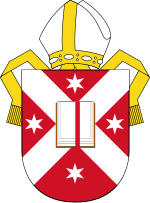
The Diocese of Dunedin is one of the thirteen dioceses and hui amorangi (Māori bishoprics) of the Anglican Church in Aotearoa, New Zealand and Polynesia. The diocese covers the same area as the provinces of Otago and Southland in the South Island of New Zealand. Area 65,990 km2, population 272,541 (2001). Anglicans are traditionally the third largest religious group in Otago and Southland after Presbyterians and Roman Catholics. Description of arms: Gules between a cross saltire argent, four starts argent on the fess point a Bible. In 1814 the Gospel first preached in Aotearoa at Oihi, Northland by Anglican missionary Samuel Marsden, in 1841George Selwyn consecrated and appointed Bishop of New Zealand (including Polynesia and Melanesia). In 1843 the first Anglican missionaries to come to Southland and Otago were Tamihana Te Rauparaha and Matene Te Whiwhi. In 1852 Rev. John Fenton arrives in Dunedin; he was the first Anglican priest to settle south of Lyttleton. In 1856 when the Diocese of New Zealand was subdivided, Southland and Otago were included in the Diocese of Christchurch. In 1866 Henry Lascelles Jenner selected and ordained by the Archbishop of Canterbury “into the office of a Bishop of the United Church of England and Ireland in the colony of New Zealand”, with the intention that he be Bishop of Dunedin. In 1869 the Diocese of Dunedin formed from the Diocese of Christchurch. The first meeting of Dunedin's synod rejected Jenner's claim to the See 1871 Samuel Nevill enthroned as 1st bishop of Dunedin. The Bishop of Dunedin's cathedra is at St. Paul's Cathedral, Dunedin. The diocese has a total of 33 parishes. The adaption of "Local Shared Ministry" has been a strategy by which local people are ordained to serve in a parish which cannot afford to support full-time professional clergy. The diocese includes Anglo-Catholic, broad and Evangelical parishes.

Saddle Hill (New Zealand)

Saddle Hill is a prominent landmark overlooking the northeastern end of the Taieri Plains in Otago, New Zealand. Within the limits of Dunedin city, it is located 18 kilometres to the west of the city centre, between Mosgiel and Green Island, and is clearly visible from many of the city's southern hill suburbs. A lookout on the northern slopes of the hill commands a good view across the plains, with Lake Waihola visible 25 kilometres to the west in clear weather. The hill has two peaks with the eastern peak rising to 473 metres, and the western peak – Jeffray's Hill – rising to 431 metres. Of largely volcanic origin, the hill is part of the extinct Dunedin Volcano complex, with a base of Cretaceous breccia overlaid with Miocene igneous rocks, these in turn overlaid with Cenozoic sediments. Erosion has revealed a volcanic plug on the western peak, giving the hill its distinct breast-like shape. The hill was – along with Cape Saunders on the Otago Peninsula – one of just two places in Otago to have been named by Captain James Cook on his 1769 voyage of discovery. Cook described the hill in his journal as "a remarkable saddle". According to pre-European Māori tradition, the hill is the remains of a taniwha called Meremere and the northern and southern peaks of hill were known by Māori by the names Makamaka and Pikiwara respectively. Early settlers' maps occasionally record the hill as "Saddleback Hill".A small coal seam on the hill was exploited by early European settlers, and was mined from as early as 1849, the first coal mine in the country. Jaffray's Hill (often wrongly called Jeffrey's Hill, and named for the Jaffray family who owned the land from 1849 until 1937), was extensively mined for basalt gravel until the mid-1980s. A DCC landscape architect reviewed the visual effects of quarrying in 2008 after concerns from local residents, and found the hill to be "relatively unchanged". This finding, however, has been successfully challenged in court with much public opinion against the continued quarrying.