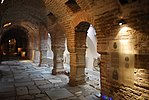
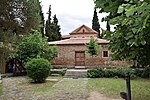
Icon of Christ of Latomos

The Icon of Christ of Latomos (or Latomou), also known as the Miracle of Latomos, is a Byzantine-style mosaic of Jesus in the monastery of Latomos (now the Church of Hosios David the Dendrite) in Thessaloniki, Greece, that is an acheiropoieton (a religious image that is believed to have been made miraculously). The origins of this mosaic icon can be traced back to the late third century AD when Maximian and Diocletian reigned jointly over the Roman Empire. The Icon of Christ of Latomos is one of the lesser-known acheiropoieta (Greek: αχειροποίητα εικόνα).According to tradition, the Icon of Christ of Latomos was discovered by Princess Flavia Maximiana Theodora, the Christian daughter of Emperor Maximian. She hid it to protect it from potential damage by the pagan, Roman authorities, and it remarkably survived Byzantine iconoclasm in the eighth century as well as a period of time in the fifteenth century when the church of Hosios David was converted to an Islamic mosque (during the Ottoman occupation of Thessaloniki). Sometime before the Ottoman occupation and prior to the twelfth century, the mosaic icon was rediscovered by a monk from Lower Egypt. It was again rediscovered in 1921, at which time the building was reconsecrated to Saint David.Thematically and artistically, the Icon of Christ of Latomos is likely the first of its type, depicting an apocalyptic scene with imagery from the Book of Ezekiel which communicates important theological ideas about the apocalypse.
Excerpt from the Wikipedia article Icon of Christ of Latomos (License: CC BY-SA 3.0, Authors, Images).Icon of Christ of Latomos
A6, Agios Pavlos Municipal Unit Άγιος Παύλος (Agios Pavlos Community)
Geographical coordinates (GPS) Address Nearby Places Show on map
 Continue reading on Wikipedia
 Geographical coordinates (GPS)
| Latitude | Longitude |
|---|---|
| N 40.641666666667 ° | E 22.968888888889 ° |
Address
A6
A6
554 38 Agios Pavlos Municipal Unit, Άγιος Παύλος (Agios Pavlos Community)
Macedonia and Thrace, Greece
Open on Google Maps