place

Bull Street Cemetery

1733 establishments in the Thirteen ColoniesCemeteries in Savannah, GeorgiaJewish cemeteries in Georgia (U.S. state)

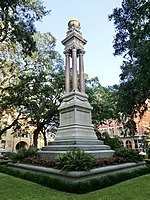
Bull Street Cemetery was a Jewish cemetery established in Savannah, Province of Georgia, in 1733. Today, a memorial in the median of West Oglethorpe Avenue, at Bull Street, erected in 1983 by the trustees of the Mordecai Sheftall Cemetery, marks the former location of the cemetery, which contained around twenty graves when it was built over around a century after it opened. The memorial says: "Original 1733 burial plot allotted by James Edward Oglethorpe to the Savannah Jewish Community." On November 3, 1761, George III "conveyed a certain half lot of land in Holland Tything, Percival Ward, to David Truan." This land was at the northwest corner of today's Bull Street and Oglethorpe Avenue.Several Jews were interred here before the family cemeteries were established. To honor the services of Benjamin Sheftall, one of the original forty or so Jews who arrived in Savannah on July 11, 1733, South Broad Street (as Oglethorpe Avenue was originally known) was extended to include within its bounds the unmarked burial of Sheftall's mother.The burial ground was closed in the first half of the 19th century, with some of the headstones that would otherwise have been discarded used as doorsteps at homes in the neighborhood.

Excerpt from the Wikipedia article Bull Street Cemetery (License: CC BY-SA 3.0, Authors).

Bull Street Cemetery
Abercorn Street, Savannah Savannah Historic District

Geographical coordinates (GPS) Address Nearby Places
placeShow on map

Wikipedia: Bull Street CemeteryContinue reading on Wikipedia

Geographical coordinates (GPS)

Latitude Longitude
N 32.076951 ° E -81.092918 °
placeShow on map

Address

Abercorn Street
31401 Savannah, Savannah Historic District
Georgia, United States
mapOpen on Google Maps

Share experience

Nearby Places

Wright Square (Savannah, Georgia)

Wright Square is one of the 22 squares of Savannah, Georgia, United States. It is located in the second row of the city's five rows of squares, on Bull Street and President Street, and was laid out in 1733 as one of the first four squares. It is south of Johnson Square, west of Oglethorpe Square, north of Chippewa Square and east of Telfair Square. The oldest building on the square is the William Waring Property, at 12 West State Street, which dates to 1825.The second square established in Savannah, it was originally name Percival Square, for John Percival, 1st Earl of Egmont, generally regarded as the man who gave the colony of Georgia its name (a tribute to Great Britain's King George II). It was renamed in 1763 to honor James Wright, the third and final royal governor of Georgia. Throughout its history it has also been known as Court House Square and Post Office Square; the present Tomochichi Federal Building and United States Court House is adjacent to the west.The square is the burial site of Tomochichi, a leader of the Creek nation of Native Americans. Tomochichi was a trusted friend of James Oglethorpe and assisted him in the founding of his colony. When Tomochichi died in 1739, Oglethorpe ordered him buried with military honors in the center of PercIval Square. In accordance with his people's customs the grave was marked by a pyramid of stones gathered from the surrounding area. In 1883, citizens wishing to honor William Washington Gordon replaced Tomochichi's monument with an elaborate and highly allegorical monument to Gordon, called the William Washington Gordon Monument. William Gordon is thus the only native Savannahian honored with a monument in one of the city's squares. Gordon's own daughter-in-law, Nellie Gordon, objected strongly to this perceived insult to Tomochichi. She and other members of the Colonial Dames of the State of Georgia planned to erect a new monument to Tomochichi, made of granite from Stone Mountain. The Stone Mountain Monument Company offered the material at no cost. Mrs. Gordon felt that she was being condescended to and insisted on paying. The Monument Company sent her a bill—some sources say for 50 cents, others for one dollar—payable on Judgment Day. Mrs. Gordon paid the bill and attached a note explaining that on Judgment Day the Dames "would be too busy attending their own duties on that momentous day." The new monument was erected in 1899. It stands in the southeast corner of the square and eulogizes Tomochichi as a great friend of James Oglethorpe and the people of Georgia.6 East State Street, in the northeastern tything lot of the square, doubled as Dixie's Flowers, the flower shop Mandy works at in Midnight in the Garden of Good and Evil. Bradley Lock and Key, located in the Patrick Duffy Building at 24 East State Street, also in the northeastern tything lot, is the oldest operating business in Savannah.

Chippewa Square (Savannah, Georgia)

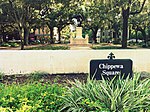
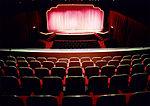
Chippewa Square is one of the 22 squares of Savannah, Georgia, United States. It is located in the middle row of the city's five rows of squares, on Bull Street and McDonough Street, and was laid out in 1815. It is south of Wright Square, west of Colonial Park Cemetery, north of Madison Square and east of Orleans Square. The oldest building on the square is The Savannah Theatre, at 222 Bull Street, which dates to 1818. The square named in honor of American soldiers killed in the Battle of Chippawa during the War of 1812. (The spelling "Chippewa" is correct in reference to this square.) In the center of the square is the James Oglethorpe Monument, created by sculptor Daniel Chester French and architect Henry Bacon and unveiled in 1910. Oglethorpe faces south, toward Georgia's one-time enemy in Spanish Florida, and his sword is drawn. Busts of Confederate figures Francis Stebbins Bartow and Lafayette McLaws were moved from Chippewa Square to Forsyth Park to make room for the Oglethorpe monument. Due to the location of the monument, Savannahians sometimes refer to this as Oglethorpe Square, but that is located just to the northeast.The "park bench" scene which opens the 1994 film Forrest Gump was filmed on the north side of Chippewa Square. The bench was a fiberglass prop, rather than one of the park's actual benches. A replica of the prop bench used in the film is on display at the Savannah Visitors Center. The original prop is now kept in Paramount Studios, Los Angeles.Chippewa Square is also home to the First Baptist Church (1833), the Independent Presbyterian Church and the Philbrick–Eastman House (1847).

First Baptist Church (Savannah, Georgia)

First Baptist Church is a historic congregation in Savannah, Georgia, which was first established in 1800. Today, the congregation worships in a Greek-Revival church building on Bull Street, on the western side of Chippewa Square in the historic district of Savannah. This location has been the congregation’s home since 1833 and the building is architecturally significant, being the oldest surviving church building in Savannah.When initially chartered in 1800, the congregation worshipped at a meeting house on Franklin Square. The church received its perpetual charter the following year by Georgia Governor Josiah Tattnall. The current church building was designed by architect Elias Carter. The cornerstone was laid on February 2, 1831, and two years later, with construction complete, the congregation relocated to its present location. Six years after moving into the current building, the growing congregation began renovations to expand the sanctuary.The church's organ, the work of Ernest M. Skinner, was installed in 1922.By 1947, the congregation was using the name "First" Baptist Church to distinguish itself from other Baptist congregations in the city. It is one of the few Southern churches to have remained open through the entirety of the American Civil War. The church utilized local architect Henrik Wallin for the notable alterations that occurred in 1922. Renovations included extending the front of the building, cladding the building in limestone, and removing the cupola.Previous pastors include W. L. Pickard, later president of Mercer University, and Norman Cox, the executive secretary of the Historical Commission of the Southern Baptist Convention.