place

Juliette Gordon Low Historic District

All pages needing cleanupBirthplaces of individual peopleGeography of Savannah, GeorgiaGirl Scouts of the USAHistoric American Buildings Survey in Georgia (U.S. state)
Historic American Landscapes Survey in Georgia (U.S. state)Historic districts on the National Register of Historic Places in Georgia (U.S. state)Historic house museums in Georgia (U.S. state)Museums in Savannah, GeorgiaNRHP infobox with nocatNational Historic Landmarks in Savannah, GeorgiaNational Register of Historic Places in Savannah, GeorgiaSavannah Historic DistrictScouting museums in the United StatesWikipedia pages needing cleanup from March 2021
GA Savannah J G Low HD Oglethorpe02

Juliette Gordon Low Historic District consists of three buildings—the Juliette Gordon Low Birthplace (also known as Wayne-Gordon House, First Girl Scout Headquarters, which was the carriage house for the Andrew Low House, converted for use by the Girl Scouts in May–June 1912, and said Andrew Low Carriage House, is a site in Savannah, Georgia, significant for its association with Juliette Gordon Low and the founding of the Girl Scouts of the USA. The district includes the Wayne-Gordon House at 10 East Oglethorpe Avenue, which is also known as Juliette Gordon Low Birthplace, the First Girl Scout Headquarters (Andrew Low Carriage House) at 330 Drayton Street, and the Andrew Low House at 329 Abercorn Street. The Birthplace was designated as a National Historic Landmark in 1965. The initial designation included the First Girl Scout Headquarters. The Andrew Low House was later added to the designation creating the Juliette Gordon Low Landmark District.

Excerpt from the Wikipedia article Juliette Gordon Low Historic District (License: CC BY-SA 3.0, Authors, Images).

Juliette Gordon Low Historic District
Abercorn Street, Savannah Savannah Historic District

Geographical coordinates (GPS) Address Nearby Places
placeShow on map

Wikipedia: Juliette Gordon Low Historic DistrictContinue reading on Wikipedia

Geographical coordinates (GPS)

Latitude Longitude
N 32.076944444444 ° E -81.0925 °
placeShow on map

Address

Abercorn Street
31401 Savannah, Savannah Historic District
Georgia, United States
mapOpen on Google Maps

GA Savannah J G Low HD Oglethorpe02
Share experience

Nearby Places

Wright Square (Savannah, Georgia)

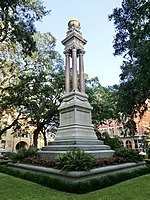
Wright Square is one of the 22 squares of Savannah, Georgia, United States. It is located in the second row of the city's five rows of squares, on Bull Street and President Street, and was laid out in 1733 as one of the first four squares. It is south of Johnson Square, west of Oglethorpe Square, north of Chippewa Square and east of Telfair Square. The oldest building on the square is the William Waring Property, at 12 West State Street, which dates to 1825.The second square established in Savannah, it was originally name Percival Square, for John Percival, 1st Earl of Egmont, generally regarded as the man who gave the colony of Georgia its name (a tribute to Great Britain's King George II). It was renamed in 1763 to honor James Wright, the third and final royal governor of Georgia. Throughout its history it has also been known as Court House Square and Post Office Square; the present Tomochichi Federal Building and United States Court House is adjacent to the west.The square is the burial site of Tomochichi, a leader of the Creek nation of Native Americans. Tomochichi was a trusted friend of James Oglethorpe and assisted him in the founding of his colony. When Tomochichi died in 1739, Oglethorpe ordered him buried with military honors in the center of PercIval Square. In accordance with his people's customs the grave was marked by a pyramid of stones gathered from the surrounding area. In 1883, citizens wishing to honor William Washington Gordon replaced Tomochichi's monument with an elaborate and highly allegorical monument to Gordon, called the William Washington Gordon Monument. William Gordon is thus the only native Savannahian honored with a monument in one of the city's squares. Gordon's own daughter-in-law, Nellie Gordon, objected strongly to this perceived insult to Tomochichi. She and other members of the Colonial Dames of the State of Georgia planned to erect a new monument to Tomochichi, made of granite from Stone Mountain. The Stone Mountain Monument Company offered the material at no cost. Mrs. Gordon felt that she was being condescended to and insisted on paying. The Monument Company sent her a bill—some sources say for 50 cents, others for one dollar—payable on Judgment Day. Mrs. Gordon paid the bill and attached a note explaining that on Judgment Day the Dames "would be too busy attending their own duties on that momentous day." The new monument was erected in 1899. It stands in the southeast corner of the square and eulogizes Tomochichi as a great friend of James Oglethorpe and the people of Georgia.6 East State Street, in the northeastern tything lot of the square, doubled as Dixie's Flowers, the flower shop Mandy works at in Midnight in the Garden of Good and Evil. Bradley Lock and Key, located in the Patrick Duffy Building at 24 East State Street, also in the northeastern tything lot, is the oldest operating business in Savannah.

Chippewa Square (Savannah, Georgia)

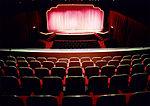
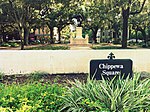
Chippewa Square is one of the 22 squares of Savannah, Georgia, United States. It is located in the middle row of the city's five rows of squares, on Bull Street and McDonough Street, and was laid out in 1815. It is south of Wright Square, west of Colonial Park Cemetery, north of Madison Square and east of Orleans Square. The oldest building on the square is The Savannah Theatre, at 222 Bull Street, which dates to 1818. The square named in honor of American soldiers killed in the Battle of Chippawa during the War of 1812. (The spelling "Chippewa" is correct in reference to this square.) In the center of the square is the James Oglethorpe Monument, created by sculptor Daniel Chester French and architect Henry Bacon and unveiled in 1910. Oglethorpe faces south, toward Georgia's one-time enemy in Spanish Florida, and his sword is drawn. Busts of Confederate figures Francis Stebbins Bartow and Lafayette McLaws were moved from Chippewa Square to Forsyth Park to make room for the Oglethorpe monument. Due to the location of the monument, Savannahians sometimes refer to this as Oglethorpe Square, but that is located just to the northeast.The "park bench" scene which opens the 1994 film Forrest Gump was filmed on the north side of Chippewa Square. The bench was a fiberglass prop, rather than one of the park's actual benches. A replica of the prop bench used in the film is on display at the Savannah Visitors Center. The original prop is now kept in Paramount Studios, Los Angeles.Chippewa Square is also home to the First Baptist Church (1833), the Independent Presbyterian Church and the Philbrick–Eastman House (1847).