place

17 Lincoln Street

1852 establishments in Georgia (U.S. state)Commercial buildings in Savannah, GeorgiaReynolds Square (Savannah) buildingsSavannah Historic DistrictUse British English from December 2021
17 Lincoln Street, Savannah

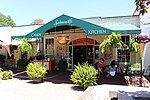
17 Lincoln Street (also 226 East Bryan Street) is a historic building in Savannah, Georgia, United States. Located in the northeastern residential block of Reynolds Square, it is one of the city's oldest continuously running bars, having been in operation as such since 1852. Today, it is home to Abe's on Lincoln, a dive bar named for Abraham Lincoln (whereas Lincoln Street, the street on which it stands, is named for Benjamin Lincoln, a Revolutionary War hero). In a survey for Historic Savannah Foundation, Mary Lane Morrison found the building to be of significant status.In 2019, a site plan submitted to the City of Savannah included moving the building (and two adjacent structures) two blocks to allow for the construction of a hotel.An entrance on the building's southern elevation is for 226 East Bryan Street.

Excerpt from the Wikipedia article 17 Lincoln Street (License: CC BY-SA 3.0, Authors, Images).

17 Lincoln Street
Lincoln Street, Savannah Savannah Historic District

Geographical coordinates (GPS) Address Nearby Places
placeShow on map

Wikipedia: 17 Lincoln StreetContinue reading on Wikipedia

Geographical coordinates (GPS)

Latitude Longitude
N 32.0794 ° E -81.0881 °
placeShow on map

Address

Lincoln Street

Lincoln Street
31401 Savannah, Savannah Historic District
Georgia, United States
mapOpen on Google Maps

17 Lincoln Street, Savannah
Share experience

Nearby Places

Reynolds Square (Savannah, Georgia)

Reynolds Square is one of the 22 squares of Savannah, Georgia, United States. It is located in the northernmost row of the city's five rows of squares, on Abercorn Street and East St. Julian Street. It is east of Johnson Square, west of Warren Square and north of Oglethorpe Square. The oldest building on the square is The Olde Pink House (originally Habersham House), which dates to 1771.Originally called Lower New Square (due to its being the first one laid out, in 1734, after the original four), it was later renamed for Captain John Reynolds, governor of Georgia in the mid-1750s. Reynolds was, in fact, an unpopular governor, and it is said that the celebration held upon his arrival in the colony was rivaled only by that held upon his departure.The square contains a bronze statue, by Marshall Daugherty, honoring John Wesley, founder of Methodism. Wesley spent most of his life in England but undertook a mission to Savannah (1735–1738), during which time he founded the first Sunday school in America. The statue was installed in 1969 on the spot where Wesley's home is believed to have stood. The statue is intended to show Wesley preaching out-of-doors as he did when leading services for Native Americans, a practice which angered church elders who believed that the Gospel should only be preached inside the church building. Scultpor Marshall said: "The moment is as he looks up from his Bible toward his congregation, about to speak and stretching out his right hand in love, invitation, and exhortation. In contrast, the hand holding the Bible is intense and powerful – the point of contact with the Almighty."Reynolds Square was the site of the Filature, which housed silkworms as part of an early—and unsuccessful—attempt to establish a silk industry in the Georgia colony.

Lower Stoddard Range

Lower Stoddard Range is a historic range of buildings in Savannah, Georgia, United States. Located in Savannah's Historic District, the addresses of some of the properties are East Bay Street, above Factors Walk, while others solely utilize the former King Cotton warehouses on River Street. As of February 2022, the businesses occupying the ground floor of the River Street elevation are: Boar's Head Grill & Tavern, Savannah's Candy Kitchen, Gallery 209 and Christmas on the River. The building stands adjacent to Archibald Smith Stores, the two separated only by steps leading to and from River Street and Factors Walk. The building was constructed by 1858 by John Stoddard (1809–1879), on foundations that were previously the three lower tiers of the early-19th-century Harden (western portion of the range) and Howard Stores (eastern portion). Harden's property was known colloquially as Coffee House Wharf.Factors Edgar L. Guerard and Edward L. Holcombe (1840–1875), formerly a major for the Confederates in the Civil War, were operating their general commission and shipping merchants enterprise from "5 Stoddard's Lower Range, Bay Street" in 1869. At number 7, meanwhile, Grantham Israel Taggart (1828–1905) was providing a similar service, under the name Taggart & Company, in addition to offering anthracite and bituminous coal.In 1898, during the Spanish–American War, the signal corps had their command headquarters in the range.The buildings that comprise Upper Stoddard Range are at 12–42 East Bay Street, to the west of the lower range.

John Berrien House
John Berrien House

The John Berrien House is a historic home in Savannah, Georgia, United States. It is located at 322–324 East Broughton Street, at its intersection with Habersham Street, and was built around 1794. One of the oldest extant buildings in Savannah, it is now part of the Savannah Historic District, and was built for major John Berrien, an army officer during the American Revolutionary War. Berrien lived in the house until 1797, when he moved to Louisville, Georgia. He sold the property to William Stephens, of Beaulieu Plantation. Stephens died in the home in 1882, at which point John Macpherson Berrien brought it back into the Berrien family. He lived there periodically until his death, also in the home, in 1856. Berrien's son-in-law Francis Bartow inherited the home, and he sold it to William Lake three years later.Lake split the property into two townhouses in 1871, with his brother-in-law, pharmacist Dr. Benjamin Hardee, occupying the eastern side. He had his offices on the first floor and lived in the upper storey.The gardens that original owner Berrien had laid out in the western lot of the two lots he purchased were replaced by a row of townhouses.The property was converted into a tenement in 1916. The building was raised over three feet the following year, with the original ground floor demolished and replaced with modern commercial space. The interior of the upper floors were divided into smaller rooms, thus original details were lost or covered up.The building was remodeled between 2012 and 2016. The stucco that had been added to its exterior in the 20th-century changes was removed, revealing the original clapboard siding, which was made of beaded cypress. Its removal also revealed the home's original cornice. The building was lowered, onto an 18th-century-style ground floor construction.