place

Lappi, Tampere

SampoWestern Finland Province geography stubs
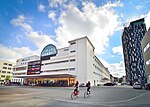
Aaltotie street in Tampere Feb2012 002

Lappi is a district in Tampere, Finland, near the Lake Näsijärvi and the Kauppi's park area. About 700 people live there. When talking about Lappi, reference is usually made to the Lapinniemi district. The district is home to the Koukkuniemi's nursing home, which is one of the largest nursing homes in Europe. There are also yacht clubs in the area (e.g. Tampere Yacht Club) and a spa and apartments in an old factory building were completed for the 1990 housing fair. The Lappi district got its name from Lapinniemi, which piers Lake Näsijärvi. The name may refer to early Lappish settlement. Part of the Lappi district is called Käpylä, which refers to the first inhabitant of the area, August Käpynen, a worker who moved there in 1915. The town plan for Lappi was confirmed in 1933. The Naistenlahti area, which officially forms one district of Tampere together with the old factory area of Tampella, became the property of the city of Tampere in 1877, at the same time as the city bought the Kyttälä area from Hatanpää Manor. Behind the name of Naistenlahti is a story according to which women on their way from Teisko to Messukylä Church got ashore here to continue their final journey.The Finnish Heritage Agency has classified Lappi's detached house area as a nationally significant built cultural environment.

Excerpt from the Wikipedia article Lappi, Tampere (License: CC BY-SA 3.0, Authors, Images).

Lappi, Tampere
Rauhaniementie, Tampere Lappi (Keskustan suuralue)

Geographical coordinates (GPS) Address Nearby Places
placeShow on map

Wikipedia: Lappi, TampereContinue reading on Wikipedia

Geographical coordinates (GPS)

Latitude Longitude
N 61.508938380556 ° E 23.777781480556 °
placeShow on map

Address

Rauhaniementie 13 B
33180 Tampere, Lappi (Keskustan suuralue)
Finland
mapOpen on Google Maps

Aaltotie street in Tampere Feb2012 002
Share experience

Nearby Places

Itsenäisyydenkatu
Itsenäisyydenkatu

Itsenäisyydenkatu (literally "Independence Street") is an east–west street in the center of Tampere, Finland. It is a significant street connection in the city center of Tampere in terms of transport connections, as it leads from Tampere's railway station to the Liisankallio district in the Tammela district. On the west side of the station, the street continues as the Hämeenkatu street, at its eastern end it meets Kalevan puistokatu, branching into Teiskontie and Sammonkatu. Today, the only crossroads on Itsenäisyydenkatu with cross-street vehicle traffic is Tammelan puistokatu–Yliopistonkatu. Itsenäisyydenkatu was known from the end of the 19th century until the 1950s as the Puolimatkankatu according to the croft named Puolimatka (literally "half way") located in the area. The impetus for renaming the street was the call made by the state to the cities in 1957 to name a significant street Itsenäisyydenkatu in honor of the 40th anniversary of Finland's independence. The name change took effect in 1958.In 2017, the renovation of the street and the station tunnel began, where the cross-section of the street will be renewed for a tramway to be built in Tampere. The former bus lanes were reserved for the local light rail network so that it runs west of the intersection of Tammelan puistokatu at the south side of the street and east of the intersection in the middle of the street; due to the arrangement, the southern surface of the station tunnel had to be lowered. A bike path was built on the northern edge of the street, and all the aged piping under the street was renewed. The renovation was completed in 2019, and tram traffic will begin in 2021.

Tampere Central Station

Tampere Central Station is a functionalist building in Tampere, Finland, designed by Eero Seppälä and Otto Flodin, completed in 1936. The station is one of the most important railway stations in Finland. In 2015, the Tampere Central Station was the second busiest railway station in Finland in terms of numbers of passengers, after the Helsinki Central Station.The 36-metre clock tower was later added because the Finnish railway bureau required it (its total height from ground level is about 50 metres). The city's main street Hämeenkatu begins at the railway station, continuing over the Hämeensilta bridge to its western end at the Aleksanteri Church. The Itsenäisyydenkatu (originally called Puolimatkankatu) street begins at the Tammela side of the station, continuing to the Kaleva Church. Situated in a central location, the station and its railway yard have served as divisors of the city's districts almost in the same way as Tammerkoski: Tamperean places are often located by saying which side of the station they are on. For decades, there has been discussion of a unified travel centre in Tampere: currently, the long-distance bus terminal, the Tampere Bus Station, is quite far away from the railway station. There are currently three platforms in the Tampere railway station, two of which have a roof. There are five tracks in total, but there are plans to add a fourth platform, making seven tracks in total. The Tampere cargo station is located south from the passenger station. It includes one of the busiest railway organisation yards in Finland. The green building on the east side of the tracks, opposite the old passenger station is the old cargo station. A track leads from the cargo station, over the highway to Helsinki, to the Nekala district, which previously contained many private tracks servicing stock companies. Nowadays, some of the tracks have been disassembled and some are disused. The starting point of the track is used to store train carriages.