place

Harper Fowlkes House

Greek Revival houses in Georgia (U.S. state)Houses completed in 1844Houses in Savannah, GeorgiaOrleans Square (Savannah) buildingsSavannah Historic District
Champion McAlpin Fowlkes house, 230 Barnard Street, Savannah, Chatham County, Georgia

Harper Fowlkes House is a historic building in Savannah, Georgia, United States. It is located at 230 Barnard Street, in the southeastern trust lot of Orleans Square, and was built in 1844. It is in the Greek Revival style.

Excerpt from the Wikipedia article Harper Fowlkes House (License: CC BY-SA 3.0, Authors, Images).

Harper Fowlkes House
Barnard Street, Savannah Savannah Historic District

Geographical coordinates (GPS) Address Nearby Places
placeShow on map

Wikipedia: Harper Fowlkes HouseContinue reading on Wikipedia

Geographical coordinates (GPS)

Latitude Longitude
N 32.07605 ° E -81.094822 °
placeShow on map

Address

Harper Fowlkes House

Barnard Street 230
31401 Savannah, Savannah Historic District
Georgia, United States
mapOpen on Google Maps

Champion McAlpin Fowlkes house, 230 Barnard Street, Savannah, Chatham County, Georgia
Share experience

Nearby Places

First Baptist Church (Savannah, Georgia)

First Baptist Church is a historic congregation in Savannah, Georgia, which was first established in 1800. Today, the congregation worships in a Greek-Revival church building on Bull Street, on the western side of Chippewa Square in the historic district of Savannah. This location has been the congregation’s home since 1833 and the building is architecturally significant, being the oldest surviving church building in Savannah.When initially chartered in 1800, the congregation worshipped at a meeting house on Franklin Square. The church received its perpetual charter the following year by Georgia Governor Josiah Tattnall. The current church building was designed by architect Elias Carter. The cornerstone was laid on February 2, 1831, and two years later, with construction complete, the congregation relocated to its present location. Six years after moving into the current building, the growing congregation began renovations to expand the sanctuary.The church's organ, the work of Ernest M. Skinner, was installed in 1922.By 1947, the congregation was using the name "First" Baptist Church to distinguish itself from other Baptist congregations in the city. It is one of the few Southern churches to have remained open through the entirety of the American Civil War. The church utilized local architect Henrik Wallin for the notable alterations that occurred in 1922. Renovations included extending the front of the building, cladding the building in limestone, and removing the cupola.Previous pastors include W. L. Pickard, later president of Mercer University, and Norman Cox, the executive secretary of the Historical Commission of the Southern Baptist Convention.

Bulloch–Habersham House

The Bulloch–Habersham House (originally the Archibald Bulloch House) was a mansion in Savannah, Georgia, United States. Completed in 1820, to a design by noted architect William Jay, it stood at the corner of Barnard Street and West Perry Street, in the southwestern trust lot of Orleans Square, until its demolition in 1916. It was replaced by what is now Savannah Civic Center. Historian John D. Duncan described the building's demise as "one of the worst cases of metropolitan malfeasance to be documented in an era when the preservation movement was just beginning to gain attention."In 1819, during the building's construction, Jay was fined $30 for obstructing Barnard Street.Originally the home of Archibald Stobo Bulloch Jr. (whose father was Georgia's first non-royal head of state), the home contained several pieces of furniture by New York City cabinetmaker Charles-Honoré Lannuier. Savannah's great fire of 1820 decimated Bulloch's fortune, and he was forced to sell his family's home to John Morel and David Leion. Morel and Leion converted the mansion into a boarding house. In 1834, it was purchased by Robert Habersham, a Savannah merchant and planter. After Habersham's death in 1870, it passed to his son, William Neyle Habersham. The home was maintained by Habersham's heirs until 1905, six years after William's death. In 1915, it was purchased by the City of Savannah, shortly after which it was demolished. The house had a broad central hall with two 20-foot wide rooms on each side, a circular domed drawing room, a spiral staircase cantilevered within a circle of six Corinthian columns, unusual tripartite windows on the main floor, and a double drawing room with Corinthian and Ionic column screens. A figural mantel in the style of Richard Westmacott Jr., graced the north-east drawing room, and carved Egyptian masks were part of the decorative vocabulary.Habersham Memorial Hall, in Atlanta, Georgia, was designed to replicate the home. It was completed in 1923.

Chippewa Square (Savannah, Georgia)

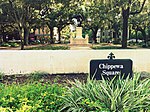
Chippewa Square is one of the 22 squares of Savannah, Georgia, United States. It is located in the middle row of the city's five rows of squares, on Bull Street and McDonough Street, and was laid out in 1815. It is south of Wright Square, west of Colonial Park Cemetery, north of Madison Square and east of Orleans Square. The oldest building on the square is The Savannah Theatre, at 222 Bull Street, which dates to 1818. The square named in honor of American soldiers killed in the Battle of Chippawa during the War of 1812. (The spelling "Chippewa" is correct in reference to this square.) In the center of the square is the James Oglethorpe Monument, created by sculptor Daniel Chester French and architect Henry Bacon and unveiled in 1910. Oglethorpe faces south, toward Georgia's one-time enemy in Spanish Florida, and his sword is drawn. Busts of Confederate figures Francis Stebbins Bartow and Lafayette McLaws were moved from Chippewa Square to Forsyth Park to make room for the Oglethorpe monument. Due to the location of the monument, Savannahians sometimes refer to this as Oglethorpe Square, but that is located just to the northeast.The "park bench" scene which opens the 1994 film Forrest Gump was filmed on the north side of Chippewa Square. The bench was a fiberglass prop, rather than one of the park's actual benches. A replica of the prop bench used in the film is on display at the Savannah Visitors Center. The original prop is now kept in Paramount Studios, Los Angeles.Chippewa Square is also home to the First Baptist Church (1833), the Independent Presbyterian Church and the Philbrick–Eastman House (1847).

Sorrel–Weed House
Sorrel–Weed House

The Sorrel–Weed House, or the Francis Sorrel House, is a historic landmark and Savannah Museum located at 6 West Harris Street in Savannah, Georgia. It represents one of the finest examples of Greek Revival and Regency architecture in Savannah and was one of the first two homes in the State of Georgia to be made a State Landmark in 1954. At 16,000 square feet, it is also one of the largest houses in the city. The Sorrel–Weed House was first opened to the public in January 1940 by the Society for the Preservation of Savannah Landmarks. It was the society's first exhibit and was called "The Society for the Preservation of Savannah Landmarks Presents a loan Exhibit of Furniture and Fine Arts 18th and 19th Centuries at the Sorrel-Weed House on Madison Square: Jan-April 1940." This society later became the Historic Savannah Foundation. The Sorrel–Weed House was opened again to the public in 2005 and conducts Historic Savannah Tours during the day and Savannah Ghost Tours inside the house every evening. These tours are conducted by the Sorrel-Weed House Museum. It is located at the corner of Bull Street and Harris Street. The Sorrel–Weed House was the boyhood home of Brigadier General Moxley Sorrel, who fought for the Confederate States of America during the Civil War. He served under General James Longstreet, and after the War wrote "Recollections of a Confederate Staff Officer", considered to be one of the top postwar accounts written. General Robert E. Lee visited the home in late 1861 and early 1862. He and Francis Sorrel had been friends since the early 1830s. Lee also visited the Sorrel family in April 1870, shortly before his death. A.J. Cohen, Sr., a prominent Savannah businessman bought the Sorrel-Weed house in 1941. The Cohen family lived in the home for more than fifty years. A.J. Cohen, Jr., built a brick addition to the house and opened Lady Jane, an upscale women's clothing store which thrived in Savannah for decades. The store closed in 1991, and the home was bought by Stephen Bader in 1996. Bader removed the brick addition soon after his purchase.The opening scene of the 1994 film Forrest Gump was filmed from the rooftop of the Sorrel–Weed House and is a popular tourist stop. The scene, which begins with a floating feather through the Savannah sky, pans the rooftops of other buildings occupying Madison Square as seen from the very top of the Sorrel–Weed home. The scene is then spliced to a scene of another church located on Chippewa square, where ultimately, Forrest is seen sitting on a bench. The house was investigated by TAPS during a special 2005 Halloween Special episode of Ghost Hunters. The house was also featured on HGTV's "If Walls Could Talk" in March 2006. It was also investigated by the Ghost Adventures crew in 2014. The house was featured on the Travel Channel's "The Most Terrifying Places in America" in 2010, and on the Paula Deen Network in 2015.The house is a contributing property to the Savannah Historic District.