place

Strymon-Kulata railway

Ottoman railwaysRail transport in BulgariaRailway lines in BulgariaRailway lines in GreeceStandard gauge railways in Greece
21.04.10 220.028 Στρυμόνας Strymónas (5824005993)

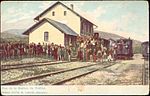
The Strymon-Kulata railway is a 17.5-kilometre-long (10.9 mi) railway line that connects the village of Strymon in Greece with Kulata in Bulgaria. The line unites three villages on opposite sides of the border, Strymon and Promachonas in Serres, Greece, and Kulata in Blagoevgrad, Bulgaria, and is entrance/exit to the Greek rail network from Bulgaria.

Excerpt from the Wikipedia article Strymon-Kulata railway (License: CC BY-SA 3.0, Authors, Images).

Strymon-Kulata railway
Μοναστηρίου, Thessaloniki Municipal Unit

Geographical coordinates (GPS) Address Nearby Places
placeShow on map

Wikipedia: Strymon-Kulata railwayContinue reading on Wikipedia

Geographical coordinates (GPS)

Latitude Longitude
N 40.6444 ° E 22.9294 °
placeShow on map

Address

Μοναστηρίου 28
546 29 Thessaloniki Municipal Unit (2nd District of Thessaloniki)
Macedonia and Thrace, Greece
mapOpen on Google Maps

21.04.10 220.028 Στρυμόνας Strymónas (5824005993)
Share experience

Nearby Places

Thessaloniki
Thessaloniki

Thessaloniki (; Greek: Θεσσαλονίκη, [θesaloˈnici] (listen), also known as Thessalonica (English: ), Saloniki, or Salonica (), is the second-largest city in Greece, with over one million inhabitants in its metropolitan area, and the capital of the geographic region of Macedonia, the administrative region of Central Macedonia and the Decentralized Administration of Macedonia and Thrace. It is also known in Greek as η Συμπρωτεύουσα (i Symprotévousa), literally "the co-capital", a reference to its historical status as the Συμβασιλεύουσα (Symvasilévousa) or "co-reigning" city of the Byzantine Empire alongside Constantinople.Thessaloniki is located on the Thermaic Gulf, at the northwest corner of the Aegean Sea. It is bounded on the west by the delta of the Axios. The municipality of Thessaloniki, the historical centre, had a population of 317,778 in 2021, while the Thessaloniki metropolitan area had 1,091,424 inhabitants in 2021. It is Greece's second major economic, industrial, commercial and political centre, and a major transportation hub for Greece and southeastern Europe, notably through the Port of Thessaloniki. The city is renowned for its festivals, events and vibrant cultural life in general, and is considered to be Greece's cultural capital. Events such as the Thessaloniki International Fair and the Thessaloniki International Film Festival are held annually, while the city also hosts the largest bi-annual meeting of the Greek diaspora. Thessaloniki was the 2014 European Youth Capital.The city was founded in 315 BC by Cassander of Macedon, who named it after his wife Thessalonike, daughter of Philip II of Macedon and sister of Alexander the Great. An important metropolis by the Roman period, Thessaloniki was the second largest and wealthiest city of the Byzantine Empire. It was conquered by the Ottomans in 1430 and remained an important seaport and multi-ethnic metropolis during the nearly five centuries of Turkish rule. It passed from the Ottoman Empire to the Kingdom of Greece on 8 November 1912. Thessaloniki exhibits Byzantine architecture, including numerous Paleochristian and Byzantine monuments, a World Heritage Site, as well as several Roman, Ottoman and Sephardic Jewish structures. The city's main university, Aristotle University, is the largest in Greece and the Balkans.Thessaloniki is a popular tourist destination in Greece. In 2013, National Geographic Magazine included Thessaloniki in its top tourist destinations worldwide, while in 2014 Financial Times FDI magazine (Foreign Direct Investments) declared Thessaloniki as the best mid-sized European city of the future for human capital and lifestyle.

Port of Thessaloniki

The Port of Thessaloniki (Greek: Λιμάνι της Θεσσαλονίκης) is one of the largest seaports in the Eastern Mediterranean. It is considered the gateway Port to the Balkans and South East Europe, located in Macedonia, Greece close to the major Trans-European motorway and railway networks with direct access to the Southeastern European countries. The port is operated by ThPA S.A. which is listed on the Athens Exchange since 2001, is authorized with AEO license and handles containers, conventional cargo, operates the free zone of the Port, offers intermodal rail services as well as serves passenger traffic through cruise and ferry. Following the privatization process, 67% of the Company’s share capital was transferred to South Europe Gateway Thessaloniki (SEGT) Ltd on March 23, 2018. SEGT Ltd. consists of "Deutsche Invest Equity Partners GmbH" (47%), "Terminal Link SAS" (33%) and "Belterra Investments Ltd." (20%). The Greek State, via HRADF, retains a stake of 7.27% of ThPA S.A. and the remaining 25.73% is free float. On June 4, 2021, the shareholding structure of SEGT Ltd. was changed since shareholder “Belterra Investments Ltd.” purchased the entire share of "Deutsche Invest Equity Partners GmbH", therefore owning 67% and consequently becoming the controlling shareholder of SEGT Ltd. 7 December 2021 Belterra, Interests Ivan Savvidis, purchased a 299,855 shares of ThPS, with an acquisition price of 26 euros per share. Before this acquisition, Belterra has already taken 189,447 shares that accounted for 1.88% of the total paid-up share capital of the Company. Following the above acquisition, the total number of shares and equal voting rights of the company directly owned by Belterra is 489,332 and corresponds to 4.85% of its share capital.Therefore, the total number of shares and the equivalent voting rights of the OPTRERRA, both directly and indirectly - through its direct participation in SEGT (which holds 67% of the shares and voting rights of the GACH) - amounts to 7,242 .932, which accounts for 71.85% of its share capital, from 68.88%, held before the transaction described.