place

Church of the Holy Apostles (Thessaloniki)

14th-century Eastern Orthodox church buildings14th-century churches in Greece14th-century establishments in the Byzantine EmpireBuildings and structures completed in 1329Byzantine church buildings in Thessaloniki
Church buildings with domesFormer mosques in GreeceMosques converted from churches in Ottoman GreeceWorld Heritage Sites in Greece
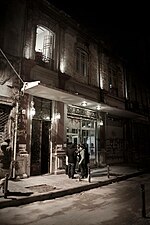
Thessaloniki, Kirche der Heiligen Apostel (Ναός Αγίων Αποστόλων) (14. Jhdt.) (33942457168)

The Church of the Holy Apostles (Greek: Ἅγιοι Ἀπόστολοι) is a 14th-century Byzantine church in the northern Greek city of Thessaloniki. Because of its outstanding Byzantine mosaics and architecture, and its testimony to the importance of Thessaloniki in early and medieval Christianity, the church is inscribed on the UNESCO World Heritage List along with other Paleochristian and Byzantine monuments of Thessaloniki.

Excerpt from the Wikipedia article Church of the Holy Apostles (Thessaloniki) (License: CC BY-SA 3.0, Authors, Images).

Church of the Holy Apostles (Thessaloniki)
Ολύμπου, Thessaloniki Municipal Unit Διοικητήριο (2nd District of Thessaloniki)

Geographical coordinates (GPS) Address Nearby Places
placeShow on map

Wikipedia: Church of the Holy Apostles (Thessaloniki)Continue reading on Wikipedia

Geographical coordinates (GPS)

Latitude Longitude
N 40.642838888889 ° E 22.937547222222 °
placeShow on map

Address

Δώδεκα Απόστολοι

Ολύμπου
543 60 Thessaloniki Municipal Unit, Διοικητήριο (2nd District of Thessaloniki)
Macedonia and Thrace, Greece
mapOpen on Google Maps

Thessaloniki, Kirche der Heiligen Apostel (Ναός Αγίων Αποστόλων) (14. Jhdt.) (33942457168)
Share experience

Nearby Places

Thessaloniki
Thessaloniki

Thessaloniki (; Greek: Θεσσαλονίκη, [θesaloˈnici] (listen), also known as Thessalonica (English: ), Saloniki, or Salonica (), is the second-largest city in Greece, with over one million inhabitants in its metropolitan area, and the capital of the geographic region of Macedonia, the administrative region of Central Macedonia and the Decentralized Administration of Macedonia and Thrace. It is also known in Greek as η Συμπρωτεύουσα (i Symprotévousa), literally "the co-capital", a reference to its historical status as the Συμβασιλεύουσα (Symvasilévousa) or "co-reigning" city of the Byzantine Empire alongside Constantinople.Thessaloniki is located on the Thermaic Gulf, at the northwest corner of the Aegean Sea. It is bounded on the west by the delta of the Axios. The municipality of Thessaloniki, the historical centre, had a population of 317,778 in 2021, while the Thessaloniki metropolitan area had 1,091,424 inhabitants in 2021. It is Greece's second major economic, industrial, commercial and political centre, and a major transportation hub for Greece and southeastern Europe, notably through the Port of Thessaloniki. The city is renowned for its festivals, events and vibrant cultural life in general, and is considered to be Greece's cultural capital. Events such as the Thessaloniki International Fair and the Thessaloniki International Film Festival are held annually, while the city also hosts the largest bi-annual meeting of the Greek diaspora. Thessaloniki was the 2014 European Youth Capital.The city was founded in 315 BC by Cassander of Macedon, who named it after his wife Thessalonike, daughter of Philip II of Macedon and sister of Alexander the Great. An important metropolis by the Roman period, Thessaloniki was the second largest and wealthiest city of the Byzantine Empire. It was conquered by the Ottomans in 1430 and remained an important seaport and multi-ethnic metropolis during the nearly five centuries of Turkish rule. It passed from the Ottoman Empire to the Kingdom of Greece on 8 November 1912. Thessaloniki exhibits Byzantine architecture, including numerous Paleochristian and Byzantine monuments, a World Heritage Site, as well as several Roman, Ottoman and Sephardic Jewish structures. The city's main university, Aristotle University, is the largest in Greece and the Balkans.Thessaloniki is a popular tourist destination in Greece. In 2013, National Geographic Magazine included Thessaloniki in its top tourist destinations worldwide, while in 2014 Financial Times FDI magazine (Foreign Direct Investments) declared Thessaloniki as the best mid-sized European city of the future for human capital and lifestyle.

Venizelou station

Venizelou (Greek: Βενιζέλου, literally Venizelos [Street]) is an under-construction metro station serving Thessaloniki Metro's Line 1 and Line 2. The station is named after Eleftherios Venizelos, Liberal Prime Minister of Greece. It is expected to enter service in 2023. Construction of this station has been held back by major archaeological finds, and it is designated as a high-importance archaeological site by Attiko Metro, the company overseeing its construction. At this station, Roman Thessaloniki's marble-clad and column-lined Decumanus Maximus (main east-west avenue), along with shops and houses, was found running along the route of the Via Egnatia (modern Egnatia Street) at 5.4 metres (18 ft) below ground level.The discovery was so major that it delayed the entire Metro project for years. A historian dubbed the discovery "the Byzantine Pompeii". Attiko Metro wanted to disassemble the road and re-assemble it elsewhere, while the City Council wanted Attiko Metro to redesign its network to accommodate the discovery in situ. Ultimately the case reached Greece's Council of State and Attiko Metro re-designed the metro line, sinking the tunnels to a depth ranging from 14 metres (46 ft) to 31 metres (102 ft), and making provisions for mini museums within the metro stations, similar to those of Athens Metro stations like Syntagma, which houses the Syntagma Metro Station Archaeological Collection.Venizelou station will also feature an open archaeological site, the first of its kind anywhere in a metro station, in order to maintain the road in its original location. At the next station, Aghia Sofia, where the same road was unearthed (and where it is arguably more important, as a public square was found as well), the road will be disassembled and reassembled elsewhere.Venizelou station also appears in the 1988 Thessaloniki Metro proposal under the name Alkazar. Alkazar is the popular name for Hamza Bey Mosque, a landmark on Egnatia and Venizelou streets.