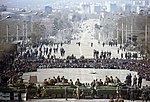
Dushanbe is the capital and largest city of Tajikistan. As of January 2022, Dushanbe had a population of 1,201,800 and that population was largely Tajik. Until 1929, the city was known in Russian as Dyushambe, and from 1929 to 1961 as Stalinabad, after Joseph Stalin. Dushanbe is located in the Gissar Valley, bounded by the Gissar Range in the north and east and the Babatag, Aktau, Rangontau and Karatau mountains in the south, and has an elevation of 750–930 m. The city is divided into four districts, all named after Persian historical figures: Ismail Samani, Avicenna, Ferdowsi, and Shah Mansur.
In ancient times, what is now or is close to modern Dushanbe was settled by various empires and peoples, including Mousterian tool-users, various neolithic cultures, the Achaemenid Empire, Greco-Bactria, the Kushan Empire, Hephthalites. In the Middle Ages, more settlements began near modern-day Dushanbe such as Hulbuk and its famous palace. From the 17th to early 20th century, Dushanbe grew into a market village controlled at times by the Beg of Hisor, Balkh, and finally Bukhara, before being conquered by the Russian Empire. Dushanbe was captured by the Bolsheviks in 1922, and the town was made the capital of the Tajik Autonomous Soviet Socialist Republic in 1924, which commenced Dushanbe's development and rapid population growth that continued until the Tajik Civil War. After the war, the city became capital of an independent Tajikistan and continued its growth and development into a modern city, today home to many international conferences.
Much of Dushanbe's education system dates from Soviet times and has a legacy of state control; today the largest university in Dushanbe, the Tajik National University, is funded by the government. Dushanbe International Airport is the primary airport serving the city. Other forms of transport include the trolleybus system dating from 1955, the small rail system, and the roads that traverse the city. Dushanbe's electricity is primarily hydroelectric, produced by the Nurek Dam, and the aging water system dates from 1932. Tajikistan's healthcare system is concentrated in Dushanbe, meaning that the major hospitals of the country are in the city. The city makes up 20% of Tajikistan's GDP and has large industrial, financial, retail, and tourism sectors. Parks and main sights of the city include Victory Park, Rudaki Park, the Tajikistan National Museum, the Dushanbe Flagpole, and the Tajikistan National Museum of Antiquities.
 Continue reading on Wikipedia