place

Mountain of Mystery (Zion National Park)

Colorado PlateauMountains of UtahMountains of Washington County, UtahSandstone formations of the United StatesTwo-thousanders of the United States
Zion National Park
Virgin River, Zion 2009

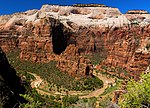
Mountain of Mystery is a 6,565-foot (2,001 m) Navajo Sandstone summit located in Zion National Park, in Washington County of southwest Utah, United States. Mountain of Mystery is situated above The Narrows, towering over 2,100 feet (640 meters) above the floor of Zion Canyon and the North Fork Virgin River which drains precipitation runoff from this mountain. This peak rises above Orderville Canyon on its north side, and Mystery Canyon on the south. Its neighbors include Mount Majestic, Cathedral Mountain, Observation Point, Cable Mountain, Angels Landing, and The Organ. This feature's name was officially adopted in 1934 by the U.S. Board on Geographic Names. The first ascent via the Northeast Buttress was made 15 September 2001, by Brian Cabe and Tom Jones.

Excerpt from the Wikipedia article Mountain of Mystery (Zion National Park) (License: CC BY-SA 3.0, Authors, Images).

Mountain of Mystery (Zion National Park)
The Narrows Day Hike Section,

Geographical coordinates (GPS) Address Nearby Places
placeShow on map

Wikipedia: Mountain of Mystery (Zion National Park)Continue reading on Wikipedia

Geographical coordinates (GPS)

Latitude Longitude
N 37.302808 ° E -112.939232 °
placeShow on map

Address

Mystery Springs

The Narrows Day Hike Section

Utah, United States
mapOpen on Google Maps

Virgin River, Zion 2009
Share experience

Nearby Places

Floor of the Valley Road

The Floor of the Valley Road, also known as the Zion Canyon Scenic Drive, follows the canyon of the North Fork of the Virgin River, also known as Zion Canyon, through Zion National Park, Utah, USA. A precursor to the present nine-mile road was first built in 1916, but was later redesigned by the National Park Service Branch of Plans and Designs to highlight the natural features of the valley while presenting a natural-appearing built environment. The road begins at the south boundary of the park and ends at the Temple of Sinawava. The design uses local materials such as red sandstone and rustic construction techniques according to the prevailing 1930s Park Service policy of naturalistic design. The Cable Creek Bridge is separately nominated to the National Register of Historic Places as a particularly prominent example of the style. The road surface is coated with red aggregate to continue the design theme. From the South Entrance to Canyon Junction at the mouth of Zion Canyon the road has been reconstructed and has lost many of the characteristic features of the 1930s construction. The original 1916 road, built by Park Service engineer W.O. Tufts, was a single-lane dirt road that extended as far as the Weeping Rock parking area. In 1925 a gravel-surfaced road, called the "Government Road" replaced the original road and extended all the way to the Temple of Sinawava. In 1931 and 1932 the present road was constructed on a new alignment as a Depression-era public works project. Further construction was performed from 1933 to 1942 by Civilian Conservation Corps labor.