place

Observation Point (Zion National Park)

Mountains of UtahMountains of Washington County, UtahSandstone formations of the United StatesZion National Park
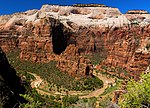
Observation Point from Angels Landing Trail

Observation Point is a 6,507-foot (1,983 m) elevation Navajo Sandstone feature located in Zion National Park, in Washington County of southwest Utah, United States. Observation Point is situated at the north end of Zion Canyon, towering 2,100 feet (640 meters) above the canyon floor and the North Fork of the Virgin River which drains precipitation runoff from this viewpoint. A popular 8-mile round-trip trail climbs from the Weeping Rock trailhead along Zion Canyon Road to reach the top. Neighbors visible from the point include The Great White Throne, Cathedral Mountain, Angels Landing, and Cable Mountain. This geographical feature's name was officially adopted in 1934 by the U.S. Board on Geographic Names.

Excerpt from the Wikipedia article Observation Point (Zion National Park) (License: CC BY-SA 3.0, Authors, Images).

Observation Point (Zion National Park)
Observation Point,

Geographical coordinates (GPS) Address Nearby Places
placeShow on map

Wikipedia: Observation Point (Zion National Park)Continue reading on Wikipedia

Geographical coordinates (GPS)

Latitude Longitude
N 37.278232 ° E -112.940381 °
placeShow on map

Address

Observation Point

Utah, United States
mapOpen on Google Maps

Observation Point from Angels Landing Trail
Share experience

Nearby Places

Floor of the Valley Road

The Floor of the Valley Road, also known as the Zion Canyon Scenic Drive, follows the canyon of the North Fork of the Virgin River, also known as Zion Canyon, through Zion National Park, Utah, USA. A precursor to the present nine-mile road was first built in 1916, but was later redesigned by the National Park Service Branch of Plans and Designs to highlight the natural features of the valley while presenting a natural-appearing built environment. The road begins at the south boundary of the park and ends at the Temple of Sinawava. The design uses local materials such as red sandstone and rustic construction techniques according to the prevailing 1930s Park Service policy of naturalistic design. The Cable Creek Bridge is separately nominated to the National Register of Historic Places as a particularly prominent example of the style. The road surface is coated with red aggregate to continue the design theme. From the South Entrance to Canyon Junction at the mouth of Zion Canyon the road has been reconstructed and has lost many of the characteristic features of the 1930s construction. The original 1916 road, built by Park Service engineer W.O. Tufts, was a single-lane dirt road that extended as far as the Weeping Rock parking area. In 1925 a gravel-surfaced road, called the "Government Road" replaced the original road and extended all the way to the Temple of Sinawava. In 1931 and 1932 the present road was constructed on a new alignment as a Depression-era public works project. Further construction was performed from 1933 to 1942 by Civilian Conservation Corps labor.

Zion Lodge
Zion Lodge

Zion Lodge is located in Zion National Park, Utah, United States. The lodge was designed in 1924 as a compromise solution between its developer, the Utah Parks Company, which wanted a large hotel, and National Park Service director Stephen Mather, who desired smaller-scale development. The Utah Parks Company had been formed in 1923 as a subsidiary of the Union Pacific Railroad, and was, like many similar programs, intended to stimulate passenger rail traffic to the national parks of southwest Utah. Gilbert Stanley Underwood designed the Zion Lodge as part of a series of similar structures for the Utah Parks Company at the north rim of the Grand Canyon and at Bryce Canyon National Park. Underwood's design was more modest in scale and detailing than those at the Grand Canyon and Bryce, substituting milled lumber for whole logs in a "studs-out" style. Underwood used less stonework, in smaller pieces. The structures were designed to be more in keeping with the character of the valley floor, which at the time of construction was still inhabited by settlers. Underwood would go on to design all of the Utah Parks Company buildings in the valley, many of which are included in the Zion Lodge Historic District, which surrounds the lodge. A fire in 1966 destroyed the original lodge. It was rebuilt within 100 days, but the original rustic look was lost in favor of expedience in reopening the lodge. A 1990 remodel restored its original look. In addition to the main lodge building there are a number of original buildings that remain in the lodge complex. This includes guest cabins built in 1927 and 1929, employee dormitories built in 1927 and 1937, and a few support buildings. All were designed by Underwood. On April 12, 1995, a landslide blocked the Virgin River downstream from the lodge. Over a period of two hours, the river had carved away 590 feet (180 m) of the only exit road from the canyon, trapping 450 guests and employees in the lodge. A one-lane temporary road was constructed within 24 hours to allow evacuation. Access to the lodge was restored on May 25, 1995. Zion Lodge is a member of Historic Hotels of America, the official program of the National Trust for Historic Preservation.