place

Maraval River

Gulf of PariaRivers of Trinidad and TobagoSouth America river stubsTrinidad (island)Trinidad and Tobago geography stubs

The Maraval River is a small river/mountain stream located on the west coast of the island of Trinidad.It runs for a length of 4.39 kilometres (3 mi) from its origins in the Northern Range to its river mouth at Port of Spain, where it enters the Gulf of Paria. In the late 1850s a dam and filtration plant was constructed on the upper reaches of the Maraval River, and until the 1900s it served as Port of Spain's main drinking water supply. In 1912 it was transferred to the Port-of-Spain Water Authority. It is currently the property of the Water and Sewerage Authority.

Excerpt from the Wikipedia article Maraval River (License: CC BY-SA 3.0, Authors).

Maraval River
Hollywood Boulevard, Port of Spain Woodbrook

Geographical coordinates (GPS) Address Nearby Places
placeShow on map

Wikipedia: Maraval RiverContinue reading on Wikipedia

Geographical coordinates (GPS)

Latitude Longitude
N 10.659444444444 ° E -61.537222222222 °
placeShow on map

Address

Invaders Bay Tower

Hollywood Boulevard
170605 Port of Spain, Woodbrook
Trinidad and Tobago
mapOpen on Google Maps

Share experience

Nearby Places

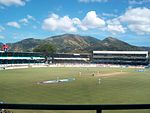
Queen's Park Oval
Queen's Park Oval

The Queen's Park Oval is a sports stadium in Port of Spain, Trinidad and Tobago, used mostly for cricket matches. It opened in 1896. Privately owned by the Queen's Park Cricket Club, it is currently the second largest capacity cricket ground in the West Indies with seating for about 20,000 spectators.It has hosted more Test matches than any other ground in the Caribbean with 60 as of January 2018, and also hosted a number of One-Day International (ODI) matches, including many World Series Cricket games in 1979 and matches of the 2007 Cricket World Cup. The Trinidad and Tobago cricket team play most of their home matches at the ground, and it is the home ground of the Caribbean Premier League team Trinbago Knight Riders. Considered by many players, journalists and critics as one of the most picturesque cricket venues, the ground first hosted a Test match in February 1930 when England toured the Caribbean, though it had previously hosted many first class tours as early as the 1897 tour under Lord Hawke. The pavilion dates back to 1896, though there were extensive renovations in the 1950s and in 2007 prior to the World Cup and following an earthquake. The "Concrete Stand" was renamed the "Learie Constantine Stand" in recognition of that former West Indies cricketer. The first ODI match at the ground was played in March 1983, and the first Twenty20 International in 2009.As well as the main cricket stadium, the facility includes a gym, indoor and outdoor cricket practice nets, two squash courts and two outdoor tennis courts. The cricket field has also been used to host several domestic and international football matches, and several music events.