place

Christ Church (Savannah, Georgia)

1733 establishments in the Thirteen ColoniesChurches completed in 1838Churches in Savannah, GeorgiaEpiscopal church buildings in Georgia (U.S. state)Johnson Square (Savannah) buildings
NRHP infobox with nocatSavannah Historic DistrictUse American English from May 2020Use mdy dates from May 2020
Christ Church Episcopal, Savannah, West view 20160705 1

Christ Church is an Episcopal church at 28 Bull Street, Johnson Square, in Savannah, Georgia. Founded in 1733, it was the first church established in the Province of Georgia and one of the first parishes within the Episcopal Diocese of Georgia, earning it the nickname "the Mother Church of Georgia". The present church building was constructed in 1838 and is located in the Savannah Historic District.

Excerpt from the Wikipedia article Christ Church (Savannah, Georgia) (License: CC BY-SA 3.0, Authors, Images).

Christ Church (Savannah, Georgia)
Bull Street, Savannah Savannah Historic District

Geographical coordinates (GPS) Address Website Nearby Places
placeShow on map

Wikipedia: Christ Church (Savannah, Georgia)Continue reading on Wikipedia

Geographical coordinates (GPS)

Latitude Longitude
N 32.079527777778 ° E -81.090777777778 °
placeShow on map

Address

Christ Episcopal Church

Bull Street 28
31401 Savannah, Savannah Historic District
Georgia, United States
mapOpen on Google Maps

Website
christchurchsavannah.org

linkVisit website

Christ Church Episcopal, Savannah, West view 20160705 1
Share experience

Nearby Places

Johnson Square (Savannah, Georgia)

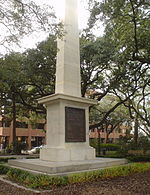
Johnson Square is one of the 22 squares of Savannah, Georgia, United States. Located in the northernmost row of the city's five rows of squares, it was the first of the squares to be laid out, in 1733, and remains the largest of the 22. It is east of Ellis Square, west of Reynolds Square and north of Wright Square. Situated on Bull Street and St. Julian Street, it is named for Robert Johnson, colonial governor of South Carolina and a friend of General James Oglethorpe. The oldest building on the square is the Ann Hamilton House, at 26 East Bryan Street, which dates to 1824.Interred under his monument in the square is Revolutionary War hero General Nathanael Greene, the namesake of nearby Greene Square. Greene died in 1786 and was buried in Savannah's Colonial Park Cemetery. His son was buried beside him after drowning in the Savannah River in 1793. Following vandalism of the cemetery by occupying Union forces during the Civil War the location of Greene's burial was lost. After the remains were re-identified Greene and his son were moved to Johnson Square. An obelisk in the center of the square now serves as a memorial to General Greene. The cornerstone of the monument was laid by Gilbert du Motier, Marquis de Lafayette, in 1825. At that time the obelisk did not yet commemorate any specific individual or event. In fact, due to financial restrictions the unmarked obelisk served for several years as a joint monument to both Greene and Casimir Pulaski. Inscriptions honoring Greene were added in 1886, but the Greenes’ physical remains did not arrive until 1901, following their "rediscovery."Johnson Square contains two fountains, as well as a sundial.Another landmark of Johnson Square is the Johnson Square Business Center. This building, formerly known as the Savannah Bank Building, was the city's first "skyscraper", built in 1911. Johnson Square is known as the financial district, or banking square, and many of the City's financial services companies are located here. These companies include the Savannah Bancorp, Savannah Bank, Coastal Bank Headquarters, Bank of America branch, SunTrust branch, TitleMax Corporate Headquarters, and a Regions Bank building. Christ Church Episcopal occupies the southeastern trust lot of the square at 28 Bull Street. Christ Church is "the Mother Church of Georgia", established in 1733. Early clergy of the church include John Wesley and George Whitefield.

The Marshall House (Savannah, Georgia)

The Marshall House is a historic building in Savannah, Georgia, United States. It was opened in 1852 by Mary Magdalene Marshall as one of Savannah's first hotels (although it was built thirty years after the City Hotel, the city's first). Located on East Broughton Street, it is the city's oldest operating hotel today, owned by Savannah's HLC Hotels, Inc., which also owns the city's Olde Harbour Inn, the Eliza Thompson House, the East Bay Inn, the Gastonian and the Kehoe House. The building was occupied by the Union Army in 1864 and 1865 during the American Civil War.Ralph Meldrim was proprietor of the Marshall House in 1857, and he erected a 12-foot-high iron veranda on the front of the second floor of the property.A decade later, the Marshall Hose Company, a volunteer fire department, was founded to protect the property, and others, in Savannah.The Florida House, an adjoining property, became part of the Marshall House in 1880.The hotel closed between 1895 and 1899. When it reopened, electric lights and hot and cold plumbing was installed on every floor. Joel Chandler Harris, author of the Uncle Remus series, was a resident at the property around this time.Mary Marshall's estate collected rent on the property until 1914.In 1933, Herbert W. Gilbert, a Jacksonville native, leased the building and changed its name to the Gilbert Hotel.Gilbert sold the hotel in 1941, at which point it had a lobby, dining room, living room, reading room, 66 guest rooms, one suite, an apartment and six storage rooms.The property was named the Geiger Hotel for a period.The Marshall House closed in 1957 due to an economic downturn. The upper three floors were abandoned, but the ground floor was used by shopkeepers up until 1998. The building was restored the following year and reopened to the public as Savannah's oldest hotel.Original parts of the building include the Philadelphia pressed brick on the exterior, the Savannah grey brick throughout, its staircases, wooden floors, fireplaces and the doors to each guest room. Several claw-foot baths date to 1880. The veranda and gas lights were reproduced in the likeness of the originals.An 1830 portrait of Mary Marshall, who died in 1877 at the age of 93, is hanging in the lobby after it was acquired from the estate of Jim Williams, the central figure in John Berendt's non-fiction novel Midnight in the Garden of Good and Evil.The hotel has a reputation of being haunted.

Reynolds Square (Savannah, Georgia)

Reynolds Square is one of the 22 squares of Savannah, Georgia, United States. It is located in the northernmost row of the city's five rows of squares, on Abercorn Street and East St. Julian Street. It is east of Johnson Square, west of Warren Square and north of Oglethorpe Square. The oldest building on the square is The Olde Pink House (originally Habersham House), which dates to 1771.Originally called Lower New Square (due to its being the first one laid out, in 1734, after the original four), it was later renamed for Captain John Reynolds, governor of Georgia in the mid-1750s. Reynolds was, in fact, an unpopular governor, and it is said that the celebration held upon his arrival in the colony was rivaled only by that held upon his departure.The square contains a bronze statue, by Marshall Daugherty, honoring John Wesley, founder of Methodism. Wesley spent most of his life in England but undertook a mission to Savannah (1735–1738), during which time he founded the first Sunday school in America. The statue was installed in 1969 on the spot where Wesley's home is believed to have stood. The statue is intended to show Wesley preaching out-of-doors as he did when leading services for Native Americans, a practice which angered church elders who believed that the Gospel should only be preached inside the church building. Scultpor Marshall said: "The moment is as he looks up from his Bible toward his congregation, about to speak and stretching out his right hand in love, invitation, and exhortation. In contrast, the hand holding the Bible is intense and powerful – the point of contact with the Almighty."Reynolds Square was the site of the Filature, which housed silkworms as part of an early—and unsuccessful—attempt to establish a silk industry in the Georgia colony.

Savannah, Georgia
Savannah, Georgia

Savannah ( sə-VAN-ə) is the oldest city in the U.S. state of Georgia and is the county seat of Chatham County. Established in 1733 on the Savannah River, the city of Savannah became the British colonial capital of the Province of Georgia and later the first state capital of Georgia. A strategic port city in the American Revolution and during the American Civil War, Savannah is today an industrial center and an important Atlantic seaport. It is Georgia's fifth-largest city, with a 2020 U.S. Census population of 147,780. The Savannah metropolitan area, Georgia's third-largest, had a 2020 population of 404,798.Each year, Savannah attracts millions of visitors to its cobblestone streets, parks, and notable historic buildings. These buildings include the birthplace of Juliette Gordon Low (founder of the Girl Scouts of the USA), the Georgia Historical Society (the oldest continually operating historical society in the South), the Telfair Academy of Arts and Sciences (one of the South's first public museums), the First African Baptist Church (one of the oldest African-American Baptist congregations in the United States), Temple Mickve Israel (the third-oldest synagogue in the U.S.), and the Central of Georgia Railway roundhouse complex (the oldest standing antebellum rail facility in the U.S. and now a museum and visitor center).Savannah's downtown area, which includes the Savannah Historic District, its 22 parklike squares, and the Savannah Victorian Historic District, is one of the largest National Historic Landmark Districts in the United States (designated by the federal government in 1966). Downtown Savannah largely retains the founder James Oglethorpe's original town plan, a design now known as the Oglethorpe Plan. During the 1996 Summer Olympics hosted by Atlanta, Savannah held sailing competitions in the nearby Wassaw Sound.