place

United States Customhouse (Savannah, Georgia)

1848 establishments in Georgia (U.S. state)Courthouses in Georgia (U.S. state)Custom houses in the United StatesCustom houses on the National Register of Historic PlacesGovernment buildings completed in 1848
Government buildings in Savannah, GeorgiaGovernment buildings on the National Register of Historic Places in Georgia (U.S. state)Greek Revival architecture in Georgia (U.S. state)History of Savannah, GeorgiaNational Register of Historic Places in Savannah, GeorgiaNeoclassical architecture in Georgia (U.S. state)Use American English from February 2020Use mdy dates from February 2020
US Custom House, Savannah

The U.S. Customhouse is a historic custom house located in Savannah in Chatham County, Georgia. It was built to house offices of the United States Customs Service.

Excerpt from the Wikipedia article United States Customhouse (Savannah, Georgia) (License: CC BY-SA 3.0, Authors, Images).

United States Customhouse (Savannah, Georgia)
East Bay Street, Savannah Savannah Historic District

Geographical coordinates (GPS) Address Website External links Nearby Places
placeShow on map

Wikipedia: United States Customhouse (Savannah, Georgia)Continue reading on Wikipedia

Geographical coordinates (GPS)

Latitude Longitude
N 32.08065 ° E -81.09101 °
placeShow on map

Address

U.S. Customs and Border Protection (United States Customs House)

East Bay Street 1, 3
31401 Savannah, Savannah Historic District
Georgia, United States
mapOpen on Google Maps

Website
cbp.gov

linkVisit website

linkWikiData (Q7889714)
linkOpenStreetMap (208324777)

US Custom House, Savannah
Share experience

Nearby Places

Savannah, Georgia
Savannah, Georgia

Savannah ( sə-VAN-ə) is the oldest city in the U.S. state of Georgia and is the county seat of Chatham County. Established in 1733 on the Savannah River, the city of Savannah became the British colonial capital of the Province of Georgia and later the first state capital of Georgia. A strategic port city in the American Revolution and during the American Civil War, Savannah is today an industrial center and an important Atlantic seaport. It is Georgia's fifth-largest city, with a 2020 U.S. Census population of 147,780. The Savannah metropolitan area, Georgia's third-largest, had a 2020 population of 404,798.Each year, Savannah attracts millions of visitors to its cobblestone streets, parks, and notable historic buildings. These buildings include the birthplace of Juliette Gordon Low (founder of the Girl Scouts of the USA), the Georgia Historical Society (the oldest continually operating historical society in the South), the Telfair Academy of Arts and Sciences (one of the South's first public museums), the First African Baptist Church (one of the oldest African-American Baptist congregations in the United States), Temple Mickve Israel (the third-oldest synagogue in the U.S.), and the Central of Georgia Railway roundhouse complex (the oldest standing antebellum rail facility in the U.S. and now a museum and visitor center).Savannah's downtown area, which includes the Savannah Historic District, its 22 parklike squares, and the Savannah Victorian Historic District, is one of the largest National Historic Landmark Districts in the United States (designated by the federal government in 1966). Downtown Savannah largely retains the founder James Oglethorpe's original town plan, a design now known as the Oglethorpe Plan. During the 1996 Summer Olympics hosted by Atlanta, Savannah held sailing competitions in the nearby Wassaw Sound.

Thomas Gamble Building

The Thomas Gamble Building, formerly known as the Eugene Kelly Stores, Kelly's Block and Kelly's Building, is a historic building in Savannah, Georgia, United States. Located in Savannah's Historic District, between Upper Stoddard Range to the east, Savannah City Hall to the south and the Hyatt Regency Savannah to the west, the addresses of some of the properties are East Bay Street, above Factors Walk, while Olympia Cafe occupies the former King Cotton warehouses on the River Street elevation. The building was constructed in 1877, by W. G. Butler, replacing the 1869 Eugene Kelly Stores, designed by Muller & Bruyn but which burned in 1876. Shortly after the fire, Kelly, a millionaire from New York, stated that he intended to rebuild, naming it "Kelly's Stores 2". To match the Bay Street frontage, the River Street façade was given a stucco finish in 1883, under the supervision of Bernard Goode.Several prominent Savannah companies were located in Kelly's Block for many years, including the John Flannery Co., which moved into the building upon its rebuilding was completed in 1877. Purse Printing & Paper Co. occupied space in the property for over sixty years.After the death of Kelly in 1894, his family maintained the property until 1907, at which point it was sold to New York's Temple Court Company, owned by Eugene's son, Thomas Hughes Kelly.The Temple Court Company sold the rear half of Wharf Lot 9, which contained the structure of Kelly's Block. Thomas rented another part of the building to the City of Savannah, before selling the entire building to the city in June 1943.The building was renamed in 1945 for Thomas Gamble, Savannah's mayor between 1933 and 1937 and 1938 until his death in 1945.

Johnson Square (Savannah, Georgia)

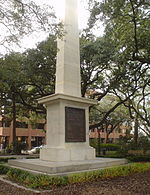
Johnson Square is one of the 22 squares of Savannah, Georgia, United States. Located in the northernmost row of the city's five rows of squares, it was the first of the squares to be laid out, in 1733, and remains the largest of the 22. It is east of Ellis Square, west of Reynolds Square and north of Wright Square. Situated on Bull Street and St. Julian Street, it is named for Robert Johnson, colonial governor of South Carolina and a friend of General James Oglethorpe. The oldest building on the square is the Ann Hamilton House, at 26 East Bryan Street, which dates to 1824.Interred under his monument in the square is Revolutionary War hero General Nathanael Greene, the namesake of nearby Greene Square. Greene died in 1786 and was buried in Savannah's Colonial Park Cemetery. His son was buried beside him after drowning in the Savannah River in 1793. Following vandalism of the cemetery by occupying Union forces during the Civil War the location of Greene's burial was lost. After the remains were re-identified Greene and his son were moved to Johnson Square. An obelisk in the center of the square now serves as a memorial to General Greene. The cornerstone of the monument was laid by Gilbert du Motier, Marquis de Lafayette, in 1825. At that time the obelisk did not yet commemorate any specific individual or event. In fact, due to financial restrictions the unmarked obelisk served for several years as a joint monument to both Greene and Casimir Pulaski. Inscriptions honoring Greene were added in 1886, but the Greenes’ physical remains did not arrive until 1901, following their "rediscovery."Johnson Square contains two fountains, as well as a sundial.Another landmark of Johnson Square is the Johnson Square Business Center. This building, formerly known as the Savannah Bank Building, was the city's first "skyscraper", built in 1911. Johnson Square is known as the financial district, or banking square, and many of the City's financial services companies are located here. These companies include the Savannah Bancorp, Savannah Bank, Coastal Bank Headquarters, Bank of America branch, SunTrust branch, TitleMax Corporate Headquarters, and a Regions Bank building. Christ Church Episcopal occupies the southeastern trust lot of the square at 28 Bull Street. Christ Church is "the Mother Church of Georgia", established in 1733. Early clergy of the church include John Wesley and George Whitefield.