place

Alexela Concert Hall

Buildings and structures in TallinnConcert halls in Estonia

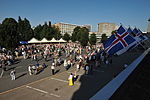
Alexela Concert Hall (Estonian: Alexela kontserdimaja; until 12 April 2018: Nordea Concert Hall (Estonian: Nordea kontserdimaja), until 15 May 2014: Nokia Concert Hall (Estonian: Nokia kontserdimaja)) is a concert hall in Tallinn, Estonia. The hall is located adjacent to Solaris Center. The hall’s owner is Tallinna Kontserdimaja AS.The hall was constructed from 2007–2009.The hall consists of 1,829 seats as follows: 1,030 in the arena, 491 in the dress circle and 308 in the upper circle.Several international events have been taken place there: e.g. 23rd European Film Awards in 2010.

Excerpt from the Wikipedia article Alexela Concert Hall (License: CC BY-SA 3.0, Authors).

Alexela Concert Hall
Estonia pst, Tallinn Kesklinna linnaosa

Geographical coordinates (GPS) Address Nearby Places
placeShow on map

Wikipedia: Alexela Concert HallContinue reading on Wikipedia

Geographical coordinates (GPS)

Latitude Longitude
N 59.433011371635 ° E 24.752075198416 °
placeShow on map

Address

Dimsum

Estonia pst 9
15030 Tallinn, Kesklinna linnaosa
Estonia
mapOpen on Google Maps

Share experience

Nearby Places

Tallinn University Academic Library

Tallinn University Academic Library (Estonian: Tallinna Ülikooli Akadeemiline Raamatukogu) is one of the most comprehensive research libraries of Estonia in all fields of knowledge, except construction and agriculture. It is located in Tallinn, the capital city of Estonia. The library was founded in April 1946 as the Central Library of the Estonian Academy of Sciences. The main building of the Tallinn University Academic Library was designed by architects Uno Tölpus and Paul Madalik and was built in 1963. Although the library is relatively young, the Library of St. Olaf's Church (founded in 1552) makes up the oldest part of the collections, including 56 incunables dating back to the 15th century and thousands of volumes published between the 16th and 19th centuries. Overall, the library's collection has over 2.6 million physical items. The number of readers is nearly 50,000. Over the years the library has gone through several administrative changes. 1990s the library used name Estonian Academic Library (Estonian: Eesti Akadeemiline Raamatukogu). In 2003, library become a structural unit of Tallinn University. The library collects and holds printed and other documents published in Estonia, creating as complete collections of these materials as possible. The library is entitled to an obligatory copy of each and every publication issued in Estonia. As one of the founding members of the Estonian Libraries Network Consortium (ELNET Consortium), the library is one of the leaders in the modernisation of the libraries in the digital era.

Roman Catholic Diocese of Reval

The Bishropic of Reval was a Latin Church ecclesiastical territory or diocese of the Catholic Church in Reval, Duchy of Estonia created by Valdemar II of Denmark in 1240. Contradictory to canon law, Valdemar II reserved the right to appoint the bishops of Reval to himself and his successor kings of Denmark. The decision to simply nominate the see of Reval was unique in the whole Catholic Church at the time and was disputed by bishops and the Pope. During the era, the election of bishops was never established in Reval and the royal rights to the bishopric and to nominate the bishops was even included in the treaty when the territories of the Duchy of Estonia were sold to Teutonic Order in 1346.Until 1374 the see was suffragan to the Archbishop of Lund after which it was transferred to the Archbishopric of Riga.The Bishopric of Reval came to an end during the Protestant Reformation in the Livonian Confederation. The last titular bishop of the see was Magnus, Duke of Holstein younger brother of Frederick II of Denmark who had bought Bishopric of Ösel-Wiek on the eve of the Livonian War. Magnus landed on Ösel (Saaremaa) in 1560 and soon after the bishop of Reval also resigned his bishopric to Magnus' hands. Magnus' attempt to gain control of the Toompea Castle in Reval was prevented by Gotthard Kettler, the master of Livonian Order. In 1561 Eric XIV of Sweden took control over Reval and after the Livonian war it became the capital city of Swedish Estonia.