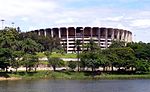
The Federal University of Minas Gerais (Portuguese: Universidade Federal de Minas Gerais, UFMG) is a federal research university located in the state of Minas Gerais. Its main and biggest campus is located at the city of Belo Horizonte, Brazil. It is one of Brazil's five largest and best universities, being the largest federal university. It offers 79 undergraduate education programs, upon completion of their curricular schedule the student is awarded either a Bachelor's degree, a Licenciate degree, or a Professional title (the latter usually applies to regulated health professions), all officialized by the issue of a University Diploma. It also has 90 postgraduate education programs, awarding 30 postbaccalaureate specialization degrees, 92 Master's degrees, and 72 Doctoral degrees, as well as 41 medical residency programs offered at UFMG's hospital facilities complexes. The UFMG has a population of roughly 72 thousand people among 34,482 undergraduate students, 2,247 postbaccalaureate specialization students, 10,556 Master's and Doctoral students, 3,202 professors, and 4,246 administrative employees. Competition to get into undergraduate programs involved 111,718 candidates to 6740 vacancy openings (16.6 candidates per vacancy; 6% of candidates get a position). It is research-oriented, even at the undergraduate level, whose students are encouraged to take part in research development through the Scientific Initiation program. Out of the number of professors, 761 (24%) are CNPq award-recipients due to outstanding research productivity. It encompasses 860 research groups, 1051 patent deposits in Brazil and abroad, and has the highest score (5 out of 5) at the Ministry of Education's undergraduate assessment.The university also has campi at Tiradentes and Montes Claros. Most courses, however, are taught at the main campus, located in the Pampulha district of Belo Horizonte. It receives the second highest amount of federal funds and resources among all federal universities, and registered over 1060 national and international patents in 2016 the biggest amount among other Brazilian higher education institutions. In 2014, according to Scopus, UFMG published over three thousand articles in influential international newspapers and magazines.
Past students include former Brazilian presidents Dilma Rousseff, Juscelino Kubitschek and Tancredo Neves; former Governor of Minas Gerais Rondon Pacheco; writer, medical doctor and diplomat João Guimarães Rosa, writers Fernando Sabino, Pedro Nava and Cyro dos Anjos; plastic surgeon Ivo Pitanguy, poet Carlos Drummond de Andrade and musicians Fernando Brant, Samuel Rosa of Skank and Fernanda Takai of Pato Fu; electrical engineer and mathematician Welington de Melo.
The undergraduate students are admitted through the national annual exams called Exame Nacional do Ensino Médio (National High School Exam). Its undergraduate courses were ranked 1st place in the 2007 results of the Student's National Performance Exam (ENADE). UFMG is the fifth best university in Latin America, according to the 2021 Times Higher Education ranking, and the 3rd best university in Brazil. UFMG's communication, psychology and management degrees, among others, were also elected as the best in the country and almost all undergraduate courses offered by the institution rank in the top 5 when compared to their counterparts in other Brazilian universities. Furthermore, the university is the highest ranking Brazilian university in terms of quality of education and second place when it comes to recognition in the job market.
.jpg)
 Continue reading on Wikipedia