place

Battle of Changsha (1944)

1944 in China1944 in JapanBattles of the Second Sino-Japanese WarHistory of ChangshaHistory of Hengyang
Chinese nationalist troops crossing the Three Gorges at West Hupei

The Battle of Changsha of 1944 (also known as the Battle of Hengyang or Campaign of Changsha-Hengyang; Chinese: 長衡會戰) was an invasion of the Chinese province of Hunan by Japanese troops near the end of the Second Sino-Japanese War. As such, it encompasses three separate conflicts: an invasion of the city of Changsha and two invasions of Hengyang. The Japanese military transferred the bulk of their troops from the Japanese homeland and Manchuria as part of Operation "Ichi-Go" or "Tairiku Datsu Sakusen" which roughly translates as 'Operation to Break through the Continent'. This was an attempt to establish a land and rail corridor from the Japanese occupied territories of Manchuria, Northern and Central China and Korea and those in South East Asia.

Excerpt from the Wikipedia article Battle of Changsha (1944) (License: CC BY-SA 3.0, Authors, Images).

Battle of Changsha (1944)
Shuyuan Road, Tianxin District Yunanjie (裕南街街道)

Geographical coordinates (GPS) Address Nearby Places
placeShow on map

Wikipedia: Battle of Changsha (1944)Continue reading on Wikipedia

Geographical coordinates (GPS)

Latitude Longitude
N 28.2 ° E 112.967 °
placeShow on map

Address

长沙府城

Shuyuan Road
410005 Tianxin District, Yunanjie (裕南街街道)
Hunan, China
mapOpen on Google Maps

Chinese nationalist troops crossing the Three Gorges at West Hupei
Share experience

Nearby Places

Changsha IFS Tower
Changsha IFS Tower

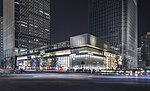
Changsha IFS Tower is a pair of skyscrapers in Changsha, Hunan, China, with Tower 1 rising 452 meters and Tower 2 rising 315 meters. Construction started in 2013 and completed in 2017. It is the 16th tallest building in the world and the tallest in Hunan. IFS stands for "International Finance Square". This twin-tower development is based on Harbour City, a hyper-connected retail development in Hong Kong. The Changsha complex sports an underground network of linkages to an interchange hub (Wuyi Square Station) for Changsha metro lines 1 and 2. The same underground passageway connects with one of the busiest pedestrian streets in China — Huangxing Road Pedestrian Shopping Street. The rectangular form of the glass-clad towers is interrupted by a series of metal fins that add a hint of complexity to their appearance and reduce glare for the interior office spaces. Tower 1 features a crown that incrementally sets back by several meters at three points. Like many towers that break the 400-meter barrier, reduced floor plate sizes at the top are best suited for hotel uses—with guest willing to pay a premium for accommodations at such heights. At the base, a block-sized podium contains a mega mall of 230,000 square meters. Changsha IFS Tower 1 also has 700 meters of retail street frontage, greater than that of its likeness, Harbour City. The retail mall, among the largest in Changsha and Central China, offers amenities spanning entertainment, lifestyle, culture, and dining.