place

Tomb of Chang Yuchun

1360s in Asia14th century in ChinaBuildings and structures completed in 1369Buildings and structures in NanjingMajor National Historical and Cultural Sites in Jiangsu
Tourist attractions in Nanjing
Tomb of Chang Yuchun 15 2013 05

The Tomb of Chang Yuchun (Chinese: 常遇春墓; pinyin: Cháng Yùchūn Mù) is the tomb of Chang Yuchun (1330–1369), a military general in late Yuan and early Ming dynasties. The tomb dates from 1369, and is located on Purple Mountain in Nanjing. There are stone horses, stone tigers, stone sheep and stone warriors in front of the tomb. It has been categorized as a "Major National Historical and Cultural Site in Jiangsu" by the State Council of China. In addition, the tomb was inscribed on the UNESCO World Heritage List in 2003 as an extension of the Imperial Tombs of the Ming and Qing Dynasties site, for its outstanding preservation and its contribution to the medieval history of China.

Excerpt from the Wikipedia article Tomb of Chang Yuchun (License: CC BY-SA 3.0, Authors, Images).

Tomb of Chang Yuchun
植物园南路, Xuanwu District 孝陵卫街道

Geographical coordinates (GPS) Address Nearby Places
placeShow on map

Wikipedia: Tomb of Chang YuchunContinue reading on Wikipedia

Geographical coordinates (GPS)

Latitude Longitude
N 32.062219444444 ° E 118.83166944444 °
placeShow on map

Address

中山植物园

植物园南路
210012 Xuanwu District, 孝陵卫街道
Jiangsu, China
mapOpen on Google Maps

Tomb of Chang Yuchun 15 2013 05
Share experience

Nearby Places

Purple Mountain (Nanjing)

Purple Mountain or Zijin Shan (Chinese: 紫金山; pinyin: Zǐjīn Shān; lit. 'Purple-Gold Mountain') is located on the eastern side of Nanjing in Jiangsu province, China. It is 448.2 metres (1,470 ft) high. Its peaks are often found enveloped in purple and golden clouds at dawn and dusk, hence its name. A small mountain with an area of about 20 square kilometres (7.7 sq mi), the altitude of Purple Mountain at the top and foot of the mountain is about 448 metres (1,470 ft) and 20 metres (66 ft) respectively. The annual average rainfall is 1,000 millimetres (39 in) to 1,050 millimetres (41 in), and the average annual sunshine time is about 2,213 hours. Purple Mountain is a mountain related to many historical events of both ancient and modern China. It was originally known as Bell Mountain (traditional Chinese: 鐘山; simplified Chinese: 钟山; pinyin: Zhōngshān) and also became known as Mount Jiang (traditional Chinese: 蔣山; simplified Chinese: 蒋山; pinyin: Jiǎngshān) after Sun Quan named Jiang Ziwen, an Eastern Han official whose spirit was said to haunt the site, as the mountain's god during the Three Kingdoms era. The name Zijin (紫金) means "copper" - when copper is pure, it appears purple in color, so in Chinese, it is also called purple-gold. It is also named Mount Jinling (金陵山), due to its purple rocks. Jinling means "the mount of purple-gold". It is the origin of the nickname "Jinling" (金陵) of Nanjing. During the Ming dynasty, it was also called Mount Shenlie (神烈山). More than 200 heritage and scenic tourist sites are now located in or around the mountain, including three national historical sites, nine provincial historical sites, and 33 prefectural historical sites. Located in or close to the hillside of the mountain, there are also about a dozen national research institutes and universities. The Sun Yat-sen Mausoleum, the tomb of Sun Yat-sen, and the Meiling Palace, the residence of Soong Meiling, are located at the foot of the mountain. Purple Mountain has 621 species of vascular plants, from 383 genera, 118 families (including 78 cultivated species).

Meiling Palace
Meiling Palace

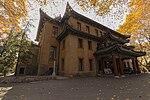
Meiling Palace (Chinese: 美齡宮, aka Meiling Villa and Meiling Gong) is a large villa in Nanjing, China, built by the chairman of the Chinese National Government, Chiang Kai-Shek, for his wife, Soong Meiling. It is known formally as the National Government Chairman Residence (Chinese: 国民政府主席官邸).The villa is located below Purple Mountain, about 6 km from Nanjing's city centre in the Zhongshan Mountain Scenic Area. It is the largest villa in Nanjing, with a floor area of more than 2,000 m2.Meiling Palace was completed in 1934, as a residence for the chairman of the Chinese National Government. Chiang Kai-Shek gave the mansion to his wife on her birthday, 4 March, and the couple moved there in summer 1936. Later it was used as a base for officials visiting the Sun Yat-sen Mausoleum, located nearby. After the end of the war between China and Japan in 1946, the National Government moved back to Nanjing and Chiang Kai-Shek used this villa as his official residence. The exterior of the villa was built in a traditional Chinese style with double eaves and a roof of green glazed tiles. There are more than a thousand phoenixes carved on the roof tiles. The Chinese artist Chen Zhifo (1896–1962) painted the eaves with birds and flowers. Viewed from above, the trees surrounding the villa are in the form of a necklace. The interior was in a western style. The building has two main storeys, a basement, and a mezzanine between the first and second floors. In the basement, there is an exhibition of paintings by Soong Meiling. On the second floor, there is a private chapel.