place

Heretaunga Plains

Hawke's Bay Region geography stubsLandforms of the Hawke's Bay RegionPlains of New Zealand
NZ Heretaunga P
NZ Heretaunga P

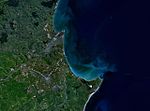
There are two places in New Zealand called Heretaunga. For the suburb of Upper Hutt, see Heretaunga, Wellington. The Heretaunga Plains is a 300 square kilometres (120 sq mi) alluvial plain at the southern end of Hawke Bay on the east coast of the North Island of New Zealand. The towns of Napier, Hastings and Havelock North are on the plain.The plain was formed over the last 250,000 years from sediment deposited by the Tutaekuri, Ngaruroro and Tukituki Rivers and from coastal marine deposits. It consists of layers of gravel, sand and silt. Permeable gravel beds form aquifers and the artesian groundwater provides 85% of the requirements for public water supply, irrigation and industrial use on the Heretaunga Plains and adjacent areas.The fertile soil, the warm, dry climate of the area, and the water for irrigation make the plain an excellent site for horticulture and agriculture. Half of the total New Zealand production of fruit, vegetables and grapes is on the Heretaunga Plains. It is one of New Zealand's leading wine producing areas. The Heretaunga Plains are named after a carved wharenui (meeting house) at Whatonga, and Māori migrating south have taken the name with them and given it to a watercourse now known as the Hutt River.

Excerpt from the Wikipedia article Heretaunga Plains (License: CC BY-SA 3.0, Authors, Images).

Heretaunga Plains
Rotary Pathway,

Geographical coordinates (GPS) Address Nearby Places
placeShow on map

Wikipedia: Heretaunga PlainsContinue reading on Wikipedia

Geographical coordinates (GPS)

Latitude Longitude
N -39.598272222222 ° E 176.87075833333 °
placeShow on map

Address

Rotary Pathway

Rotary Pathway
4102
Hawke's Bay, New Zealand
mapOpen on Google Maps

NZ Heretaunga P
NZ Heretaunga P
Share experience

Nearby Places

Napier-Hastings Urban Area

The Napier-Hastings Urban Area was defined by Statistics New Zealand (Stats NZ) as a main urban area of New Zealand that was based around the twin cities of Napier and Hastings in the Hawke's Bay Region. It was defined under the New Zealand Standard Areas Classification 1992 (NZSAC92), which has since been superseded by the Statistical Standard for Geographic Areas 2018 (SSGA18). The urban area lay mostly on the Heretaunga Plains, with part on surrounding hills. It was a city cluster consisting of the cities of Napier and Hastings, the town of Havelock North and some smaller settlements. It was the sixth-most-populous urban area in the country under the NZSAC92, with 134,500 residents, fewer than Tauranga (141,600) and more than Dunedin (122,000). While the two cities are separated by 9 km (5.6 mi) of rural land from city edge to edge (20 km from one city centre to the next), there is sufficient economic and social integration between the cities that Stats NZ treated them as a single urban area. Stats NZ also subdivided the urban area into urban zones, as they did for the urban areas of Auckland, Hamilton and Wellington. The Napier-Hastings Urban Area contains about three-quarters of the population of the entire Hawke's Bay. Under SSGA18, Stats NZ split up the Napier-Hastings Urban Area for statistical purposes. It was split into two "large urban areas" (30,000 to 99,999 population) of Napier and Hastings, the "medium urban area" (10,000 to 29,999) of Havelock North, the "small urban area" (1,000 to 9,999) of Clive, and the "rural settlements" (300 to 999) of Haumoana, Te Awanga, Whakatu and Whirinaki. Some settlements of less than 300 that were included in the Napier-Hastings Urban Area were left out entirely, including Eskdale, Omahu, Pakipaki, Pakowhai and Waiohiki. Stats NZ similarly split Wellington into Lower Hutt, Porirua, Upper Hutt and the urban part of Wellington City under SSGA18.