place

Foinikas (river)

Drainage basins of the Gulf of CorinthLandforms of AchaeaRivers of GreeceRivers of Western Greece
Foinikas river north Peloponnese

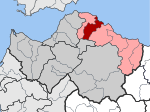
The river Foinikas (Greek: Φοίνικας, Ancient Greek: Φοίνιξ) is a river in the northern Peloponnese, Greece. It is also known as Salmenikos River (Σαλμένικος). Its source is on the north-eastern slopes of Mount Panachaiko, near the village of Vounopirgos (Loubista). It empties into the Gulf of Corinth, between the villages of Longos and Kamares. Major tributaries are Kloumenitis (intermittent stream) and Stachtaina (intermittent stream). The total length of the river is 22.8 kilometres (14.2 mi) and it flows along the following places, from the source downstream: Damakini, Salmenikο, Kamares. Foinikas is an intermittent river that has a continuous flow in all its length from October to June every year (during years of normal rainfall). Close to the sources, the river has a yearly flow but during the summer months, the water is used for agriculture.

Excerpt from the Wikipedia article Foinikas (river) (License: CC BY-SA 3.0, Authors, Images).

Foinikas (river)
Municipal Unit of Erineos κ. Καμάρων

Geographical coordinates (GPS) Address Nearby Places
placeShow on map

Wikipedia: Foinikas (river)Continue reading on Wikipedia

Geographical coordinates (GPS)

Latitude Longitude
N 38.3097 ° E 22.019 °
placeShow on map

Address


250 09 Municipal Unit of Erineos, κ. Καμάρων
Peloponnese, Western Greece and the Ionian, Greece
mapOpen on Google Maps

Foinikas river north Peloponnese
Share experience

Nearby Places

Aegium

Aegium or Aigion (Ancient Greek: Αἴγιον), or Aegeium or Aigeion (Αἴγειον), was a town and polis (city-state) of ancient Achaea, and one of the twelve Achaean cities. It was situated upon the coast west of the river Selinus, 30 stadia from Rhypae, and 40 stadia from Helice. The city stood between two promontories in the corner of a bay, which formed the best harbour in Achaea next to that of Patrae. It is said to have been formed out of a union of seven or eight villages. It was already mentioned in the Homeric Catalogue of Ships in the Iliad. When the neighbouring city of Helice sank into the sea following an earthquake in 373 BCE, Aegium annexed its territory and became the chief city of the Achaean League. When the League dissolved later in the same century, however, Aegium came for some time under Macedonian rule. Eventually, the Achaean League was refounded by the cities of Dyme and Patras in 280 BC, and the citizens of Aegium, taking courage to expel the Macedonian garrison, joined in 275 BC. From this time on Aegium served as the capital of the Achaean League. It was the meeting place for the assembly of the Achaeans and retained this distinction until Philopoemen carried a law that the meeting might be held in any of the towns of the confederacy. Even under the Roman Empire the Achaeans were allowed to keep up the form of their periodical meetings at Aegium, just as the Amphictyons were permitted to meet at Thermopylae and Delphi.The meetings were held in a grove near the sea, called Homagyrium or Homarium, sacred to Zeus Homagyrius or Homarius (Ὁμαγύριον, Ὁμάριον); a temple was also there called Homarium. Close to this grove was a temple of Demeter Panchaea. The words Homagyrium, 'assembly', and Homarium, 'union', refer to those meetings, though in later times they were explained as indicating the spot where Agamemnon assembled the Grecian chieftains before the Trojan War. There were several other temples and public buildings at Aegium, of which an account is given by Pausanias.Aegium had several Olympic winners including Xenophon, Ladas (stadion race), Athenodorus (Αθηνόδωρος) (stadion race), Straton (Στράτων) (pancration and wrestling). Its site is located near the modern city of Aigio.