place

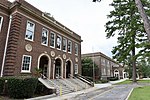
Joe M. Beutell House

Georgia (U.S. state) Registered Historic Place stubsHouses completed in 1930Houses in Thomas County, GeorgiaHouses on the National Register of Historic Places in Georgia (U.S. state)National Register of Historic Places in Thomas County, Georgia
Tudor Revival architecture in the United StatesUse mdy dates from August 2023
Joe M. Beutell House

The Joe M. Beutell House in Thomasville, Georgia was built in 1930. It is notable for its Tudor Revival architecture and was listed on the National Register of Historic Places in 1991.It was built by and for contractor Joe M. Beutell and was designed by architect Russell L. Beutell (1891-1943).It was later the home of Judge Reason C. Bell while he was chief justice of the Georgia Supreme Court.

Excerpt from the Wikipedia article Joe M. Beutell House (License: CC BY-SA 3.0, Authors, Images).

Joe M. Beutell House
Myrtle Drive,

Geographical coordinates (GPS) Address Nearby Places
placeShow on map

Wikipedia: Joe M. Beutell HouseContinue reading on Wikipedia

Geographical coordinates (GPS)

Latitude Longitude
N 30.84842 ° E -83.97121 °
placeShow on map

Address

Myrtle Drive 218
31792
Georgia, United States
mapOpen on Google Maps

Joe M. Beutell House
Share experience

Nearby Places

Augustine Hansell House

The Augustine Hansell House, also known as Jeffries House, is a historic home of exceptional quality in Thomasville, Georgia, United States. It was designed by architect John Wind, the leading architect of Thomas County, in Greek Revival style. A 1+1⁄2-story cottage, it was built during 1852–53 for Augustine Hansell. Hansell, who later (1869) was mayor of Thomasville, was a judge of the Superior Court of the Southern Judicial Circuit. He also organized the Thomas Reserves and was commander of a militia company of Thomas County. He was a lieutenant in the Thomas Reserves.The American Civil War did not bring fighting to Thomas County, with the closest battle being the Battle of Natural Bridge in Natural Bridge, Florida, 56 miles (90 km) away from Thomasville.The house is a 1+1⁄2-story wood-frame cottage, with the main house having four rooms in a center-hall plan. It has an overhanging portico supported by six square columns. It has two small windows centered in the gable front.Its interior is little-altered from the original and has Greek Revival details in its doorways, stairway, and four fireplaces with carved mantels.The addition of wings for a kitchen and a bedroom in 1927 did not detract from the architectural character of the house.It was listed on the National Register of Historic Places in 1970.Up to 1969 the house had remained in the same family and was then owned by a granddaughter of Augustine Hansell. It has been described as one of the "three best cottages" in Thomasville.

Lapham–Patterson House

The Lapham–Patterson House is a historic site at 626 North Dawson Street in Thomasville, Georgia. The house, built between 1884-85 as a winter cottage for businessman C.W. Lapham of Chicago, is a significant example of Victorian architecture. It has a number of architectural details, such as fishscale shingles, an intricately designed porch, long-leaf pine inlaid floors, and a double-flue chimney. Inside, the house was well-appointed with a gas lighting system, hot and cold running water, indoor plumbing, and modern closets. Its most significant feature is its completely intentional lack of symmetry. None of the windows, doors, or closets are square. The house is a Georgia Historic Site and is also a National Historic Landmark, designated in 1973 for its architecture. It is also a contributing building in the National Register-listed Dawson Street Residential Historic District. The three-story structure has a mellow-yellow exterior with brick-red roof and chimneys. At the core of the house is a hexagonal-shaped room. There are at least 50 exits; Mr. Lapham had been in the Great Chicago Fire and subsequently became paranoid about being trapped in a burning building. The house was deliberately constructed slightly askew to take advantage of sunlight entering the third floor during the Spring and Fall Equinoxes. Within is a gentlemen's parlor with a small stage featuring a stained-glass window in the center. In the fretwork outside the room over the balcony are animal and amorphous shapes cut into the wood. In the center is a cutout of what is presumably the head of Mrs. O'Leary's cow. During the Spring and Fall Equinoxes the patterns are projected by sunlight onto the floor through the glass. The total effect is that, in the center of the stained glass window's colorful pattern on the floor, the shadow of the cow's head can be seen. Mr. Lapham was a Quaker.