place

Lincoln High School (South Dakota)

Buildings and structures in Sioux Falls, South DakotaEducation in Sioux Falls, South DakotaPublic high schools in South DakotaSchools in Minnehaha County, South DakotaVague or ambiguous time from March 2018
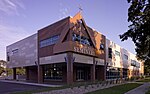
Lincoln HS Sioux Falls 1

Lincoln High School is a high school in Sioux Falls, South Dakota. Enrollment is currently at 1,966 students. Lincoln was included in the list of the top 1200 public schools in the US by Newsweek in their May 8, 2006 issue, ranking at 1,027.

Excerpt from the Wikipedia article Lincoln High School (South Dakota) (License: CC BY-SA 3.0, Authors, Images).

Lincoln High School (South Dakota)
South Cliff Avenue, Sioux Falls

Geographical coordinates (GPS) Address Phone number Website External links Nearby Places
placeShow on map

Wikipedia: Lincoln High School (South Dakota)Continue reading on Wikipedia

Geographical coordinates (GPS)

Latitude Longitude
N 43.5186 ° E -96.7092 °
placeShow on map

Address

Lincoln High School

South Cliff Avenue 2900
57105 Sioux Falls
South Dakota, United States
mapOpen on Google Maps

Phone number

call+16053677990

Website
sf.k12.sd.us

linkVisit website

linkWikiData (Q6550731)
linkOpenStreetMap (15803378)

Lincoln HS Sioux Falls 1
Share experience

Nearby Places

Josephine Martin Glidden Memorial Chapel

The Josephine Martin Glidden Memorial Chapel is a historic church at 2121 E. Twelfth Street in Sioux Falls, South Dakota. It was built in 1924 and was added to the National Register in 1987.It was deemed notable as "a good example of funerary architecture in a gothic style with Romanesque features."Located at the entrance to Mt. Pleasant Cemetery, it has also been known as Mt. Pleasant Chapel.Story of the chapel: "1904, it was then that Daniel Smith Glidden was asked to serve on the board of trustees for the Mt Pleasant Cemetery Association. Josephine, the more action-oriented member of the Glidden team, became interested in her husband’s responsibilities. In 1912, Daniel passed and Mt Pleasant Cemetery became a regular visiting place for Josephine. After her death on Christmas Day 1921, it was revealed that Josephine left Mt Pleasant Cemetery Association a gift of $13,000 to build a memorial known as the Glidden Memorial Chapel today. The cemetery board had been seeking to erect a suitable building in the cemetery for a chapel, lavatory, and shelter house for a number of years, as documented in July 3, 1899 meeting minutes. Body storage was a real problem and a yearly headache for undertakers and cemetery Sextons as it was too hard and too costly to dig graves when the ground was frozen in the winter. On July 15, 1901, it was reported that “the committee appointed to investigated the matter of erecting a chapel and vault-building reports that the cost of such a building is beyond the present ability of the association and the matter is dropped.” Long-time family friend of the Glidden's and President of the cemetery board at the time, Dennis L McKinney wasted no time in contacting architectural firms and called a special meeting of the board on Feb. 24, 1922. The drawings and ideas of architects Hugill and Blatherwick were accepted with the understanding that the construction costs shall not exceed the sum of $13,000. April 7, 1922, Carlson & Snitky Contractors bid $12,975."

South Dakota School for the Deaf

The South Dakota Services for the Deaf (SDSD) is a state agency that supports deaf children in South Dakota. Formerly it was a state-supported school located in Sioux Falls, South Dakota that provided services to meet the educational needs of children who are deaf, hard-of-hearing, or have cochlear implants. SDSD is governed by the South Dakota Board of Regents. SDSD was founded in 1880 as the Dakota Territorial School for Deaf Mutes when the area was still part of the Dakota Territory. When South Dakota became a state in 1889, the school was placed under the state's Board of Charities and Corrections and the name changed to its present form. In 1944, voters ratified an amendment to the state constitution which moved SDSD and the South Dakota School for the Blind (now the South Dakota School for the Blind and Visually Impaired) under the care of the South Dakota Board of Regents. The student population reached a peak of 100-150 students by the 1960s; advances in hearing aid technology made it possible for hard of hearing students to stay in regular classes and various disability-related laws passed between the 1970s and 1990s led to increased placement of deaf students in public school environments rather than sending them to SDSD. The result was a gradual decline to about 50 students by the mid-1990s. This combined with the prevailing attitude of the Regents towards deafness led to the establishment of the current auditory / oral (cochlear implant) program and later, the transfer of both this and the original sign language-based program to neighboring school districts, leading to the closure of the main campus in 2011. The campus was sold, the remaining functions (administration and outreach) relocated to a building in a commercial area adjacent to a strip joint. Shelly Conlon of The Argus Leader in Sioux Falls stated that the decline and closure of SDSD and the placement of the burden on local school districts to educate deaf children reflected a negligence of deaf children from South Dakota state legislators.