place

Bagatelle Plantation

Greek Revival houses in LouisianaHouses in Iberville Parish, LouisianaHouses on the National Register of Historic Places in LouisianaLouisiana Registered Historic Place stubsNational Register of Historic Places in Iberville Parish, Louisiana
Plantation houses in LouisianaUse mdy dates from August 2023
Bagatelle Plantation, East River Road (moved to Iberville Parish), Donaldsonville vicinity (St. James Parish, Louisiana)

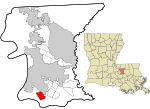
The Bagatelle Plantation is a Southern plantation with a historic mansion in Sunshine, Louisiana, USA. The house was designed by architect Robert S. Chadsey in the Greek Revival architectural style in 1841 for the plantation owner, Augustin Marius Tureaud.The historic house has been moved twice. After the Great Mississippi Flood of 1927 it was moved a further back from the levee, inside the same property in St. James Parish. In 1977 a second move, due to a purchase of the land by Missouri-Portland Cement Company, brought the house to its present location in Iberville Parish. The house was moved in one piece on a barge up Mississippi River course, about 30 miles (48 km) north of its original location.The house was listed on the National Register of Historic Places on May 9, 2007.

Excerpt from the Wikipedia article Bagatelle Plantation (License: CC BY-SA 3.0, Authors, Images).

Bagatelle Plantation
River Road, St. Gabriel

Geographical coordinates (GPS) Address Nearby Places
placeShow on map

Wikipedia: Bagatelle PlantationContinue reading on Wikipedia

Geographical coordinates (GPS)

Latitude Longitude
N 30.30957 ° E -91.18551 °
placeShow on map

Address

River Road

River Road
70765 St. Gabriel
Louisiana, United States
mapOpen on Google Maps

Bagatelle Plantation, East River Road (moved to Iberville Parish), Donaldsonville vicinity (St. James Parish, Louisiana)
Share experience

Nearby Places

Plaquemine Lock State Historic Site

Plaquemine Lock State Historic Site, located in Plaquemine, Louisiana, commemorates an early example of hydraulic engineering design and the historic significance of Bayou Plaquemine, an important navigable waterway that was once a distributary of the Mississippi River. Bayou Plaquemine promoted settlement beginning in the 18th century and helped the area economically by providing an access route between southwestern Louisiana (and thus Texas) and the Mississippi via the Atchafalaya Basin.The lock itself was designed by Colonel George Washington Goethals of the United States Army Corps of Engineers, who later served as chief engineer of the construction of the Panama Canal Lock, and went on to be the Canal Zone's first governor. Plaquemine Lock was opened on April 9, 1909, after 14 years of construction. When it was built, Plaquemine Lock was the highest freshwater lift of any lock in the world. The lock initially utilized a gravity-flow principle until pumps were installed years later. The lock was closed after 52 years of service in 1961 due to increased river traffic and the demand for a larger lock, which opened thereafter in Port Allen. The Plaquemine Lock structure was placed on the National Register of Historic Places in 1972. Today, the Gary James Hebert Memorial Lockhouse serves as an on-site museum and visitors center. It is named for the man who led the way to help preserve the Lock site, which today covers 19 acres (7.7 ha).

Sunshine, Louisiana

Sunshine is a populate place in Iberville Parish, Louisiana, United States which is now partially within the city limits of St. Gabriel. Located approximately 15 miles south of Baton Rouge along the Mississippi River, the community was originally named Forlorn Hope by inhabitants but was given its current name by Oscar Richard, Sr., who was the post master of the Forlorn Hope, La. post office. He petitioned the federal government for permission to change the name of the post office to Sunshine, La., in order to give it a more uplifting name. As frequently happens, the villages took the name of the local post office; hence, the name of the village and community became known as Sunshine, La. Much of the community annexed was annexed to St. Gabriel in 1987, excluding a peninsual along the river. The ZIP Code for Sunshine is 70780.The "Sunshine" type of vetiver grass, whose roots have long been used in Louisiana as an insect repellent, was given that name by the USDA in 1989 for Sunshine, Louisiana, where Eugene LeBlanc Sr. grew a heritage clone given to his grandparents by Felix Perilloux, who in turn had acquired it from his wife Myrthee Froisy Perilloux in the 1860s. Vetiver was clonally introduced throughout the tropics in the 19th century, and DNA fingerprinting has shown that almost all the vetiver grown worldwide for perfumery, agriculture, and bioengineering is essentially the same nonfertile cultigen as Sunshine. This type of essential-oil vetiver is known by various names in different locations (e.g., 'Monto' in Australia), but because "Sunshine" was the earliest name used in modern times, that is how it is collectively known throughout the world today.