place

Old Protestant Cemetery (Macau)

1821 establishments in China1821 establishments in the Portuguese Empire19th-century establishments in MacauAnglican cemeteries in AsiaCemeteries in Macau
Christianity in MacauHistoric Centre of MacauLutheran cemeteriesMacau PeninsulaProtestant Reformed cemeteriesTourist attractions in MacauWorld Heritage Sites in China
Macau Protestant Chapel and Old Protestant Cemetery sign 20060401

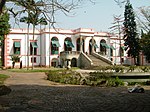
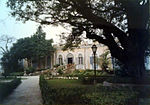
The Old Protestant Cemetery (Chinese: 基督教墳場; Portuguese: Cemitério Protestante) is a cemetery in Santo António, Macau, China. It was established by the British East India Company in 1821 in Portuguese Macau in response to a lack of burial sites for Protestants in the Roman Catholic Portuguese colony. It is the last resting place of the artist George Chinnery, missionaries Robert Morrison and Samuel Dyer (his wife Maria is buried at the Old Protestant Cemetery in Penang), Royal Navy captain Henry John Spencer-Churchill (son of the 5th Duke of Marlborough and great-great-granduncle of Winston Churchill) and US Naval Lieutenant Joseph Harod Adams (grandson of the second president of the United States, John Adams, and nephew of the sixth, John Quincy Adams). Humphrey Fleming Senhouse, a captain in the Royal Navy, is also buried here, as is John Robert Morrison, son of Robert Morrison, who was appointed as Acting Colonial Secretary of Hong Kong but died eight days later in Macau from fever. William Napier, 9th Lord Napier was buried in the cemetery but his body was subsequently exhumed and reburied in Scotland. Another grave is that of Anders Ljungstedt, a prosperous Swedish businessman, interpreter and historian.In 2005, the cemetery was officially enlisted as part of the UNESCO World Heritage Site Historic Center of Macau.

Excerpt from the Wikipedia article Old Protestant Cemetery (Macau) (License: CC BY-SA 3.0, Authors, Images).

Old Protestant Cemetery (Macau)
Membrodsweg, Heilbronn Sontheim

Geographical coordinates (GPS) Address Nearby Places
placeShow on map

Wikipedia: Old Protestant Cemetery (Macau)Continue reading on Wikipedia

Geographical coordinates (GPS)

Latitude Longitude
N 22.199897222222 ° E 113.54019722222 °
placeShow on map

Address

Membrodsweg

Membrodsweg
74074 Heilbronn, Sontheim
Baden-Württemberg, Deutschland
mapOpen on Google Maps

Macau Protestant Chapel and Old Protestant Cemetery sign 20060401
Share experience

Nearby Places

Fortaleza do Monte
Fortaleza do Monte

The Fortaleza do Monte (Portuguese for Mount Fortress, also Monte Forte; officially Fortaleza de Nossa Senhora do Monte de São Paulo, in English: Fortress of Our Lady of the Mount of St. Paul; Chinese: 大砲台; Cantonese Yale: daaih paau yìh) is a fort in Santo António in Macau. It is the historical military centre of Macau. The fort forms part of the "Historic Centre of Macau" and is a UNESCO World Heritage Site.The fort was built between 1617 and 1626 on the 52-metre tall Mount Hill, located directly east of the Ruins of Saint Paul's. It was constructed to protect the properties of the Jesuits (mainly Portuguese Jesuits) in Macau, especially from pirates. Later, the fort was taken over by the Portuguese colonial governor and the relevant authorities for the defence of Macau. The fort occupies an area of roughly 8,000 square metres. Thirty-two muzzle-loading cannon were placed around the fort's walls, and the two corners of the southeastern fort wall have small watchtowers. The fort proved crucial in successfully holding off the attempted Dutch invasion of Macau in 1622.The fort remained a restricted military area until 1965 when the barracks in the fort were converted into a weather observatory and the fort was opened to the public. The observatory ceased its function and was relocated to Taipa in 1996 before it was demolished to make way for the Museum of Macau, which was officially opened on 19 April 1998. The tree-covered park at the top of the fort has a panoramic view of the mainland area of Macau. Apart from being a fortress, it has served various functions: The first residence of the governors of Macau (in 1623 and in 1740). The base for two companies of the Portuguese Prince Regent Battalion to act as a police force from 1810 to 1841. A weather observatory of the Meteorological Department of Portuguese Macau (from 1966 to 1996). The Museum of Macau (1998 to present).