place

Hamilton Gardens

Botanical gardens in New ZealandGardens in New ZealandGeography of Hamilton, New ZealandProtected areas of WaikatoTourist attractions in Hamilton, New Zealand
Use New Zealand English from July 2019
Italian Renaissance Garden in Hamilton Gardens along central axis

Hamilton Gardens is a public garden park in the south of Hamilton owned and managed by Hamilton City Council in New Zealand. The 54-hectare park is based on the banks of the Waikato River and includes enclosed gardens, open lawns, a lake, a nursery, a convention centre and the Hamilton East Cemetery. It is the Waikato region's most popular visitor attraction, attracting more than 1 million people and hosting more than 2,000 events a year.Hamilton Gardens is described in popular culture as a botanical garden, but does not technically qualify as a botanical garden. Instead, the site features 21 gardens representing the art, beliefs, lifestyles and traditions of different civilisations or historical garden styles. These gardens are grouped into the Paradise, Productive, Fantasy, Cultivar and Landscape garden collections, and there is space for gardens which are still in development.The first development of the gardens began in the early 1960s at what was then the city's waste disposal site. The first substantial development, the Rogers Rose Garden, was opened in 1971 in an attempt to block highway development over the site. Since 1982 many newly developed areas have been opened to the public. Additional features of the gardens now include a lake walkway and a waterfall lookout.

Excerpt from the Wikipedia article Hamilton Gardens (License: CC BY-SA 3.0, Authors, Images).

Hamilton Gardens
Grey Street, Hamilton Hamilton East

Geographical coordinates (GPS) Address External links Nearby Places
placeShow on map

Wikipedia: Hamilton GardensContinue reading on Wikipedia

Geographical coordinates (GPS)

Latitude Longitude
N -37.8046 ° E 175.3039 °
placeShow on map

Address

Hamilton Gardens

Grey Street
3216 Hamilton, Hamilton East
Waikato, New Zealand
mapOpen on Google Maps

linkWikiData (Q5644961)
linkOpenStreetMap (149530738)

Italian Renaissance Garden in Hamilton Gardens along central axis
Share experience

Nearby Places

Peacocke Bridge
Peacocke Bridge

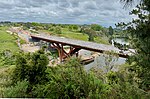
Peacocke Bridge is a girder bridge under construction over the Waikato River in Hamilton, New Zealand. The bridge on Wairere Drive is part of the Southern Links, which will complete a ring road around Hamilton. It will link Hamilton East with a new suburb of Peacocke. Construction started in 2020, though the plan originated in 1962.The bridge is formed with 2,650 tonnes of steel and is expected to be completed by mid 2024, at a cost of $160.2M, though budgeted at $135M in 2020, estimated at no more than $60M in 2017 and formerly at $40M. The bridge was delayed by COVID-19 and Cyclone Gabrielle and other storms. The four-lane bridge was designed by Bloxam Burnett & Olliver, and is being built by HEB Construction. It will include bus lanes and cycle paths, and will also carry the Peacocke to Pukete sewer line. The river was closed to boats during construction.Both banks of the river have been stabilised to support the bridge. The north bank, next to the bridge abutments, has a 50-degree slope, rising 45 metres (148 ft), or 35 metres (115 ft), and was stabilised with 150-millimetre (5.9 in) soil nails. The total length of the bridge is 215 metres (705 ft), including the 11-metre-high (36 ft) mechanically stabilised earth wall of the southern bridge abutment, which is on compressible, loose Taupō Pumice alluvial soils, of the river terraces. The bridge itself is 180 metres (590 ft) long (made up of a 70-metre (230 ft) northern span, 50-metre (160 ft) central span and a 60-metre (200 ft) southern span), 26.2 metres (86 ft) wide, on 38-metre-deep (125 ft), closely spaced, bridge piles, with 35-metre-long (115 ft) earth anchors and over 600 eight-metre-long (26 ft) soil nails. The bridge is over 30 metres (98 ft) above the normal river level. The main support is a pier on the south bank of the river, formed of weathering steel, in two lattice-shaped, 30-by-22-metre (98 ft × 72 ft) Y sections, each weighing over 200 tonnes. The lattice is made up of 2.2-by-0.82-metre (7.2 ft × 2.7 ft) box-section welded plates. They were lifted into position by a 600-tonne crane.