place

Fitzroy, Hamilton

Suburbs of Hamilton, New ZealandUse New Zealand English from July 2019
FitzroyHamilton
FitzroyHamilton

Fitzroy is a suburb in southern Hamilton in New Zealand. It is named after Robert FitzRoy, who commanded HMS Beagle and was later the Governor of New Zealand. It was declared a suburb in 1974.

Excerpt from the Wikipedia article Fitzroy, Hamilton (License: CC BY-SA 3.0, Authors, Images).

Fitzroy, Hamilton
Fitzroy Avenue, Hamilton Fitzroy

Geographical coordinates (GPS) Address Nearby Places
placeShow on map

Wikipedia: Fitzroy, HamiltonContinue reading on Wikipedia

Geographical coordinates (GPS)

Latitude Longitude
N -37.813919444444 ° E 175.29939722222 °
placeShow on map

Address

Fitzroy Avenue 110
3206 Hamilton, Fitzroy
Waikato, New Zealand
mapOpen on Google Maps

FitzroyHamilton
FitzroyHamilton
Share experience

Nearby Places

Peacocke Bridge
Peacocke Bridge

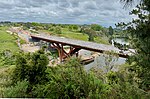
Peacocke Bridge is a girder bridge under construction over the Waikato River in Hamilton, New Zealand. The bridge on Wairere Drive is part of the Southern Links, which will complete a ring road around Hamilton. It will link Hamilton East with a new suburb of Peacocke. Construction started in 2020, though the plan originated in 1962.The bridge is formed with 2,650 tonnes of steel and is expected to be completed by mid 2024, at a cost of $160.2M, though budgeted at $135M in 2020, estimated at no more than $60M in 2017 and formerly at $40M. The bridge was delayed by COVID-19 and Cyclone Gabrielle and other storms. The four-lane bridge was designed by Bloxam Burnett & Olliver, and is being built by HEB Construction. It will include bus lanes and cycle paths, and will also carry the Peacocke to Pukete sewer line. The river was closed to boats during construction.Both banks of the river have been stabilised to support the bridge. The north bank, next to the bridge abutments, has a 50-degree slope, rising 45 metres (148 ft), or 35 metres (115 ft), and was stabilised with 150-millimetre (5.9 in) soil nails. The total length of the bridge is 215 metres (705 ft), including the 11-metre-high (36 ft) mechanically stabilised earth wall of the southern bridge abutment, which is on compressible, loose Taupō Pumice alluvial soils, of the river terraces. The bridge itself is 180 metres (590 ft) long (made up of a 70-metre (230 ft) northern span, 50-metre (160 ft) central span and a 60-metre (200 ft) southern span), 26.2 metres (86 ft) wide, on 38-metre-deep (125 ft), closely spaced, bridge piles, with 35-metre-long (115 ft) earth anchors and over 600 eight-metre-long (26 ft) soil nails. The bridge is over 30 metres (98 ft) above the normal river level. The main support is a pier on the south bank of the river, formed of weathering steel, in two lattice-shaped, 30-by-22-metre (98 ft × 72 ft) Y sections, each weighing over 200 tonnes. The lattice is made up of 2.2-by-0.82-metre (7.2 ft × 2.7 ft) box-section welded plates. They were lifted into position by a 600-tonne crane.

Braemar Hospital

Braemar Hospital is one of the New Zealand's largest private hospitals. It is owned by the Braemar Charitable Trust located in Hamilton, New Zealand. There was a separate and unrelated organisation, Braemar Hospital in Nelson, New Zealand which provided long term psychiatric care for children. It was founded in 1926 and moved from Lake Road in 2009.The hospital is located on Ohaupo Road, Melville. It carries out 10,000 surgical and medical procedures a year. It started a bowel-cancer screening service in 2014. In 2015 it had 85 beds, eight theatres and two endoscopy units. It was the first private hospital in New Zealand to offer endoscopic ultrasound and the first hospital in Australasia to install ultra high-definition imaging tools in the operating theatres, which enabled it to expand the range of keyhole surgery.It says that the fees charged "are very reasonable and any surplus we make goes back into the hospital or the charitable activities that we do, like supplying free surgery and supporting doctors and nurses with ongoing education."Hamilton City Council's proposed long-term plan would involve raising its rates by $355,400, compounded by a proposed transition from a land value to capital value rating system which chief executive Paul Bennett says would cause considerable problems. The hospital's annual rates bill was $52,550 in 2014/15.It initiated a $20 million expansion plan in 2015, driven by the demand for orthopaedic surgery from the aging population.