place

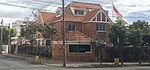
Teatro Royal Center

Theatres in BogotáTourist attractions in Bogotá

The Royal Theatre Center is located in the Chapinero neighborhood in the city of Bogotá. It is a modern theater that can hold music, theater and television events. The maximum capacity of the theatre is 4,500 people, it is the largest theater located in Bogotá. Its facilities include restrooms, special boxes, meeting room, seats, food court, telephones and emergency exits.

Excerpt from the Wikipedia article Teatro Royal Center (License: CC BY-SA 3.0, Authors).

Teatro Royal Center
Carrera 13, Bogota Localidad Chapinero

Geographical coordinates (GPS) Address Website Nearby Places
placeShow on map

Wikipedia: Teatro Royal CenterContinue reading on Wikipedia

Geographical coordinates (GPS)

Latitude Longitude
N 4.6530753888889 ° E -74.062697194444 °
placeShow on map

Address

Royal Center

Carrera 13 a 66-74
110231 Bogota, Localidad Chapinero
Colombia
mapOpen on Google Maps

Website
royalcenter.com.co

linkVisit website

Share experience

Nearby Places

La Salle University, Colombia

The Universidad de La Salle is a private, Catholic and Lasallian institution of higher education run by the Institute of the Brothers of the Christian Schools in Bogotá, D.C., Cundinamarca, Colombia. It was founded by the Christian Brothers in 1964. It has 4 locations: 3 in Bogotá DC- one in the downtown area, in Chapinero, and in the northern section of city. There is also a campus in El Yopal, Casanare in the East of the Country. This campus is the seat where the La Salle has developed the most innovative social and educational projects for young farmers, victims of violence in Colombia. The University is accredited as a High Quality University by the NAC or National Accreditation Council (CNA or Consejo Nacional de Acreditacion in Spanish). It also has an ISO 9001/2008 certification. The University has eight colleges offering 23 academic degree programs, 16 specialization programs and 5 master's degrees. Currently, the University has 13,950 students matriculated in degree programs and 700 students in postgraduate courses. As of 2012, the University has a team of 245 full-time teachers, 91 mid-time teachers and 2 three quarter-time teachers. Of those, 209 have undefined term contracts, 29 are doctors, 194 have master's degrees and 112 are specialists. As of 2012, the University has graduated more than 40,000 students since its foundation in 1964. The University of La Salle is a private institution and its educational vision is based on the Christian vision of the human and his environment.

Colegio Jordán de Sajonia

Colegio Jordán de Sajonia (English: Jordan of Saxony School; Latin: Schola Jordanus de Saxonia), is a private Catholic elementary, secondary and preparatory school located in Bogotá, D.C., Colombia. The bilingual school was founded on February 1, 1954 by Alberto E. Ariza, a Dominican Friar. La historia y actividad educativa del Colegio Jordán de Sajonia se remonta a comienzos del siglo pasado, cuando los frailes dominicos lograron restaurar varias de sus casas, conventos, parroquias e instituciones educativas, tras la clausura realizada por el gobierno de Tomás Cipriano de Mosquera y organizar nuevamente la Provincia de Colombia, junto a la Virgen de Chiquinquirá y al santuario. Allí se funda un centro de estudios denominado “Escuela Apostólica San Vicente Ferrer”, el cual en 1947 fue trasladado a Villa de Leyva, para regresar nuevamente a Chiquinquirá. El seminario fue inaugurado el 2 de febrero de 1954, albergando en su momento a 98 seminaristas, con el carácter de internado y centrado en su formación apostólica, bajo la rectoría de Fr. José de Jesús Sedano, O.P. En el año 1968 empiezan a recibir estudiantes externos, cambiando parte del plan de estudios, dejando asignaturas de la formación de los seminaristas solamente para ellos y dando apertura a la formación académica propia de la educación primaria y media. Han sido casi setenta años de historia, en los cuales los Dominicos han formado niños, niñas y jóvenes desde un proyecto basado en la formación integral y el pensamiento crítico. Setenta años en los cuales el colegio ha tenido transformaciones que van a la vanguardia de los procesos educativos y tecnológicos. Los cambios en términos de la infraestructura inicial han sido bastantes, la mayoría de estos centrados en la necesidad de adecuación y construcción de nuevos espacios para el desarrollo de las actividades académicas y lúdicas de los estudiantes, así como de las zonas comunes como restaurante y cafetería, teniendo en cuenta además que el número de estudiantes aumenta con frecuencia, lo que permite proyectar la construcción de un nuevo edificio para albergar a los niños y niñas de preescolar. ver más