place

Republic of New Granada

1831 establishments in the Republic of New Granada1858 disestablishments in the Republic of New GranadaRepublic of New GranadaStates and territories disestablished in 1858States and territories established in 1831
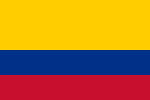
Flag of New Granada
Flag of New Granada

The Republic of New Granada was a centralist unitary republic consisting primarily of present-day Colombia and Panama with smaller portions of today's Costa Rica, Ecuador, Venezuela, Peru, and Brazil. On 9 May 1834, the national flag was adopted and was used until 26 November 1861, with the Gran Colombian colours in Veles' arrangement. The merchant ensign had the eight-pointed star in white. In 1851, a civil war broke out when conservative and pro-slavery groups from Cauca and Antioquia departments, led by Manuel Ibánez, Julio Arboleda, and Eusebio Borrero, revolted against liberal president José Hilario López, in an attempt to prevent emancipation of disenfranchised groups and abolition of slavery, in addition to a number of religious issues.

Excerpt from the Wikipedia article Republic of New Granada (License: CC BY-SA 3.0, Authors, Images).

Republic of New Granada
Bogota Localidad Kennedy

Geographical coordinates (GPS) Address Nearby Places
placeShow on map

Wikipedia: Republic of New GranadaContinue reading on Wikipedia

Geographical coordinates (GPS)

Latitude Longitude
N 4.65 ° E -74.05 °
placeShow on map

Address

Vieja La. Bellavista. Captacion Q Vieja


110831 Bogota, Localidad Kennedy
Colombia
mapOpen on Google Maps

Flag of New Granada
Flag of New Granada
Share experience

Nearby Places

Gran Colombia
Gran Colombia

Gran Colombia (Spanish pronunciation: [ˈɡɾaŋ koˈlombja] (listen), "Great Colombia"), or Greater Colombia, officially the Republic of Colombia (Spanish: República de Colombia), was a state that encompassed much of northern South America and part of southern Central America from 1819 to 1831. It included present-day Colombia, mainland Ecuador (i.e. excluding the Galapagos Islands), Panama, and Venezuela, along with parts of northern Peru and northwestern Brazil. The terms Gran Colombia and Greater Colombia are used historiographically to distinguish it from the current Republic of Colombia, which is also the official name of the former state. At the time of its creation, this Colombia was the most prestigious country in Spanish America. John Quincy Adams, then Secretary of State and future president of the United States, claimed it to be one of the most powerful nations on the planet. This prestige, added to the personal stature of Simón Bolívar, resulted in independence movements in Cuba, the Dominican Republic, and Puerto Rico desiring to form an associated state with the republic.But international recognition of the legitimacy of the Gran Colombian state ran afoul of European opposition to the independence of states in the Americas. Austria, France, and Russia only recognized independence in the Americas if the new states accepted monarchs from European dynasties. In addition, Colombia and the international powers disagreed over the extension of the Colombian territory and its boundaries.Gran Colombia was proclaimed through the Fundamental Law of the Republic of Colombia, issued during the Congress of Angostura (1819), but did not come into being until the Congress of Cúcuta (1821) promulgated the Constitution of Cúcuta. Gran Colombia was constituted as a unitary centralist state. Its existence was marked by a struggle between those who supported a centralized government with a strong presidency and those who supported a decentralized, federal form of government. At the same time, another political division emerged between those who supported the Constitution of Cúcuta and two groups who sought to do away with the Constitution, either in favor of breaking up the country into smaller republics or maintaining the union but creating an even stronger presidency. The faction that favored constitutional rule coalesced around Vice-President Francisco de Paula Santander, while those who supported the creation of a stronger presidency were led by President Simón Bolívar. The two of them had been allies in the war against Spanish rule, but by 1825, their differences had become public and were an important part of the political instability from that year onward. Gran Colombia was dissolved in 1831 due to the political differences that existed between supporters of federalism and centralism, as well as regional tensions among the peoples that made up the republic. It broke into the successor states of Colombia, Ecuador, and Venezuela; Panama was separated from Colombia in 1903. Since Gran Colombia's territory corresponded more or less to the original jurisdiction of the former Viceroyalty of New Granada, it also claimed the Caribbean coast of Nicaragua, the Mosquito Coast, as well as most of Esequiba.

Colegio Nueva Granada

Colegio Nueva Granada is a bilingual international private elementary, middle and high school in Bogotá, Colombia. Colegio Nueva Granada was founded in 1938 by Frederic Dever, Doris de Samper and Irwin C. Byington. Its original name was "The Anglo-American School" and Dr. Gabriel Jinich was its first director. Colegio Nueva Granada teaches a U.S. college-preparatory curriculum. Students study for both the U.S. High School Diploma and the Colombian Bachillerato Diploma. The majority of the classes are taught in English with a varied curriculum including Foreign Languages (Chinese and French), Sports, and Technology. The school's staff includes foreign as well as Colombian teachers. The AP system is offered to students, allowing them to gain college credits. The CNG student body in August 2020 was made up 1,701 students of 47 nationalities (42% Colombian, 18% dual citizenship (U.S-Colombia), 16% U.S citizens, 14% dual citizenship (Other-Colombian) and 10% from other countries. Moreover, the total number of employees was 388 (Faculty: 287, Administrative support: 56 and General Services: 45). All CNG teachers are certified professionals Among social projects in which students participate are the Hogar Nueva Granada, Alianza Educativa and mandatory personal student social service hours. Hogar Nueva Granada and Alianza Educativa are projects formed to help children and families in need with health and education programs to ensure their futures as Colombian citizens.Yearly, students teach English to approximately 40 children, ages 7 to 14, from the surrounding neighborhoods of Juan XXIII and Bosque Calderón in Bogotá.Others participate in the continuing education program for adults, 18 to 40 years old. This is a joint program, with Caja de Compensacion Familiar (CAFAM) with the help of teacher and student volunteers, to prepare adults to validate elementary school and also to get ready for ICFES exams in the higher levels of education.Colegio Nueva Granada is home to the first Confucius Institute established in a K-12 school in Latin America. The institute, founded in October 2009, promotes the study of Chinese language, culture, ethics, and philosophy. Eighteen CNG students have been awarded full scholarships to study in China by the CI since 2009.

Colegio Jordán de Sajonia

Colegio Jordán de Sajonia (English: Jordan of Saxony School; Latin: Schola Jordanus de Saxonia), is a private Catholic elementary, secondary and preparatory school located in Bogotá, D.C., Colombia. The bilingual school was founded on February 1, 1954 by Alberto E. Ariza, a Dominican Friar. La historia y actividad educativa del Colegio Jordán de Sajonia se remonta a comienzos del siglo pasado, cuando los frailes dominicos lograron restaurar varias de sus casas, conventos, parroquias e instituciones educativas, tras la clausura realizada por el gobierno de Tomás Cipriano de Mosquera y organizar nuevamente la Provincia de Colombia, junto a la Virgen de Chiquinquirá y al santuario. Allí se funda un centro de estudios denominado “Escuela Apostólica San Vicente Ferrer”, el cual en 1947 fue trasladado a Villa de Leyva, para regresar nuevamente a Chiquinquirá. El seminario fue inaugurado el 2 de febrero de 1954, albergando en su momento a 98 seminaristas, con el carácter de internado y centrado en su formación apostólica, bajo la rectoría de Fr. José de Jesús Sedano, O.P. En el año 1968 empiezan a recibir estudiantes externos, cambiando parte del plan de estudios, dejando asignaturas de la formación de los seminaristas solamente para ellos y dando apertura a la formación académica propia de la educación primaria y media. Han sido casi setenta años de historia, en los cuales los Dominicos han formado niños, niñas y jóvenes desde un proyecto basado en la formación integral y el pensamiento crítico. Setenta años en los cuales el colegio ha tenido transformaciones que van a la vanguardia de los procesos educativos y tecnológicos. Los cambios en términos de la infraestructura inicial han sido bastantes, la mayoría de estos centrados en la necesidad de adecuación y construcción de nuevos espacios para el desarrollo de las actividades académicas y lúdicas de los estudiantes, así como de las zonas comunes como restaurante y cafetería, teniendo en cuenta además que el número de estudiantes aumenta con frecuencia, lo que permite proyectar la construcción de un nuevo edificio para albergar a los niños y niñas de preescolar. ver más

2003 El Nogal Club bombing

The 2003 El Nogal Club bombing was a terrorist attack that occurred in Bogotá, Colombia. On 7 February 2003, a car containing 200 kg of explosives that was parked in a garage on the third floor of the multi-story El Nogal club, an elite, high-class social and business club, exploded, killing 36 people and wounding more than 200. There were approximately 600 people in the building at the time of the explosion. The attack was the worst in Colombia for more than a decade.No group publicly claimed responsibility for the bombing. The United Nations adopted Security Council Resolution 1465 on 13 February 2003 condemning the attack. Colombian Vice President Francisco Santos Calderón blamed the guerrilla group FARC, saying that there was "not the slightest doubt" that they were responsible and that the government had enough evidence of its involvement. Colombian authorities and investigators, with the aid of ATF members from the U.S., inspected the scene and the remains of the car bomb. Colombian prosecutors linked FARC to the bombing through the participation of, among others, John Freddy Arellan, a squash instructor who died in the bombing. According to the government, Arellan had recently acquired membership in the club and drove the car containing the explosives, a vehicle which had been bought in late 2002 using false documents, into the parking area. The government claimed Arrellan would have been employed by FARC's "Javier Paz", not knowing that the bomb would be detonated with him and his uncle still inside the club.On 10 March 2003, FARC denied any responsibility in the attack and described it as "state terrorism", claiming that the government of Colombia planted the bomb in order to unite the country against them.In March 2008, Colombian authorities released documents said to be found in a computer belonging to the slain FARC commander "Raúl Reyes", including a 13 February 2003 message in which "Reyes" called the attack a "formidable act" and mentioned the "political convenience of denying responsibilities".