place

Geumseong-dong

Geumjeong DistrictNeighbourhoods in Busan
Sanseong, Geumjeong dong, Busan, South Korea

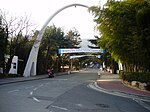
Geumseong is a dong, or precinct, in Geumjeong-gu, Busan, South Korea. A lightly populated district, it is situated entirely within the mountain range of Geumjeongsan. It is bounded to the west by Hwamyeong-dong and Geumgok-dong in Buk District, to the northwest by Dong-myeon of Yangsan City, to the east by Cheongnyong-dong, Namsan-dong, Guseo-dong, and Jangjeon-dong of Geumjeong-gu, and to the south by Oncheon-dong in Dongnae-gu. The northernmost point in Geumseong-dong is at Godang-bong, the highest peak in Geumjeongsan. Geumseong-dong is a rural district connected by public transit to the rest of Busan by bus service only. Despite covering a comparatively large area, Geumseong-dong is not subdivided into additional "administrative dong" due to its low population. There are two points of access to the dong where the main road, Sanseong-ro, connects to Hwamyeong-dong in the west, and Jangjeon-dong in the east. The only major area of settlement within the dong is in the village of Sanseong-myeon (literally "mountain fortress village"). The name Geumseong derives from Geumjeongsanseong, a large mountain fortress built in 1703 that is located largely within the dong.

Excerpt from the Wikipedia article Geumseong-dong (License: CC BY-SA 3.0, Authors, Images).

Geumseong-dong
Jukjeon 2-gil, Busan

Geographical coordinates (GPS) Address Nearby Places
placeShow on map

Wikipedia: Geumseong-dongContinue reading on Wikipedia

Geographical coordinates (GPS)

Latitude Longitude
N 35.253333333333 ° E 129.05638888889 °
placeShow on map

Address

죽전2길

Jukjeon 2-gil
46237 Busan
South Korea
mapOpen on Google Maps

Sanseong, Geumjeong dong, Busan, South Korea
Share experience

Nearby Places

Geumjeongsanseong
Geumjeongsanseong

Geumjeongsanseong (Korean: 금정산성; lit. Geungjeong Mountain Fortress) is the largest mountain fortress in the Republic of Korea today. It is located on Geumjeongsan in the Busan Metropolitan City. Following the Japanese invasion of 1592 and the Manchu invasions of 1627 and of 1637, awareness of the necessity of national defence was heightened, especially against attacks from the sea. As a result of this awareness, this fortress was built in the 29th year (1703) of the reign of King Sukjong. The inner and the outer walls were mainly built of natural stones, but weak portions were reinforced with artificially worked square stone blocks. The walls are about 17 kilometers in length and from 1.5 meters to 3 meters in height. The area surrounded by the fortress is about 8.2 square kilometers. It is clear that fortresses had been already built on this site before 1700. Yi Chi-hong, a naval commander, left a record in 1667 in which he mentions traces of an old fortress on the site. The construction of the fortress began in 1701 at the recommendation of Jo Tae-dong, the Governor of Gyeongsang-do, and was completed in 1702. In 1707 the walls were built around the main structure of the fortress. This fortress fell to disuse because it was too large to maintain. After lying empty for a century, it was repaired in 1807, the seventh year of the reign of King Sunjo. Oh Han-won, the Dongnae Magistrate, took the responsibility for building the west gate in 1807, and the other gates the following year. There is a stele recording the building of the gates. The fortress was destroyed during the Japanese occupation (1910-1945), but began to be restored in 1972. The East, West and South gates were restored by 1974 and the north gate was rebuilt in 1989. Today, thanks to the restoration efforts, much of the walls and the four gates still stand. Of the 4 existing observation towers, the tower number 1 (제1망루) located on the south-west side was destroyed by the typhoon Rusa on the morning of September 1, 2002. The area around the South Gate is a popular resting place. The West Gate, even though it is the most impressive of the four, is the less frequented one due to its lack of accessibility.