place

Patras Lighthouse

Buildings and structures in PatrasEuropean lighthouse stubsLighthouses in GreeceTourist attractions in PatrasTransport in Patras
Leuchtturm Patras 2
Leuchtturm Patras 2

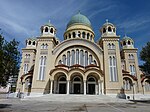
Patras Lighthouse (Greek: Φάρος της Πάτρας) is a lighthouse and landmark of the Greek city of Patras. It is situated on the seafront (at the beginning of Trion Navarchon street), opposite the temple of Saint Andrew.

Excerpt from the Wikipedia article Patras Lighthouse (License: CC BY-SA 3.0, Authors, Images).

Patras Lighthouse
Ακτή Δυμαίων, Municipality of Patras 4th Community of Patras - Central Sector (Municipal Unit of Patras)

Geographical coordinates (GPS) Address External links Nearby Places
placeShow on map

Wikipedia: Patras LighthouseContinue reading on Wikipedia

Geographical coordinates (GPS)

Latitude Longitude
N 38.245078 ° E 21.72559 °
placeShow on map

Address

Φάρος της Πάτρας

Ακτή Δυμαίων
362 22 Municipality of Patras, 4th Community of Patras - Central Sector (Municipal Unit of Patras)
Peloponnese, Western Greece and the Ionian, Greece
mapOpen on Google Maps

linkWikiData (Q1304210)
linkOpenStreetMap (154525274)

Leuchtturm Patras 2
Leuchtturm Patras 2
Share experience

Nearby Places

1991 Patras bombing

On April 19, 1991, a bomb exploded in the centre of Patras, Greece, killing six citizens and the terrorist who was carrying the bomb.The bomb was carried by Ibrahim Hasikeh, a 26 years old Palestinian terrorist, who allegedly belonged to a group linked to Abu Nidal's network. The target of Hasikeh is believed to be the British consulate, at the junction of Votsi and Othonos Amalias streets. But Hasikeh, either because he wanted to do a final check of the explosive device or because there were people in the consulate who might suspect him or due to some mishandling of the bomb, entered the apartment building on Votsi Street, 14, and headed to the elevator. There, probably trying to change the time of the bomb's explosion, which consisted of 11 kilograms of dynamite, the bomb exploded dismembering Hasikeh and killing six people who were in a company courier on the ground floor of the apartment building. Outside the building was waiting Hasikeh accomplice, Asar Al Nobani, 29, who disappeared after the explosion. The six citizens who were killed due to the explosion were: George Papasotiropoulos, 58, Vassilis Kyriakopoulos, 53, Yannis Kavkas, 25, Olga Stagalinou, 25, Dimitris Seitanidis, 23, and Georgia Verra, 24.Police officers who checked the debris after the explosion found pieces of the Hasikeh student ID and one of his shoes and soon managed to identify him. A few days later they arrested Al Nobani and two other Palestinians, Baykarat and Awad Khalil. In the autumn of 1995, Al Nobani and Baykarat Khalil were sentenced to 25 years in prison while Awad Khalil in three years. The court also ordered their immediate deportation after serving their sentences.Every year on April 19, a memorial service is held in Patras for the six dead from the bomb explosion on Votsi Street.

Patras
Patras

Patras (Greek: Πάτρα, romanized: Pátra pronounced [ˈpatra] ; Katharevousa and Ancient Greek: Πάτραι; Latin: Patrae) is Greece's third-largest city and the regional capital of Western Greece, in the northern Peloponnese, 215 km (134 mi) west of Athens. The city is built at the foot of Mount Panachaikon, overlooking the Gulf of Patras. As of the 2021 census, the city of Patras has a population of 173,600; the municipality has 215,922 inhabitants. The core settlement has a history spanning four millennia. In the Roman period, it had become a cosmopolitan center of the eastern Mediterranean whilst, according to the Christian tradition, it was also the place of Saint Andrew's martyrdom. Dubbed as Greece's 'Gate to the West', Patras is a commercial hub, while its busy port is a nodal point for trade and communication with Italy and the rest of Western Europe. The city has three public universities, hosting a large student population and rendering Patras an important scientific centre with a field of excellence in technological education. The Rio-Antirio Bridge connects Patras' easternmost suburb of Rio to the town of Antirrio, connecting the Peloponnese peninsula with mainland Greece. Every year, in February, the city hosts one of Europe's largest carnivals. Notable features of the Patras Carnival include its mammoth satirical floats and balls and parades, enjoyed by hundreds of thousands of visitors in a Mediterranean climate. Patras is also famous for supporting an indigenous cultural scene active mainly in the performing arts and modern urban literature. It was European Capital of Culture in 2006.