place

Roman Catholic Diocese of Pueblo

AC with 0 elementsCatholic Church in ColoradoChristian organizations established in 1941Pueblo, ColoradoRoman Catholic Diocese of Pueblo
Roman Catholic Ecclesiastical Province of DenverRoman Catholic dioceses and prelatures established in the 20th centuryRoman Catholic dioceses in the United States
The French Gothic Revival style, Roman Catholic Cathedral of the Sacred Heart in Pueblo, Colorado LCCN2015632410

The Diocese of Pueblo (Latin: Dioecesis Pueblensis) is a Latin Church ecclesiastical territory or diocese of the Catholic Church in southern Colorado. The diocese was created on November 15, 1941. It encompasses the southern half of Colorado, from the state's borders with Utah to the west, to Kansas in the east. The Cathedral of the Sacred Heart in Pueblo is the seat of the diocese. The Diocese of Pueblo is a suffragan diocese part of the ecclesiastical province of the metropolitan Archdiocese of Denver. In 2009, the diocese had nearly 100,000 registered Catholics, about 16% of the population.

Excerpt from the Wikipedia article Roman Catholic Diocese of Pueblo (License: CC BY-SA 3.0, Authors, Images).

Roman Catholic Diocese of Pueblo
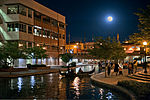
Arkansas River Multi-Use Path, Pueblo

Geographical coordinates (GPS) Address Nearby Places
placeShow on map

Wikipedia: Roman Catholic Diocese of PuebloContinue reading on Wikipedia

Geographical coordinates (GPS)

Latitude Longitude
N 38.266944444444 ° E -104.62027777778 °
placeShow on map

Address

South Pueblo

Arkansas River Multi-Use Path
81003 Pueblo
Colorado, United States
mapOpen on Google Maps

The French Gothic Revival style, Roman Catholic Cathedral of the Sacred Heart in Pueblo, Colorado LCCN2015632410
Share experience

Nearby Places

Pueblo, Colorado
Pueblo, Colorado

Pueblo () is a home rule municipality that is the county seat and the most populous municipality of Pueblo County, Colorado, United States. The city population was 111,876 at the 2020 United States Census, making Pueblo the ninth most populous city in Colorado. Pueblo is the principal city of the Pueblo, CO Metropolitan Statistical Area and a major city of the Front Range Urban Corridor. Pueblo is situated at the confluence of the Arkansas River and Fountain Creek, 112 miles (180 km) south of the Colorado State Capitol in Denver. The area is considered semi-arid desert land, with approximately 12 inches (304.80 mm) of precipitation annually. With its location in the "Banana Belt", Pueblo tends to get less snow than the other major cities in Colorado. Pueblo is one of the largest steel-producing cities in the United States, for which reason Pueblo is referred to as the "Steel City". The Historic Arkansas River Project (HARP) is a riverwalk in the Union Avenue Historic Commercial District, and shows the history of the devastating Pueblo Flood of 1921. Pueblo has the least expensive residential real estate of all major cities in Colorado. The median home price for homes on the market in Pueblo is $192,500 as of April 2018. It is the sixth most affordable place to live in the United States as measured by the 2014 Cost of Living Index. Costs of housing, goods and services, utilities, transportation, groceries and health care are lower than the national average. Pueblo was listed by AARP in 2013 as one of the best affordable places to live.

Pueblo Opera House
Pueblo Opera House

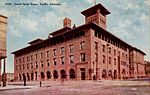
The Pueblo Opera House (also known as the Grand Opera House) was a theater built in Pueblo, Colorado, and opened in 1890. The building was completely destroyed by a fire in 1922. In June 1888 the architectural firm of Adler & Sullivan was contracted to design an opera house in Pueblo, Colorado. They were to be paid $400,000, the largest fee the firm had yet received for a building outside of Chicago.The exterior of the four-story building was designed in a combination Richardsonian Romanesque and Italian Renaissance style, with rusticated Manitou red sandstone on a granite base.The hall seated 1,200 people, and the balcony was the first in the United States to "span an auditorium without intermediate buttressing". The ceiling and walls of the auditorium were covered with Louis Sullivan's distinctive decorations. Mario Elia, in his study of Sullivan and his work, suggests that the broad projecting roof was a detail contributed by Frank Lloyd Wright, who was employed at Sullivan's office at the time.The building was topped by a tower. On the night of February 28 – March 1, 1922, the Pueblo Grocers' Association's annual ball was held there, and it is believed that a cigarette may have ignited litter left behind after the event. The fire was discovered at 1:15 a.m., the roof collapsed at 1:50, and all the interior floors had given way by 2:10. Despite the fire department's efforts to save the building, it was a total loss.