place

South Mills, North Carolina

Census-designated places in Camden County, North CarolinaCensus-designated places in North CarolinaCentral North Carolina geography stubsUnincorporated communities in Camden County, North CarolinaUnincorporated communities in North Carolina
Use mdy dates from July 2023
South Mills NC bridge 2020a

South Mills is an unincorporated community and census-designated place (CDP) in Camden County, North Carolina, United States. Its population was 454 as of the 2010 census. South Mills has a post office with ZIP code 27976, which opened on March 2, 1840. The community is located near U.S. Route 17, and U.S. Route 17 Business and North Carolina Highway 343, and future Interstate 87 (North Carolina) pass through the community. The community derived its name from a watermill which operated near the original town site.The William Riley Abbott House, Dismal Swamp Canal, and Morgan House are listed on the National Register of Historic Places.

Excerpt from the Wikipedia article South Mills, North Carolina (License: CC BY-SA 3.0, Authors, Images).

South Mills, North Carolina

Geographical coordinates (GPS) Address Nearby Places
placeShow on map

Wikipedia: South Mills, North CarolinaContinue reading on Wikipedia

Geographical coordinates (GPS)

Latitude Longitude
N 36.437777777778 ° E -76.330833333333 °
placeShow on map

Address


27976
North Carolina, United States
mapOpen on Google Maps

South Mills NC bridge 2020a
Share experience

Nearby Places

Milford (Camden, North Carolina)

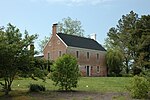
Milford, also known as the Relfe-Grice-Sawyer House, is the oldest two-story brick home located near Camden, Camden County, North Carolina, United States. Its 1746 construction date is carved on a brick on the interior face of the north chimney & was confirmed by dendrochronology test in the 1990s. The formal two-story brick gabled structure, two bays deep and three bays wide, has interior end chimneys terminating in molded caps.The brickwork is of Flemish bond with glazed headers, featuring three-course stringers of Flemish bond between the first and second stories and at the base of the gables. The use of one-to-three common bond in the brick of the south gable represents the earliest known example of this type of bonding in North Carolina. The north gable probably corresponds, but the entire north side is now concealed by stucco. Tumbling of the brick occurs along the rakes of the south gable. Tumbled bricks are usually placed at right angles to the gable slope, and the vertical placement of these bricks is, according to Thomas Waterman in The Early Architecture of North Carolina, found in only one other structure, the Wallop house in Accomack County, Virginia.The west facade formerly functioned as the principal front, but the main entrance is located now in the central bay of the east facade. The doorway as well as the windows of the first story are ornamented only by flat arches serving as lintels. The windows of the second story, set quite close to the cornice, are completely plain. The lintels are formed of rowlocks which originally surmounted the south gable windows are still visible, although the windows are now much smaller.The great plaster cove cornices, believed by Waterman to be unique in colonial architecture south of Maryland, further enhance the monumentality of the house.It was listed on the National Register of Historic Places in 1972.