place

Sofia Ring Mall

Shopping malls in Sofia

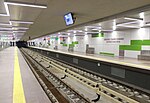
Sofia Ring Mall is a shopping mall in Sofia, Bulgaria. It opened doors on 6 November 2014. Sofia Ring Mall is a shopping center of new generation, which has two hundred stores representing over 400 brands of which 100 completely new to the Bulgarian market. The shopping center has the largest indoor amusement center; the largest indoor karting track for the country with an area of 7,500 m2 (81,000 sq ft); the largest department store, extending to 6,500 m2 (70,000 sq ft); free parking lot with a total of 3,500 parking spaces and VIP parking lot with 100 places.Sofia Ring Development will have a total cost of more than 300 million euro. The investment comes from the Greek companies Fourlis Group, which manages IKEA's franchising in Bulgaria, and Danaos Group, specialized in the shipping industry. It will be the largest mixed-use project in Bulgaria, spreading over an area of 400,000 m2 (4,300,000 sq ft), with 100,000 m2 (1,100,000 sq ft) belonging to the mall and its adjacent IKEA store, all near the southern arc of the Sofia ring road. In the near future it is expected that the Sofia Metro will have a nearby Metro station.

Excerpt from the Wikipedia article Sofia Ring Mall (License: CC BY-SA 3.0, Authors).

Sofia Ring Mall
Ring Road, Sofia kv. Simeonovo

Geographical coordinates (GPS) Address External links Nearby Places
placeShow on map

Wikipedia: Sofia Ring MallContinue reading on Wikipedia

Geographical coordinates (GPS)

Latitude Longitude
N 42.6246 ° E 23.3519 °
placeShow on map

Address

София Ринг Мол

Ring Road 214
1434 Sofia, kv. Simeonovo
Bulgaria
mapOpen on Google Maps

linkWikiData (Q12294461)
linkOpenStreetMap (170658898)

Share experience

Nearby Places

Studentski grad, Sofia

Studentski grad (Bulgarian: Студентски град [stoˈdɛntski ˈɡrat], 'Students' town/city') is the student campus area for most universities in Sofia, the capital of Bulgaria, and also one of the 24 districts of Sofia. It was created in the 1980s and now has over 40,000 residents. The real number of people living temporarily there can hardly be estimated. It is one of the most diversified areas in Sofia, with old dwellings from the communist era which are inhabited by the students of different Sofia universities, and new nightclubs, trade, business and residential centres. The construction boom has already taken its toll as overdevelopment appears ubiquitous. Parking lots and green areas remain inadequate. The year 2011 marked the set-up of the largest skatepark on the Balkans situated within the park area in front of the University of National and World Economy. Two multifunctional halls, Hristo Botev and the Winter Palace of Sports, host a number of events on regular basis. Because of the usually cheap rent (less than €20 per month), it is very attractive for living. Recent renovations have brought about improvements in many dormitories, including those hosting foreign students. They are mostly from the Bulgarian diaspora in Macedonia, Moldova, Ukraine, Serbia, and since 2004, non-Bulgarians from Turkey. The area is famous for its busy nightlife. A variety of taverns and disco clubs make the campus one of the central night entertainment locations of Sofia. Studentski grad hosts a district police department that strives to tackle the fast-growing alcohol-driven offenses, thefts, vandalism, football fans clashing, etc. The brutal murder of the student Stojan Baltov by drunken youths outside a disco club sparked debates on social environment and security issues, including the development of an integral video surveillance system. Places for eating out vary from high-end restaurants to cheap pizzerias. Particularly popular is the so-called Mandzha street where a number of banitsa pastry, burger, Döner kebab and pancake shops are lined up. Unlike most campus areas in Western Europe and Northern America, Studentski grad is a common living place for most of the students of Sofia's numerous universities rather than being in the vicinity of one particular university. This helps students from different higher education institutions meet and interact, but on the other hand causes major transportation issues as the bulk of Sofia's university faculties are situated relatively far from the city center and public transport is often unable to cope with Studentski grad's needs. The traffic is frequently congested especially during rush hours in the mornings and late afternoons. Regular buses run on average every ten minutes. Fixed-route minibus taxis called marshrutka alleviate the situation. Sofia municipality plans to connect Studentski grad with its metro system. The neighbourhood is affectionately known as "Stuttgart". The abbreviation from Stud. (Studentski, "student") and grad ("city") resembles the name of the German city of Stuttgart.

University of Forestry, Sofia

The University of Forestry, (Bulgarian: Лесотехнически университет (ЛТУ), often abbreviated as LTU), based in Sofia, is a state university with 6 faculties with a total of 30 departments. It is located in Sofia, the capital of Bulgaria and is close to the Technical University and the University of Chemical Technology and Metallurgy. The University of Forestry has two Research Forests: the first one located near the village of Yundola in coniferous forest, and the other in the village of Barzia in deciduous forest. It also has a Training and Experimental Field Station in Vrazhdebna suburb of Sofia. For more than 90 years now, the University of Forestry has been the only university in Bulgaria providing education in forestry, forest management, landscape architecture and wood processing. In the 1990s, the range of scientific fields was expanded to include ecology, agronomy, veterinary medicine and business management. In mid 1990s, the University adopted the three-level degree system of bachelor, master and doctor degrees. At that time, it also introduced the European Credit Transfer System. The motto of the University is Bulgarian traditions and European standards in education. As an educational institution the University of Forestry strives to establish an academic environment in which values such as professionalism, freedom of speech and thought, humanism, collaboration and tolerance are encouraged.