place

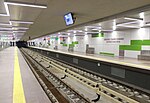
Akademik Aleksandar Teodorov - Balan Metro Station

2015 establishments in BulgariaBulgaria stubsEurope transport stubsEuropean rapid transit stubsRailway stations opened in 2015
Sofia Metro stations
Al. Teodorov Balan Metrostation

Akademik Aleksandar Teodorov - Balan Metro Station (Bulgarian: Метростанция "Академик Александър Теодоров - Балан") is a station on the Sofia Metro in Bulgaria. It started operation on 8 May 2015.

Excerpt from the Wikipedia article Akademik Aleksandar Teodorov - Balan Metro Station (License: CC BY-SA 3.0, Authors, Images).

Akademik Aleksandar Teodorov - Balan Metro Station
bul. Aleksandar Malinov, Sofia ж.к. Младост 2 (Mladost)

Geographical coordinates (GPS) Address External links Nearby Places
placeShow on map

Wikipedia: Akademik Aleksandar Teodorov - Balan Metro StationContinue reading on Wikipedia

Geographical coordinates (GPS)

Latitude Longitude
N 42.640277777778 ° E 23.372777777778 °
placeShow on map

Address

Академик Александър Теодоров - Балан

bul. Aleksandar Malinov
1799 Sofia, ж.к. Младост 2 (Mladost)
Bulgaria
mapOpen on Google Maps

linkWikiData (Q19702051)
linkOpenStreetMap (1309441909)

Al. Teodorov Balan Metrostation
Share experience

Nearby Places

Institute of Astronomy of the Bulgarian Academy of Sciences

The Institute of Astronomy of the Bulgarian Academy of Sciences is a leading Bulgarian research facility in the field of astronomy and astrophysics, located in Sofia, Bulgaria. The institute co-operates closely with the other two institutions involved in the same field of research in the country - the Department of Astronomy at the Faculty of Physics of Sofia University and the Astronomical centre at the Faculty of Natural Sciences of Shumen University. It owns and operates the Bulgarian National Rozhen Observatory located at an altitude of 1750 m in the Rhodopi mountains in south Bulgaria, as well as the Belogradchik Observatory situated at 650 m at the foot of the Western Balkan Mountains in north-west Bulgaria. The institute was inaugurated in 1958 as an independent section of the larger Institute of Physics of the Bulgarian Academy of Sciences by the academician Nikola Bonev. In 1995, it became a separate institute. The current director of the institute is Professor Dr. Evgeni Semkov. The deputy-director is Associate Professor Dr. Boyko Mihov. Following a reorganisation in the structure of its departments in 2010, researchers at the institute were divided into three departments: "Sun and Solar System" (head: Dr. K. Kozarev), "Stars and stellar systems" (head: Dr. I. Stateva), "Galaxies" (head: Dr. B. Mihov). They replaced the previous division into seven sectors: "Sun", "Solar system", "Non-stationary stars", "Stellar atmospheres and envelopes", "Chemically peculiar stars", "Stellar clusters" and "Galaxies".

University of Forestry, Sofia

The University of Forestry, (Bulgarian: Лесотехнически университет (ЛТУ), often abbreviated as LTU), based in Sofia, is a state university with 6 faculties with a total of 30 departments. It is located in Sofia, the capital of Bulgaria and is close to the Technical University and the University of Chemical Technology and Metallurgy. The University of Forestry has two Research Forests: the first one located near the village of Yundola in coniferous forest, and the other in the village of Barzia in deciduous forest. It also has a Training and Experimental Field Station in Vrazhdebna suburb of Sofia. For more than 90 years now, the University of Forestry has been the only university in Bulgaria providing education in forestry, forest management, landscape architecture and wood processing. In the 1990s, the range of scientific fields was expanded to include ecology, agronomy, veterinary medicine and business management. In mid 1990s, the University adopted the three-level degree system of bachelor, master and doctor degrees. At that time, it also introduced the European Credit Transfer System. The motto of the University is Bulgarian traditions and European standards in education. As an educational institution the University of Forestry strives to establish an academic environment in which values such as professionalism, freedom of speech and thought, humanism, collaboration and tolerance are encouraged.