place

Dibe, Trinidad and Tobago

Villages in Trinidad and Tobago
TnT PoS Dibe 1
TnT PoS Dibe 1

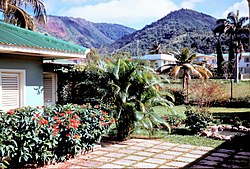
Dibe is a village in north Trinidad located northwest of downtown Port of Spain, Trinidad and Tobago. The village is home to the poor and the rich, who respectively live on the surrounding hills and meadows, which has been described as living between a rock and a hard place. Upper Dibe, better known as “Cripple Creek” or ‘’’the Creek”’, has had a dark history with incessant gang warfare for over three decades.The Dibe area is culturally and racially diverse with a population mix of African Trinidadian (73%), Indian Trinidadian (10%), Mixed (14%), and Chinese/Caucasian/Syrian (2%). The age group of the youth population 7 - 24 represents 35% of the local population. Dibe has a high number of women who have never been married 36% as compared to married couples 23%, or to Common-Law relationships which make up approximately 15%. Most of the households in Dibe are low income households, but there is an upscale housing project, “the Meadows”, with about fifty high income households.In spite of its continued high risk reputation, the Dibe Community has produced some notable personalities including: Frank Porter, the holder of a 2004 National Award of the Public Service Medal of Merit Gold, an author of several books including the Trinidad and Tobago Republic Readers, and a National Director of Youth For Christ Trinidad and Tobago; Joan Porter, a three times National 100 metres Women's Champion and former Trinidad and Tobago Olympic athlete; Dwight Yearwood, the well known differently-abled marathon runner, a member of the Dibe Church of the Nazarene, which is one of two influential community churches that have been working to improve the reputation of Dibe, the other being the People’s United fellowship; Ester Hope-Washington who currently resides in the USA, a three times National 100 metres Women's Champion and former Trinidad and Tobago Olympic athlete; Michael Fraser, a Disabled Peoples International Deputy Chairperson for Human Rights and President of DPI Trinidad and Tobago.

Excerpt from the Wikipedia article Dibe, Trinidad and Tobago (License: CC BY-SA 3.0, Authors, Images).

Dibe, Trinidad and Tobago
Dundonald Hill,

Geographical coordinates (GPS) Address Nearby Places
placeShow on map

Wikipedia: Dibe, Trinidad and TobagoContinue reading on Wikipedia

Geographical coordinates (GPS)

Latitude Longitude
N 10.683333333333 ° E -61.533333333333 °
placeShow on map

Address

Dundonald Hill 128
190130 , Saint James (Saint James)
Diego Martin, Trinidad and Tobago
mapOpen on Google Maps

TnT PoS Dibe 1
TnT PoS Dibe 1
Share experience

Nearby Places

Emperor Valley Zoo
Emperor Valley Zoo

The Emperor Valley Zoo is the only zoo in Trinidad and Tobago. The 7.2-acre (2.91 ha) facility is located north of Queen's Park Savannah and west of the Royal Botanic Gardens, in Port of Spain. The zoo first opened on 8 November 1952, operated then by Governor Sir Hubert Rance. At that time, there were 10 mediocre cages containing 127 animals, mainly indigenous species. The zoo now has a collection of over 2,300 animals from over 200 species. The zoo was named after the large blue emperor (or morpho) butterfly, which once frequented the valley where the zoo is located in larger numbers. The zoo’s collection features both local and foreign animals, such as African giraffes and lions (in addition to several other large cats), Asian tigers, native caiman, ocelots, macaws (among other parrots) and waterfowl, as well as the national bird, the scarlet ibis. Different exhibits include small mammals, a reptile house, aquarium, a deer park, primates and gardens and ponds.The zoo has undergone major upgrades over the past few years, both for upkeep to its existing infrastructure (to bring it up to international standards) as well as in-preparation for additions to and growth of its animal stock. These upgrades have been undertaken by the Zoological Society of Trinidad and Tobago (ZSTT) with financial assistance from the government of Trinidad and Tobago, to the value of TTD $56 Million. During the upgrade periods, the zoo oversaw the construction of a refurbished giraffe enclosure, which was unveiled in December 2013, featuring two giraffes. The addition of a tiger exhibit received three tigers in 2014 - two white Bengals and a ginger Bengal. The white Bengal tigers have successfully bred, producing two healthy cubs in January 2015. On 12 October 2016, the zoo announced that they had received six llamas from a nature park in Texas, USA. Zoo officials stated that, of the six llamas, four are female.

Queen's Park Oval
Queen's Park Oval

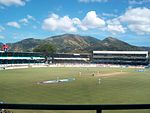
The Queen's Park Oval is a sports stadium in Port of Spain, Trinidad and Tobago, used mostly for cricket matches. It opened in 1896. Privately owned by the Queen's Park Cricket Club, it is currently the second largest capacity cricket ground in the West Indies with seating for about 20,000 spectators.It has hosted more Test matches than any other ground in the Caribbean with 60 as of January 2018, and also hosted a number of One-Day International (ODI) matches, including many World Series Cricket games in 1979 and matches of the 2007 Cricket World Cup. The Trinidad and Tobago cricket team play most of their home matches at the ground, and it is the home ground of the Caribbean Premier League team Trinbago Knight Riders. Considered by many players, journalists and critics as one of the most picturesque cricket venues, the ground first hosted a Test match in February 1930 when England toured the Caribbean, though it had previously hosted many first class tours as early as the 1897 tour under Lord Hawke. The pavilion dates back to 1896, though there were extensive renovations in the 1950s and in 2007 prior to the World Cup and following an earthquake. The "Concrete Stand" was renamed the "Learie Constantine Stand" in recognition of that former West Indies cricketer. The first ODI match at the ground was played in March 1983, and the first Twenty20 International in 2009.As well as the main cricket stadium, the facility includes a gym, indoor and outdoor cricket practice nets, two squash courts and two outdoor tennis courts. The cricket field has also been used to host several domestic and international football matches, and several music events.

Magnificent Seven (Port of Spain)

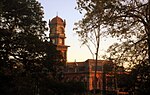
The Magnificent Seven is a group of seven mansions located west of the Queen's Park Savannah in northern Port of Spain, Trinidad and Tobago on Maraval Road in the St Clair neighborhood. They were built between 1902 and 1910 on land that was previously used as a government stock farm and are listed as heritage sites at the National Trust of Trinidad and Tobago. Stollmeyer's Castle was the first building in the neighborhood and took several years to complete, as was typical of the Magnificent Seven. The structures were designed in an array of architectural styles including French Colonial, Scottish baronial, Indian Empire, and Moorish Mediterranean styles—often blended with Caribbean architecture. Many have unusual elements, like the chiming clock and lighted clock tower of Queen's Royal College. Stollmeyer's Castle is said to be modeled after a wing of Balmoral Castle. Hayes Court, a French Colonial style building, has contemporary Scottish cast iron elements and traditional Demerara windows. White Hall is made of natural white limestone of Barbados. Some of the structures were made of imported materials, like Italian marble and Scottish cast iron elements. Most were originally built as residences and kept within families for decades. Archbishop's House was built as, and remains, the official residence of the Archbishop of Port of Spain. The Anglican Bishop to Trinidad resided in Hayes Court. Queen's Royal College was built as a secondary school for boys. White Hall was used as the Office of the Prime Minister from 1963 to 2009. White Hall and Stollmeyer's Castle fall under the purview of the Office of the Prime Minister. The two buildings had restoration work so that they could be used by foreign dignitaries visiting Port of Spain. Both buildings were commandeered by the United States Armed Forces during World War II. Most of the Magnificent Seven Houses retain the aesthetics of the original designs. Of the buildings, Milles Fleur is the one most in disrepair due to extended periods where it was not occupied or maintained.