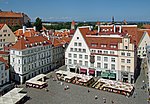
The Tallinn Town Hall (Estonian: Tallinna raekoda) is a building in the Vanalinn ("Old town") of Tallinn (Reval), Estonia, next to the Town Hall Square. The building is located in the south side of the medieval market square and is 36.8 metres (121 ft) long. The west wall is 14.5 metres (48 ft) in length, and the east is 15.2 metres (50 ft). It is a two-storey building with a spacious basement. It is the oldest town hall in the whole Baltic Sea region and Scandinavia.
The weather vane "Old Thomas" (Estonian: Vana Toomas) on the top of the town hall's spire, that has been there since 1530, is one of the symbols of Tallinn. The height of the tower is 64 metres. Tallinn Town Hall is located on the Town Hall Square, where the streets Kullassepa street, Dunkri street and Vanaturu kael lead. One of the shortest streets of Tallinn is Raekoja tänav, which is located behind the Town Hall.
The town hall was built by what was then the market square. The town hall square got its current length in the 1370s. Covered with a board roof in 1374, the town hall was probably a single-decked stone building with a basement. The attic was used as a storeroom. The façade of this long and narrow building is now a rear wall of the arcade, where some of the simple statuary framed windows from this time are still visible.A town hall with a huge meeting room was firstly mentioned in a real estate book in 1322 as a consistorium, which had a giant warehouse (cellarium civitatis) for the time. Some walls in the eastern part of the modern town hall and seven windows in the basement and on the ground floor have remained from that time. In 1364, it was called a playhouse (teatrum) and in 1372 a town hall (Rathus).The town council controlled the town's political, economic and even partially parlour action. The town hall was often a courthouse and a place to introduce goods; sometimes it was even used as a room for theatre, as is evident from the word teatrum. Therefore, it was very important to be placed in the heart of the town and to look representative.Although the city administration worked in the town hall until 1970, it still holds the role of a representational building of the city administration and welcomes visitors as a concert venue and a museum where visitors can learn about the centuries-long historical and architectural value of the Tallinn Town Hall. In conjunction with the Tallinn Old Town, the town hall has been on the UNESCO world Heritage Sites list since 1997. In 2004, the Tallinn Town Hall celebrated its 600th birthday.In 2005, the Tallinn Town Hall received a high recognition – second prize in the category of conservation of Architectural Heritage for the revival of the last surviving Gothic Town Hall in Northern Europe and the exemplary revealing of all the historical layers of this icon of the great European tradition of municipal power. The prize was presented to Elvira Liiver Holmström, the director of Tallinn Town Hall by Queen Sofía of Spain at the European Heritage Awards Ceremony which was held on 27 June 2006 at the Palacio Real de El Pardo, Madrid. Europa Nostra medal was presented to Tallinn Town Hall at the ceremony on 15 September 2006 by Siim Kallas, Vice President of the European Commission, and Thomas Willoch, Europa Nostra board member.In the 1870s, when the Town Hall was going through a renovation, the workers found behind a cabin, 14 woodboxes of old documents. They had not been opened for several centuries. The oldest document was from 1248. The 300 documents span from period 1200-1700 centuries and are written in Latin, two kind of German languages and Swedish. The documents is about Tallins, then called Reval, history as well in general the history of the East-Sea Provinces. The documents was sorted by a appointed Commission by Filologs Christian Eduard Pabst, Rutzwurm and Gotthard von Hansen in six chategories: the Danish Kings Privilegies for Reval, letters to a council Selhorst in Reval, historic documents about the Swedish Town Visby.
Architecture
The town hall was initially a building where urban citizens held meetings. It was later used as a government building, a court and a place to introduce new goods. The building process of representational town halls started in the 12th century. Usually they were built in the centre of the town, near the market square. The Lübeck Town Hall (13th–14th century), the Venetian Doge's Palace (started in the first half of the 14th century), the Town Hall of Narva, Estonia (built at the end of the 17th century, restored in 1963) and of course the Tallinn Town Hall are the most famous.
The town hall is built out of grey limestone and the roof out of clay roof tiles. The town hall is much older than it looks and its current appearance shows. The old walls hiding behind later constructions tell a story about the multi-stage construction of the town hall. According to newest studies, the multi-stage expansion of the town hall took place in five different periods from the west to the east. Therefore, the layout of the town hall is crooked and curved and up to half a metre narrow, which makes it look like a trapezium. In the first quarter of the 14th century the existing building was extended and the basement rooms were expanded. A sort of diele-dornse (vestibule and a rear) spatial system of distribution emerged. According to the results of field studies, it can be said that the oldest town hall building covered the current town hall's western part and the south wall of the current arcade faced the market square.In 1346, the king of Denmark ceded the power in Estonia to the Teutonic Order. As a Hanseatic city, Tallinn gained the right to control the eastern trade having the so-called right as a stockpile area. The fast growth of trading and prosperity determined the need for new rooms and a presentable appearance for the town hall.The oldest, eastern part of the building was extended from 1371 to 1374 towards the west. This building with the current length did not differ much from a big citizen's house. The building got its exterior in 1402–04, with the rebuilding led by stonemason Ghercke, which has been preserved in the key features to the present day. The building was built with two storeys.A salient octahedral tower, which is mostly built into the building and leans on the wall, rises from the building's eastern gable. It was built in 1627–28 by G. Graff. It has a three-piece baroque spire with open galleries. The tower is 64 metres high. The spire was built in, 1627 but obtained its final shape in 1781 and was also reconstructed in this shape in 1952 after destruction in the World War II (architect A. Kukkur). The spire is in Late Renaissance style.Decorative details are a crenelated battlement that acts as a stronghold, the "Old Thomas" (Vana Toomas) on top of the tower (the copy of the original from 1530 is in the Tallinn City Museum (Linnamuuseum)), vane with three eggs, that are held by the simple rock lion and gargoyles decorated with the heads of dragons on the western gable. The Old Thomas is wearing the clothing of a 16th-century city guard. He can be named the symbol of Tallinn and there are even poems dedicated to him. The Old Thomas is holding a flag that has 1996 written on it.
An open arcade gear is on the building's square's long side, which is almost on the whole façade's ground floor scope (archway). Cellar entrances and windows unfold here. The initial portal was placed on the façade's western side. The current main entrance was built later, supposedly in the 18th century. The door next to the former portal is subsequent. Low annexes on the western side of the building were established at the end of the 18th century. The main façade's windows were also repeatedly changed; in the 18th century they were quadrangular. The rooms on the western side of the cellar are covered with edgeline vaults that are carried by the strong quadrangular pillars. Part of the cellar's partitions were probably built later. A strong wall separates the western side of the cellar from the noticeably lower building in the east.
An open arcade gear is on the square side of the building. The current main entrance with a stairway was built in the 18th century. Low annexes on the western side of the building were built at the end of the same century. During the Middle Ages, a trade hall and a torture chamber and wine cellar were located on the first floor. In the Middle Ages, there was a court on the second floor and in addition a coffer, a room for keeping accounts, representative hall for citizens, town hall parlour (raesaal) and town hall kitchen (raeköök).The massive façade supporting on the open sharp arcade gear is split into groups by narrow quadrangular windows, which are a bit bigger than those of regular houses.
These groups of windows mark the three most important offices and representational spaces of the main floor, starting from the tower: the town hall writer's room (kämmerei); the single-nave town hall room, which was the hall meetings room for the town hall lords; and a two-nave citizens' hall. From the tin squared windows, town hall lords could see several houses under the town hall: weighing house, pharmacy, coin mint and a jail. At the end of the façade is a parapet reminding of the upper part of a fortress wall with decorative loop-holes. The shape of the tower following directly the example of the Church of the Holy Ghost and a rear parapet on the façade's cornice line refer to the indirect contacts with the sub-Rhineland building art.The main façade is decorated by a defensive parapet and dragon head-shaped gargoyles. It is pervaded by an arcade, which consists of nine arcs and is the length of almost the whole building. In addition, the façade is supported by eight pillars. It was comfortable for merchants to shelter under the arcade in case of rain. One of the pillars of the arcade-gear of the town hall was used as a pillory. Criminals were chained to it to display them to the townspeople, so that they could dishonor and mock them. It had a neck rail and manacles. The arcade ends with the town hall's main entrance in the right side. The main door differs from other smaller doors and hatches with beautiful statuary jambs and three stairs that lead to the door. Because of them it is visible that that is the main entrance.The fiber of the first floor's western side is similar to the cellar under it – its edgeline vault is carried by four low tetrahedral pillars. In the Middle Ages there was supposedly a so-called trade hall here where new goods were introduced and bargains were made. The room on the eastern side from the trade hall, whose vaults lean on identical tetrahedral pillars, was a torture chamber in the Middle Ages. The room was connected by the staircases built in the northern wall, with the parlour of the Town Hall on the second floor where a court was located. From the two eastern rooms, the one in the south was a coffer, from which there was access to the second floor in the accounting room (kämmerei) by the staircases located in the city wall. As a treasury, the room located in the north is also covered with a barrel vault. This room's city wall held an oven (kalorifeer) before, to heat the parlour with warm air.The most interesting rooms of the main storey are a festive citizen's hall with six vaults and the town hall parlour in the east. The so-called citizens' hall on the second floor in the west, which is 16.2 metres long and 12 metres wide, is a 7.5 metre-high room with two vaults. The room is supported by two octahedral pillars typical to the 16th-century architecture. The room is covered by a low octahedral groin vault, which is allocated by a three-piece belt arc (vööndkaar). In the southeast corner of the town hall is a shaft, which pervades all of the floors, used to be a lavatory (profatt)

 Continue reading on Wikipedia