place

University of Art

1980 establishments in IranTehran University of ArtUniversities and colleges established in 1980
Tehran University of Art LOGO

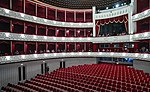
University of Art (Persian: دانشگاه هنر, Daneshgah-e Honar), also known as Tehran University of Art, formally Art Academic Complex (1979-1991), is the largest art university in Iran, consisting of seven faculties and an international campus in Tehran and its suburb Karaj. It is composed of five former separate academic institutions: the Conservatory of Music (founded 1918), the College of National Music (founded 1949), the College of Decorative Arts (founded 1960), the College of Dramatic Arts (founded 1964), and Farabi University (founded 1975).

Excerpt from the Wikipedia article University of Art (License: CC BY-SA 3.0, Authors, Images).

University of Art
Balavar, Tehran District 6

Geographical coordinates (GPS) Address Website Nearby Places
placeShow on map

Wikipedia: University of ArtContinue reading on Wikipedia

Geographical coordinates (GPS)

Latitude Longitude
N 35.703333333333 ° E 51.406388888889 °
placeShow on map

Address

دانشگاه هنر - دانشکده هنرهای کاربردی

Balavar
15916-33548 Tehran, District 6
Iran
mapOpen on Google Maps

Website
art.ac.ir

linkVisit website

Tehran University of Art LOGO
Share experience

Nearby Places

Amirkabir University of Technology

Amirkabir University of Technology (AUT) (Persian: دانشگاه صنعتی امیرکبیر), also called the Tehran Polytechnic, is a public technological university located in Tehran, Iran. Founded in 1958, AUT is the oldest technical university established in Iran.It is referred to as the 'Mother of Engineering Universities'. Acceptance to the university is competitive, entrance to undergraduate and graduate programs requiring scoring among the top 1% of students in the Iranian University Entrance Exam, known as 'Konkour'. The university was founded in 1928 as a technical academy, and was further transformed into a full-fledged university by Habib Nafisi in 1956, after that it was extended and enlarged by Dr. Mohammad Ali Mojtahedi, during the Pahlavi dynasty. Named the Tehran Polytechnic, it initially offered five engineering degrees, namely; Electrical and Electronics, Mechanical, Textile, Chemistry and Construction and Infrastructure. Six months before the victory of 1979 Iranian Revolution, Tehran Polytechnic was renamed after the Iranian prime minister Amir Kabir (1807–1852). The university now has 18 science and engineering departments, dozens of research groups and laboratories and three other affiliated centers, located in Garmsar, Bandar Abbas and Mahshahr. Around 13,400 students are enrolled in the undergraduate and graduate programs. AUT has more than 500 full-time academic faculty members and 550 administrative employees, giving it the highest staff-to-student ratio among the country's universities. The executive branch consists of four departments which receive participation from councils in planning and administering affairs. AUT has signed agreements with international universities for research and educational collaboration. There is a joint program between AUT and the University of Birmingham.AUT is one of the leading universities in E-Learning systems in Iran which began its activities in 2004. AUT is the pioneer of sustainable development in Iran and established the Office of Sustainability in 2011. The activities of this office contribute to the AUT campus by reducing energy consumption, costs, and emissions, and also provide student coursework, volunteer opportunities for students, as well as research and education academic activities on sustainable development.

Ministry of Petroleum (Iran)

The Ministry of Petroleum (MOP) (Persian: وزارت نفت, romanized: Vezârat-e Naft) manages the oil industry, the producer of oil and petrochemical products. MoP is in charge of all issues pertaining to exploration, extraction, exploitation, distribution and exportation of crude oil and oil products. In addition, according to the "Imports and Exports Regulation Act", issuing import licenses for such products is also among the functions of the Ministry of Petroleum. The ministry has been placed under sanctions by the United States Department of State as of 2020.According to BP, Iran's has 137.6 billion barrels (2.188×10¹⁰ m3) of proven oil reserves and 29.61 trillion cubic meters of proven gas reserves. Iran ranks third in the world in oil reserves and second in gas reserves. It is responsible for applying the principle of Iranian ownership and sovereignty over oil and gas reserves. Also, it is undertake the separation of sovereignty tasks from management and development of country's oil and gas industry. The Ministry of petroleum was established after revolution in Iran and in the interim government of Bazargan, after departure of Hasan Nazia, the managing director of National Iranian Oil Company from the country in 1979. The organizational structure of this ministry consists of a central headquarters and four subsidiaries, including National Iranian Oil Company, National Iranian Gas Company, National Iranian Petrochemical Company and National Iranian Oil Refining and Distribution Company. It monitors the operations of exploration, extraction, marketing and sale of crude oil, natural gas and oil products in the country through its subsidiaries. In addition to meeting its major energy needs, the ministry supplies over 80% of foreign currency earnings by exporting crude oil and refined petroleum products. According to the Fourth Economic, Social and Cultural Development Plan, the Government has been required to transfer at least 10% of the activities related to the exploration, extraction and production of crude oil to the private sector, while in the meantime retaining its ownership of oil resources. This is also the case in other fields of the Ministry of Petroleum's activities.Iran plans to invest $500 billion in the oil sector until 2025. As of 2010, US$70 billion worth of oil and gas projects were under construction. Iran's annual oil and gas revenues were expected to reach $250 billion by 2015.