place

City Theater of Tehran

Buildings and structures in TehranCulture in TehranTheatre in IranTheatres completed in 1972Tourist attractions in Tehran
City Theater of Tehran

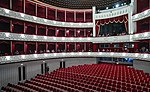
The City Theater (Persian: تئاتر شهر, Teātr-e Šahr) is a performing arts complex in Tehran, the capital of Iran. This complex is considered as the main outlet of Iran artistic theater. It was built with the initiative of Shahbanu Farah Pahlavi under the rule of Mohammad Reza Pahlavi, the last Shah of Iran. It contains several performance spaces including the halls of Cheharsou, Qashqai, Sayeh, the performance studio, and the main hall. The complex was designed by architect Ali Sardar Afkhami in the 1960s, and opened in 1972. After the 1979 Revolution, the Ministry of Culture and Islamic Guidance has overseen its operation. City Theater of Tehran is closed on Saturdays.

Excerpt from the Wikipedia article City Theater of Tehran (License: CC BY-SA 3.0, Authors, Images).

City Theater of Tehran
Valiasr Street, Tehran District 11

Geographical coordinates (GPS) Address External links Nearby Places
placeShow on map

Wikipedia: City Theater of TehranContinue reading on Wikipedia

Geographical coordinates (GPS)

Latitude Longitude
N 35.700077777778 ° E 51.405619444444 °
placeShow on map

Address

تئاتر شهر

Valiasr Street
15916-33548 Tehran, District 11
Iran
mapOpen on Google Maps

linkWikiData (Q2276437)
linkOpenStreetMap (118574379)

City Theater of Tehran
Share experience

Nearby Places

Amirkabir University of Technology

Amirkabir University of Technology (AUT) (Persian: دانشگاه صنعتی امیرکبیر), also called the Tehran Polytechnic, is a public technological university located in Tehran, Iran. Founded in 1958, AUT is the oldest technical university established in Iran.It is referred to as the 'Mother of Engineering Universities'. Acceptance to the university is competitive, entrance to undergraduate and graduate programs requiring scoring among the top 1% of students in the Iranian University Entrance Exam, known as 'Konkour'. The university was founded in 1928 as a technical academy, and was further transformed into a full-fledged university by Habib Nafisi in 1956, after that it was extended and enlarged by Dr. Mohammad Ali Mojtahedi, during the Pahlavi dynasty. Named the Tehran Polytechnic, it initially offered five engineering degrees, namely; Electrical and Electronics, Mechanical, Textile, Chemistry and Construction and Infrastructure. Six months before the victory of 1979 Iranian Revolution, Tehran Polytechnic was renamed after the Iranian prime minister Amir Kabir (1807–1852). The university now has 18 science and engineering departments, dozens of research groups and laboratories and three other affiliated centers, located in Garmsar, Bandar Abbas and Mahshahr. Around 13,400 students are enrolled in the undergraduate and graduate programs. AUT has more than 500 full-time academic faculty members and 550 administrative employees, giving it the highest staff-to-student ratio among the country's universities. The executive branch consists of four departments which receive participation from councils in planning and administering affairs. AUT has signed agreements with international universities for research and educational collaboration. There is a joint program between AUT and the University of Birmingham.AUT is one of the leading universities in E-Learning systems in Iran which began its activities in 2004. AUT is the pioneer of sustainable development in Iran and established the Office of Sustainability in 2011. The activities of this office contribute to the AUT campus by reducing energy consumption, costs, and emissions, and also provide student coursework, volunteer opportunities for students, as well as research and education academic activities on sustainable development.