place

Chaktomuk Conference Hall

Buildings and structures completed in 1961Buildings and structures in Phnom PenhConvention centers in Cambodia

The Chaktomuk Conference Hall (Khmer: សាលសន្និសីទចតុមុខ, Sal Sânnĭsit Châtŏmŭkh) is a theatre located in the city of Phnom Penh, Cambodia. The fan-shaped hall is one of the most iconic works of famous Cambodian architect Vann Molyvann. Mainly used for the purpose of conducting ceremonies for foreign governors, the hall is a designed concrete structure which radiates in a fan shape referencing a palm leaf. The design combines traditional building elements (Khmer architecture) with a modern structure. Most of the events that take place in the hall are performance art and meetings of high class like royalties and presidents.

Excerpt from the Wikipedia article Chaktomuk Conference Hall (License: CC BY-SA 3.0, Authors).

Chaktomuk Conference Hall
Preah Sisowath Quay,

Geographical coordinates (GPS) Address Nearby Places
placeShow on map

Wikipedia: Chaktomuk Conference HallContinue reading on Wikipedia

Geographical coordinates (GPS)

Latitude Longitude
N 11.5627 ° E 104.9349 °
placeShow on map

Address

សាលសន្និសីទចតុមុខ

Preah Sisowath Quay
120205
Phnom Penh, Cambodia
mapOpen on Google Maps

Share experience

Nearby Places

Khmer Republic
Khmer Republic

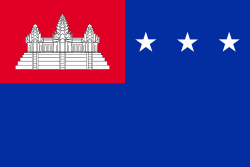
The Khmer Republic (Khmer: សាធារណរដ្ឋខ្មែរ, Sathéarônârôdth Khmêr; French: République khmère) was a Cambodian state under the United States-backed military dictatorship of Marshal Lon Nol from 1970 to 1975. Its establishment was formally declared on 9 October 1970, following the 18 March 1970 coup d'état which saw the overthrow of Norodom Sihanouk's government and the abolition of the Cambodian monarchy. The main cause of the coup was Norodom Sihanouk's tolerance of North Vietnamese military activity within Cambodia's borders; Vietnamese communist forces had gained de facto control over vast areas of eastern Cambodia as a result. Another important factor was the dire state of the Cambodian economy, an indirect result of Sihanouk's policies of pursuing neutrality. With the removal of Sihanouk, the existing Kingdom of Cambodia became a republic, officially removing Sisowath Kossamak. The character of the new regime was far-right and militaristic; most significantly, it ended Sihanouk's period of covert co-operation with the North Vietnamese regime and the Viet Cong, and aligned Cambodia with South Vietnam in the ongoing Second Indochina War. The Khmer Republic was opposed within the Cambodian borders by the National United Front of Kampuchea (Front uni national de Kampuchéa, FUNK), a relatively broad alliance between Sihanouk, his supporters, and the Communist Party of Kampuchea. The insurgency itself was conducted by the CPNLAF, the Cambodian People's National Liberation Armed Forces: they were backed by both the People's Army of Vietnam (PAVN) and the National Liberation Front (NLF, better known as the Viet Cong), who occupied parts of Cambodia as part of their ongoing war with the South Vietnamese government. Despite the large quantities of military and financial aid from the United States, the Khmer National Armed Forces (Forces armées nationales khmères, or FANK) were poorly trained and unable to defeat either the CPNLAF or the Vietnamese forces of the PAVN and NLF. The Republic eventually fell on 17 April 1975, when the Khmer Rouge took Phnom Penh and briefly restored the Kingdom of Cambodia before renaming itself Democratic Kampuchea on 5 January 1976.

Silver Pagoda
Silver Pagoda

The Silver Pagoda is located on the south side of the Royal Palace in Chey Chumneas, Phnom Penh. The official name is Wat Ubaosoth Ratanaram (Khmer: វត្តឧបោសថរតនារាម), also known as Wat Preah Keo Morakot (Khmer: វត្តព្រះកែវមរកត, "Temple of the Emerald-Crystal Buddha") which is commonly shortened to Wat Preah Keo (Khmer: វត្តព្រះកែវ) in Khmer. The vihara houses many national treasures including many golds and jeweled Buddha statues. The most significant are a small green crystal Buddha (the "Emerald Buddha" of Cambodia — some sources maintain it was made of Baccarat Crystal in the 17th century but that's not possible since Baccarat Crystal didn't exist until the 18th century, and other sources indicate it was made in the 19th century by Lalique, a glass designer who lived in the 19th-20th century), and a life-sized gold Maitreya Buddha commissioned by King Sisowath, weighing 90 kg and dressed in royal regalia and set with 9584 diamonds, the largest of which weighing 25 carats, created in the palace workshops during 1906 and 1907. After the Cambodian Civil War the gold Maitreya Buddha lost most of its two-thousand diamonds. During King Norodom Sihanouk's pre-Khmer Rouge reign, the Silver Pagoda was inlaid with more than 5,329 silver tiles and some of its outer facades was remodeled with Italian marble. However, only a small area of these tiles are available to be viewed by the public on entering the pagoda. The wall that surrounds the structures is covered with murals of the Reamker painted in 1903-1904 by Cambodian artists directed by the architect of the Silver Pagoda Oknha Tep Nimit Mak. The legend of Preah Ko Preah Keo is also represented by two statues. It is a notable wat (Buddhist temple) in Phnom Penh; Its grounds being used for various national and royal ceremonies. The cremated remains of Norodom Sihanouk are interred in the stupa of Kantha Bopha located on the temple's compound.

Thai Boon Roong Twin Tower World Trade Center

Thai Boon Roong Twin Tower World Trade Center is a planned skyscraper complex in Phnom Penh, Cambodia, consisting of twin 133-storey skyscrapers with a height of 567 m (1,860 ft). The project is managed by the Cambodian company Thai Boon Roong Group, with the Macau-based Sun Kian Ip Group as co-developer. It is planned to be built on a 5 hectare property in the Doun Penh section, formerly occupied by the Dreamland amusement park, and was approved for construction in February 2016. In December of that year, the developers entered a $2.7 billion construction contract with Chinese firms Wuchang Shipbuilding Industry Group and Sino Great Wall International Engineering, who formed a joint venture for this purpose; at this time, the building's announced height was 560 m (1,840 ft). Described since then as what would be Southeast Asia's tallest building, if built, the twin skyscrapers would be the second tallest buildings in the region—after Merdeka 118, which is nearing completion in 2023 and has a height of 678.9 m (2,227 ft). Upon completion, the Thai Boon Roong Twin Towers would surpass the Petronas Towers as the world's tallest twin skyscraper (as of 2023). In mid-2017, 1 August 2017 was set as the date of the start of construction. Since then, construction has been delayed multiple times. A groundbreaking ceremony was held on the site in 2018, however, later that year, Sino Great Wall International Engineering withdrew from the project due to concerns over financing and citing "greater uncontrollable risks." As of 2022, the project has been "failing to materialize", according to Southeast Asia Globe, and, as of 2023, the Council on Tall Buildings and Urban Habitat website lists the project's status as "proposed". The company has cited the COVID-19 pandemic as a reason for the delay. This construction site has been inactive since the COVID-19 pandemic, and it is possible that the project has been canceled, although no official announcement has been made regarding its cancellation. There is a sign saying "NO PARKING! SITE UNDER CONSTRUCTION!" along with a Khmer translation of the text, seen on a Google Streetview in Preah Sisowath Quay, with the latest screenshot showing the sign, taken on November 2022, suggesting that it was under construction in November 2022, although it is possible that it could have been a outdated sign. There is also a decline in ongoing interest or activity related to this project. In fact, the most recent known published video on YouTube surrounding this project is titled 'Thai Boon Roong Tower' published by a YouTube channel named 'Sakal Real Estate' which was released on August 28, 2024.