place

Foreign Correspondents' Club, Phnom Penh

Cambodian building and structure stubsPhnom PenhTourism in Cambodia
The FCC (Phnom Penh, Cambodia 2011) (6659847313)

The Foreign Correspondents' Club in Phnom Penh, capital of Cambodia, is a public bar and restaurant along the Tonle Sap river, not far from the conjunction with the Mekong river. It is often referred to as 'the FCC,' or just simply 'the F.' It is in a three-story colonial-style building with wonderful views over the river. It is currently undergoing a major remodel and upgrade, planned to be complete at the end of 2021. The earlier configuration was very charming and atmospheric, featuring photos on the wall dating back to the Khmer Rouge invasion of Phnom Penh, taken by war correspondents who used to hang out at FCC back in the day. The FCC in Phnom Penh is not a private club, like other Foreign Correspondents' Clubs around the world, but members from reciprocal clubs (like the FCC Hong Kong) get a 10% discount on food and drinks. The FCC in Phnom Penh has nine hotel rooms. They also have a hotel, restaurant and bar in Siem Reap, the gateway to Angkor Wat.

Excerpt from the Wikipedia article Foreign Correspondents' Club, Phnom Penh (License: CC BY-SA 3.0, Authors, Images).

Foreign Correspondents' Club, Phnom Penh
Preah Ang Makhak Vann (Street 178),

Geographical coordinates (GPS) Address External links Nearby Places
placeShow on map

Wikipedia: Foreign Correspondents' Club, Phnom PenhContinue reading on Wikipedia

Geographical coordinates (GPS)

Latitude Longitude
N 11.566936 ° E 104.931457 °
placeShow on map

Address

FCC Phnom Penh (closed)

Preah Ang Makhak Vann (Street 178)
120205
Phnom Penh, Cambodia
mapOpen on Google Maps

linkWikiData (Q5468239)
linkOpenStreetMap (372670709)

The FCC (Phnom Penh, Cambodia 2011) (6659847313)
Share experience

Nearby Places

Royal University of Fine Arts

The Royal University of Fine Arts (RUFA; Khmer: សាកលវិទ្យាល័យភូមិន្ទវិចិត្រសិល្បៈ; French: Université royale des beaux-arts) is a university in Chey Chumneas, Phnom Penh specialising in architecture and fine arts. It is the oldest university in Cambodia, having been in existence since 1917. The establishment of the Royal University of Fine Arts dates back to 1917. At the time, the Khmer Arts School was established inside the Royal Palace. Later, because the courtyard inside the Royal Palace was too small, King Sisowath tasked the French artist George Grolier, as well as seven other Cambodian artists, with establishing a new Fine Arts School situated at the present-day site of the Royal University of Fine Arts. In 1965, the Fine Arts School was transformed into the Royal University of Fine Arts, which had five faculties: Faculty of Choreographic Arts, which was expanded from the national dance group; Faculty of Music, expanded from the musical school; and the Faculty of Plastic Arts, expanded from the Khmer Arts School or Fine Arts School. At the same time, two new faculties were established: Faculty of Archaeology, and the Faculty of Architecture and Urbanization. The university operated until April 1975, when it closed as the country fell to the Khmer Rouge regime. In October 1988, the Cambodian government issued the sub-decree to re-open the university as the University of Fine Arts. Then, the university was renamed the Royal University of Fine Arts in the sub-decree in October 1996.

Silver Pagoda
Silver Pagoda

The Silver Pagoda is located on the south side of the Royal Palace in Chey Chumneas, Phnom Penh. The official name is Wat Ubaosoth Ratanaram (Khmer: វត្តឧបោសថរតនារាម), also known as Wat Preah Keo Morakot (Khmer: វត្តព្រះកែវមរកត, "Temple of the Emerald-Crystal Buddha") which is commonly shortened to Wat Preah Keo (Khmer: វត្តព្រះកែវ) in Khmer. The vihara houses many national treasures including many golds and jeweled Buddha statues. The most significant are a small green crystal Buddha (the "Emerald Buddha" of Cambodia — some sources maintain it was made of Baccarat Crystal in the 17th century but that's not possible since Baccarat Crystal didn't exist until the 18th century, and other sources indicate it was made in the 19th century by Lalique, a glass designer who lived in the 19th-20th century), and a life-sized gold Maitreya Buddha commissioned by King Sisowath, weighing 90 kg and dressed in royal regalia and set with 9584 diamonds, the largest of which weighing 25 carats, created in the palace workshops during 1906 and 1907. After the Cambodian Civil War the gold Maitreya Buddha lost most of its two-thousand diamonds. During King Norodom Sihanouk's pre-Khmer Rouge reign, the Silver Pagoda was inlaid with more than 5,329 silver tiles and some of its outer facades was remodeled with Italian marble. However, only a small area of these tiles are available to be viewed by the public on entering the pagoda. The wall that surrounds the structures is covered with murals of the Reamker painted in 1903-1904 by Cambodian artists directed by the architect of the Silver Pagoda Oknha Tep Nimit Mak. The legend of Preah Ko Preah Keo is also represented by two statues. It is a notable wat (Buddhist temple) in Phnom Penh; Its grounds being used for various national and royal ceremonies. The cremated remains of Norodom Sihanouk are interred in the stupa of Kantha Bopha located on the temple's compound.

Khmer Republic
Khmer Republic

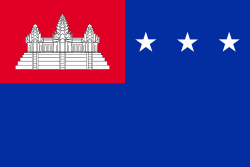
The Khmer Republic (Khmer: សាធារណរដ្ឋខ្មែរ, Sathéarônârôdth Khmêr; French: République khmère) was a Cambodian state under the United States-backed military dictatorship of Marshal Lon Nol from 1970 to 1975. Its establishment was formally declared on 9 October 1970, following the 18 March 1970 coup d'état which saw the overthrow of Norodom Sihanouk's government and the abolition of the Cambodian monarchy. The main cause of the coup was Norodom Sihanouk's tolerance of North Vietnamese military activity within Cambodia's borders; Vietnamese communist forces had gained de facto control over vast areas of eastern Cambodia as a result. Another important factor was the dire state of the Cambodian economy, an indirect result of Sihanouk's policies of pursuing neutrality. With the removal of Sihanouk, the existing Kingdom of Cambodia became a republic, officially removing Sisowath Kossamak. The character of the new regime was far-right and militaristic; most significantly, it ended Sihanouk's period of covert co-operation with the North Vietnamese regime and the Viet Cong, and aligned Cambodia with South Vietnam in the ongoing Second Indochina War. The Khmer Republic was opposed within the Cambodian borders by the National United Front of Kampuchea (Front uni national de Kampuchéa, FUNK), a relatively broad alliance between Sihanouk, his supporters, and the Communist Party of Kampuchea. The insurgency itself was conducted by the CPNLAF, the Cambodian People's National Liberation Armed Forces: they were backed by both the People's Army of Vietnam (PAVN) and the National Liberation Front (NLF, better known as the Viet Cong), who occupied parts of Cambodia as part of their ongoing war with the South Vietnamese government. Despite the large quantities of military and financial aid from the United States, the Khmer National Armed Forces (Forces armées nationales khmères, or FANK) were poorly trained and unable to defeat either the CPNLAF or the Vietnamese forces of the PAVN and NLF. The Republic eventually fell on 17 April 1975, when the Khmer Rouge took Phnom Penh and briefly restored the Kingdom of Cambodia before renaming itself Democratic Kampuchea on 5 January 1976.