place

Tin Can Cathedral

Churches in WinnipegEastern Christianity in CanadaRusyn CanadianRusyn cultureUkrainian-Canadian culture in Manitoba
Ukrainian Canadian religion
Tin Can Cathedral
Tin Can Cathedral

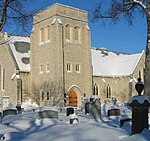
The Tin Can Cathedral (Ukrainian: Бляшана Катедра, romanized: Blyashana Katedra) was the first independent Ukrainian church in North America. It was the heart of the Seraphimite Church. Founded in Winnipeg, it had no affiliation with any church in Europe. Ukrainian immigrants began arriving in Canada in 1891 mainly from the Austro-Hungarian provinces, the regions of Bukovina and Galicia. The new arrivals from Bukovina were Eastern Orthodox, those from Galicia Eastern Catholic. In either case it was the Byzantine Rite with which they were familiar. By 1903 the Ukrainian immigrant population in Western Canada had become large enough to attract the attention of religious leaders, politicians, and educationalists.

Excerpt from the Wikipedia article Tin Can Cathedral (License: CC BY-SA 3.0, Authors, Images).

Tin Can Cathedral
Selkirk Avenue, Winnipeg Mynarski

Geographical coordinates (GPS) Address Nearby Places
placeShow on map

Wikipedia: Tin Can CathedralContinue reading on Wikipedia

Geographical coordinates (GPS)

Latitude Longitude
N 49.912255555556 ° E -97.134147222222 °
placeShow on map

Address

Selkirk Avenue

Selkirk Avenue
R2W 2L5 Winnipeg, Mynarski
Manitoba, Canada
mapOpen on Google Maps

Tin Can Cathedral
Tin Can Cathedral
Share experience

Nearby Places

Fort Douglas (Canada)

Fort Douglas was the Selkirk Settlement (Red River Colony) fort and the first fort associated with the Hudson's Bay Company near the confluence of the Red and Assiniboine rivers in today's city of Winnipeg. Named for Thomas Douglas, 5th Earl of Selkirk, founder of the Selkirk Settlement, the fort was built by Scottish and Irish settlers beginning in 1813. Completed in 1815, it was in the immediate vicinity (down river) of the North West Company establishment, Fort Gibraltar.After the Battle of Seven Oaks in 1816, during the conflict between the Hudson's Bay Company and the North West Company, the fort was captured by the Métis and employees of the North West Company. The fort was soon retaken by Selkirk's men and there was a short period of relative peace. Thomas Douglas, 5th Earl of Selkirk lived at the fort during his visit to the Selkirk Settlement (Red River Colony) in the summer of 1817. It was later used as a trading post and was the residence of the Governor of Assiniboia. Following the amalgamation of the Hudson's Bay Company (HBC) and the North West Company (NWC) in 1821, the HBC's operations were relocated to the NWC's Fort Gibraltar, renamed Fort Garry. Fort Douglas remained the residence of the Governor of Assiniboia until it was mostly destroyed in the great Red River flood of 1826. A second flood in 1852 swept away remnants. Today the site of Fort Douglas is located on Waterfront Drive in downtown Winnipeg, in Fort Douglas Park. As the heart of the Selkirk Settlement and the first significant structure in what is today Winnipeg's historic Exchange District, the site of the fort is the most important historical site in the district. The eminent Canadian historian Professor Chester Martin of the University of Manitoba, in 1924 described the site of Fort Douglas as "perhaps the most historic site in the prairie provinces."