place

Nanjing West railway station

Chinese museum stubsJiangsu railway station stubsRailway museums in ChinaRailway stations closed in 2012Railway stations in China opened in 1908
Railway stations in Nanjing
Nanjingxi
Nanjingxi

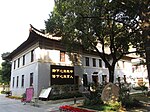
Nanjing West railway station (Chinese: 南京西站) is a railway station in Nanjing, China. Originally named Nanjing railway station, it was first opened in 1908. as the end point of the Shanghai–Nanjing Railway (a section of the Beijing–Shanghai Railway). Later, it also became the starting point of the Nanjing–Tongling Railway. Located in Nanjing's Xiaguan District, near the southern bank of the Yangtze River, opposite Nanjing North railway station on the northern side of the river (in Pukou), the station was a point where passengers traveling e.g. from Shanghai to Beijing would have to get off the train and board a river ferry, to resume their northward journey from the other station. After Nanjing Yangtze River Bridge was built, a new Nanjing railway station was constructed closer to the city center, and the original Nanjing railway station near the river was renamed to Nanjing West railway station, which name it has retained to this day. By the 21st century, the Nanjing West station saw only a few trains a day. This station suspended passenger services 25 March 2012, and will be converted to a railway museum.

Excerpt from the Wikipedia article Nanjing West railway station (License: CC BY-SA 3.0, Authors, Images).

Nanjing West railway station
龙江路, Gulou District 下关街道

Geographical coordinates (GPS) Address External links Nearby Places
placeShow on map

Wikipedia: Nanjing West railway stationContinue reading on Wikipedia

Geographical coordinates (GPS)

Latitude Longitude
N 32.097222222222 ° E 118.73666666667 °
placeShow on map

Address

南京西

龙江路
210000 Gulou District, 下关街道
Jiangsu, China
mapOpen on Google Maps

linkWikiData (Q6963696)
linkOpenStreetMap (9218083763)

Nanjingxi
Nanjingxi
Share experience

Nearby Places

High School Affiliated to Nanjing Normal University

High School Affiliated to Nanjing Normal University (Chinese: 南京師範大學附屬中學, or NSFZ/南師附中 for short) is a high school located in Nanjing, China. It was founded in 1902, and was known as High School Affiliated to National Central University (國立中央大學附屬中學) before 1949, and High School Affiliated to Nanjing University (南京大學附屬中學) during a short period later, until 1952. The school boasts two campuses. At its main campus, it has hosted the Nanjing campus of Caulfield Grammar School, an independent Australian school, which has run an internationalism program in China since 1998. Students from Caulfield live on the campus for five week programs, and during this time they participate in two day homestay visits with students from the High School Affiliated to Nanjing Normal University. In 2007, the High School Affiliated to Nanjing Normal University joined in a sister school partnership with Charlotte Country Day School in Charlotte, North Carolina, US. Since 2007, the two schools have organized annual teacher exchanges and student visits. High School Affiliated to Nanjing Normal University is nationally and regionally recognized and received titles and awards such as National Model High School, Basic Education Reform Experiment School (Ministry of Education), Top Ten Schools of Basic Education in China, Key Middle School of Jiangsu, Model School of Jiangsu, and Top Four Schools of Jiangsu Province. The school is also a member of International School Connection. In 2007, the school became a member of International Baccalaureate and now offers IB Diploma Programme taught in English. In a 2016 ranking of Chinese high schools that send students to study in American universities, it ranked number 22 in mainland China in terms of the number of students entering top American universities.The school sets up several international exchange programs cooperated with Caulfield High School in Australia. Students from the two countries live together and have both Chinese and English Classes. The program not only provide students with an international studying environment, but also promote the relationship the two countries.