place

Colonial Building

Buildings and structures in St. John's, Newfoundland and LabradorGeneral Assembly of Newfoundland and LabradorHistoric buildings and structures in Newfoundland and LabradorHouses completed in 1850Legislative buildings in Canada
Neoclassical architecture in Canada
Colonial Building, St. John's, Canada

The Colonial Building is a historic government building located in St. John's, Newfoundland and Labrador, Canada. The building was the home of the colonial and later provincial Newfoundland government and the House of Assembly from January 28, 1850 to July 28, 1959. In 1974, it was declared a Provincial Historic Site. In 1832 when the Colony of Newfoundland governed itself by representative government there was not a formal building assigned to house the legislature. The first home of the Legislature was a tavern and lodging house on Duckworth Street owned and operated by a Mrs. Mary Travers. The stay was brief as in the legislature's haste and inexperience it forgot to vote approval for the funds to pay rent. The first building was destroyed in city fire of 1846. For the next seventeen years they would meet in various temporary quarters including the local courthouse. In 1846 an act was approved authorizing the construction of the Colonial Building as a permanent home. On May 24, 1847, the cornerstone was laid by the Governor, Major-General Sir John Gaspar Le Marchant. The official opening of the Colonial Building took place on January 28, 1850, by Governor Le Marchant for the second session of the House's fourth general assembly.

Excerpt from the Wikipedia article Colonial Building (License: CC BY-SA 3.0, Authors, Images).

Colonial Building
Bannerman Street, St. John's

Geographical coordinates (GPS) Address Nearby Places
placeShow on map

Wikipedia: Colonial BuildingContinue reading on Wikipedia

Geographical coordinates (GPS)

Latitude Longitude
N 47.570927777778 ° E -52.706788888889 °
placeShow on map

Address

Colonial Building

Bannerman Street
A1B 2L5 St. John's
Newfoundland and Labrador, Canada
mapOpen on Google Maps

Colonial Building, St. John's, Canada
Share experience

Nearby Places

Government House (Newfoundland and Labrador)

Government House is the official residence of the lieutenant governor of Newfoundland and Labrador. Government House was a by-product of the wave of administrative initiatives that took place during the 1820s. The royal charter of 1825 bestowed official colonial status for Newfoundland. The first governors of Newfoundland were naval officers who resided on their flagship, anchored in St. John's harbour. However, Admiral Richard Edwards decided it would be more apt for the Governor to live ashore, and thenceforth the governor resided at Fort Townshend, where the first Government House was constructed. Completed in 1781, it was intended to be a summer house for the governors, but remained in constant use until the present structure was finished in 1831. Never intended for winter use, the inhabitants complained of the cold, and Francis Pickmore even died there in the winter of 1818. The building plans for Government House were drawn up in England. The Ordinance had told the Treasury that workmen's wages were too high in Newfoundland, and subsequently, workmen in Scotland were engaged and arrived in St. John's to begin construction in April 1827. The original plan as conceived by Governor Cochrane was for a Palladian style two-storey house, plus basement. When completed in 1831, Government House cost £38,175, which was five times the original estimate; equal to £3491958.09 today. The two-storey building consists of a centre block flanked by slightly lower wings on the east and on the west. The exterior is of rough, red sandstone quarried at Signal Hill, trimmed with English Portland stone. The construction of the new Government House was meant to reflect the proper status of the governor of a province that was now a proper British colony, and a key part of the Empire. The principal rooms for entertaining—a salon, dining room, and ballroom—along with the main entrance hall were laid out in such a manner as to allow for ceremonial processions, and pomp befitting a governor.The Lieutenant-Governor's residence is where the Canadian Royal Family and visiting foreign dignitaries are greeted. Inside are also reception rooms, offices and support facilities; the Lieutenant-Governor's office is the site of swearing-in ceremonies for Cabinet ministers, where Royal Assent is granted, and where the Lieutenant-Governor receives the Premier. The site was designated a National Historic Site of Canada.

Benevolent Irish Society

The Benevolent Irish Society (BIS) is a philanthropic organization founded on 17 February 1806, a month before the Feast of St. Patrick, in St. John's, Newfoundland. It is the oldest philanthropic organization in North America. Membership is open to adult residents of Newfoundland who are of Irish birth or ancestry, regardless of religious persuasion. The BIS is a charitable, fraternal, middle-class social organization founded on the principles of "benevolence and philanthropy", and had as its original objective of helping the growing numbers of poor in St. John's, and providing the necessary skills which would enable people to better themselves. The rules of the BIS prohibited members from formally discussing political or religious questions, but the Society occasionally took a public political stand. In 1829 it participated in a large parade through St. John's to celebrate Roman Catholic Emancipation. In the early years of the nineteenth century, St. John's had a large Irish population with some members of affluence. Many of these Irish both saw social needs which were not being met by government, and desired to belong to a fraternal, gentlemanly organization. Under Bishop O'Donel's patronage, they founded the BIS under the motto He that gives to the poor lends to the Lord. By the 1820s, many BIS members were beginning to play prominent roles in the political life of Newfoundland and the Irish community in St. John's. By the 1840s the BIS had become so wealthy and influential that, next to the House of Assembly and the governor's council, the BIS was able to marshal considerable resources to address social problems and needs. In 1876 it sponsored the establishment in St. John's of the Irish Christian Brothers, and assisted with the maintenance of the Saint Bonaventure's College and the opening of St. Patrick's School. In 1996, the then Taoiseach of Ireland, John Bruton, visited the BIS in St. Patrick's Hall on St. Patrick's Day. The headquarters of the BIS, fronting on Queen's Road, backing on Military Road opposite of the Basilicia, with its side on Garrison Hill, was converted into a condominium residence in the late 1990s/early 2000s; the price of a single condo unit can reach over 1 million Canadian dollars. The BIS is now based about two minutes walk west at 30 Harvey Road.

Bank of British North America Building

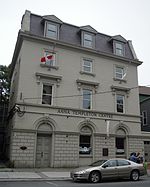
The Bank of British North America Building built in the Italianate style was constructed in 1849 for the British Bank of North America, Newfoundland's first commercial bank. The building was built after the St. John's fire of 1846 by Halifax architect David Stirling. The British Bank of North America was formed in 1835 and opened its first colonial branch in Newfoundland in 1837, with other branches soon to follow in New Brunswick, Nova Scotia, British Columbia, Yukon and in California. From 1857 to 1894 the building was acquired by the Commercial Bank of Newfoundland and had replaced the original hipped roof with a mansard roof. In 1892 it sustained more fire damage in the fire of 1892, it was of the few structures that survived the devastation. It was reconstructed by William Howe Greene, who had also built the Supreme Court House and Cabot Tower. In 1895 the Bank of Montreal moved into the building and two years later, the only Newfoundland bank to survive the 1894 Crash, the Newfoundland Savings Bank, moved into the building. Then again in 1962 the Bank of Montreal purchased the Savings Bank and reacquired the building. In 1985 the Bank of Montreal donated the building to the City of St. John's. This style later became popular in Canada. Newfoundland’s first commercial bank from 1849-1857. In the following century the building housed a few other banks. From 1857 to 1894 The Banks of Newfoundland, then from 1895 for two years Bank of Montreal and Newfoundland Savings Bank from 1697 to 1962 and Bank of Montreal again from 1962 to 1985.At present the building is home to the College of the North Atlantic's Anna Templeton Centre established as a non-profit crafts and arts training and education centre. The building was designated a National Historic Site of Canada in 1990. The Heritage Foundation of Newfoundland and Labrador designated the site a Registered Heritage Structure on May 3, 1991.