place

St. John's metropolitan area

Geography of St. John's, Newfoundland and LabradorMetropolitan areas of Newfoundland and LabradorUse Canadian English from January 2023
City of St. John's
City of St. John's

The St. John's metropolitan area is the most populous census metropolitan area (CMA) in the Canadian province of Newfoundland and Labrador. With a population of 212,579 in the 2021 Canadian Census, the CMA is the second largest in Atlantic Canada and the 22nd largest CMA in Canada.The St. John’s CMA has an estimated population of 212,579 as of 2021. The CMA comprises the City of St. John's and twelve other communities, the largest of which are the town of Conception Bay South and the city of Mount Pearl.

Excerpt from the Wikipedia article St. John's metropolitan area (License: CC BY-SA 3.0, Authors, Images).

St. John's metropolitan area
Prescott Street, St. John's

Geographical coordinates (GPS) Address Nearby Places
placeShow on map

Wikipedia: St. John's metropolitan areaContinue reading on Wikipedia

Geographical coordinates (GPS)

Latitude Longitude
N 47.5675 ° E -52.707222222222 °
placeShow on map

Address

Prescott Street

Prescott Street
A1C 3V2 St. John's
Newfoundland and Labrador, Canada
mapOpen on Google Maps

City of St. John's
City of St. John's
Share experience

Nearby Places

Bank of British North America Building

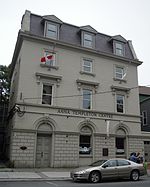
The Bank of British North America Building built in the Italianate style was constructed in 1849 for the British Bank of North America, Newfoundland's first commercial bank. The building was built after the St. John's fire of 1846 by Halifax architect David Stirling. The British Bank of North America was formed in 1835 and opened its first colonial branch in Newfoundland in 1837, with other branches soon to follow in New Brunswick, Nova Scotia, British Columbia, Yukon and in California. From 1857 to 1894 the building was acquired by the Commercial Bank of Newfoundland and had replaced the original hipped roof with a mansard roof. In 1892 it sustained more fire damage in the fire of 1892, it was of the few structures that survived the devastation. It was reconstructed by William Howe Greene, who had also built the Supreme Court House and Cabot Tower. In 1895 the Bank of Montreal moved into the building and two years later, the only Newfoundland bank to survive the 1894 Crash, the Newfoundland Savings Bank, moved into the building. Then again in 1962 the Bank of Montreal purchased the Savings Bank and reacquired the building. In 1985 the Bank of Montreal donated the building to the City of St. John's. This style later became popular in Canada. Newfoundland’s first commercial bank from 1849-1857. In the following century the building housed a few other banks. From 1857 to 1894 The Banks of Newfoundland, then from 1895 for two years Bank of Montreal and Newfoundland Savings Bank from 1697 to 1962 and Bank of Montreal again from 1962 to 1985.At present the building is home to the College of the North Atlantic's Anna Templeton Centre established as a non-profit crafts and arts training and education centre. The building was designated a National Historic Site of Canada in 1990. The Heritage Foundation of Newfoundland and Labrador designated the site a Registered Heritage Structure on May 3, 1991.

Benevolent Irish Society

The Benevolent Irish Society (BIS) is a philanthropic organization founded on 17 February 1806, a month before the Feast of St. Patrick, in St. John's, Newfoundland. It is the oldest philanthropic organization in North America. Membership is open to adult residents of Newfoundland who are of Irish birth or ancestry, regardless of religious persuasion. The BIS is a charitable, fraternal, middle-class social organization founded on the principles of "benevolence and philanthropy", and had as its original objective of helping the growing numbers of poor in St. John's, and providing the necessary skills which would enable people to better themselves. The rules of the BIS prohibited members from formally discussing political or religious questions, but the Society occasionally took a public political stand. In 1829 it participated in a large parade through St. John's to celebrate Roman Catholic Emancipation. In the early years of the nineteenth century, St. John's had a large Irish population with some members of affluence. Many of these Irish both saw social needs which were not being met by government, and desired to belong to a fraternal, gentlemanly organization. Under Bishop O'Donel's patronage, they founded the BIS under the motto He that gives to the poor lends to the Lord. By the 1820s, many BIS members were beginning to play prominent roles in the political life of Newfoundland and the Irish community in St. John's. By the 1840s the BIS had become so wealthy and influential that, next to the House of Assembly and the governor's council, the BIS was able to marshal considerable resources to address social problems and needs. In 1876 it sponsored the establishment in St. John's of the Irish Christian Brothers, and assisted with the maintenance of the Saint Bonaventure's College and the opening of St. Patrick's School. In 1996, the then Taoiseach of Ireland, John Bruton, visited the BIS in St. Patrick's Hall on St. Patrick's Day. The headquarters of the BIS, fronting on Queen's Road, backing on Military Road opposite of the Basilicia, with its side on Garrison Hill, was converted into a condominium residence in the late 1990s/early 2000s; the price of a single condo unit can reach over 1 million Canadian dollars. The BIS is now based about two minutes walk west at 30 Harvey Road.