place

Nickel Film Festival

2001 establishments in CanadaCanadian film festival stubsFestivals in St. John's, Newfoundland and LabradorFilm festivals established in 2001Film festivals in Newfoundland and Labrador
Newfoundland and Labrador stubs

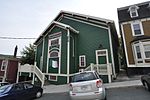
The Nickel Independent Film Festival (otherwise known simply as the Nickel Film Festival) is an annual film festival held in St. John's, Newfoundland and Labrador, Canada. The festival was conceived in 2001 by filmmaker Roger Maunder to allow local filmmakers to exhibit their film and video work. The festival is named after the Nickel Theatre which was the first theatre in Newfoundland to have talking film feature movies. Since then the festival has grown to include other Canadian and even international short films, features, documentaries and music videos. The festival is held at the LSPU hall which is run by the Resource Centre for the Arts, an artist-run company. In 2020, the festival celebrated its 20th anniversary virtually due to the COVID-19 pandemic in Canada. The program featured premieres of shorts and features, workshops, film challenges, and a retrospective of classic Newfoundland titles from the festival's two decades of screenings, all screened on an online platform.

Excerpt from the Wikipedia article Nickel Film Festival (License: CC BY-SA 3.0, Authors).

Nickel Film Festival
Cochrane Street, St. John's

Geographical coordinates (GPS) Address Nearby Places
placeShow on map

Wikipedia: Nickel Film FestivalContinue reading on Wikipedia

Geographical coordinates (GPS)

Latitude Longitude
N 47.5692 ° E -52.7026 °
placeShow on map

Address

Cochrane Street 24
A1C 3L2 St. John's
Newfoundland and Labrador, Canada
mapOpen on Google Maps

Share experience

Nearby Places

Government House (Newfoundland and Labrador)

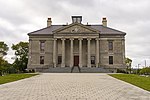
Government House is the official residence of the lieutenant governor of Newfoundland and Labrador. Government House was a by-product of the wave of administrative initiatives that took place during the 1820s. The royal charter of 1825 bestowed official colonial status for Newfoundland. The first governors of Newfoundland were naval officers who resided on their flagship, anchored in St. John's harbour. However, Admiral Richard Edwards decided it would be more apt for the Governor to live ashore, and thenceforth the governor resided at Fort Townshend, where the first Government House was constructed. Completed in 1781, it was intended to be a summer house for the governors, but remained in constant use until the present structure was finished in 1831. Never intended for winter use, the inhabitants complained of the cold, and Francis Pickmore even died there in the winter of 1818. The building plans for Government House were drawn up in England. The Ordinance had told the Treasury that workmen's wages were too high in Newfoundland, and subsequently, workmen in Scotland were engaged and arrived in St. John's to begin construction in April 1827. The original plan as conceived by Governor Cochrane was for a Palladian style two-storey house, plus basement. When completed in 1831, Government House cost £38,175, which was five times the original estimate; equal to £3491958.09 today. The two-storey building consists of a centre block flanked by slightly lower wings on the east and on the west. The exterior is of rough, red sandstone quarried at Signal Hill, trimmed with English Portland stone. The construction of the new Government House was meant to reflect the proper status of the governor of a province that was now a proper British colony, and a key part of the Empire. The principal rooms for entertaining—a salon, dining room, and ballroom—along with the main entrance hall were laid out in such a manner as to allow for ceremonial processions, and pomp befitting a governor.The Lieutenant-Governor's residence is where the Canadian Royal Family and visiting foreign dignitaries are greeted. Inside are also reception rooms, offices and support facilities; the Lieutenant-Governor's office is the site of swearing-in ceremonies for Cabinet ministers, where Royal Assent is granted, and where the Lieutenant-Governor receives the Premier. The site was designated a National Historic Site of Canada.

Bank of British North America Building

The Bank of British North America Building built in the Italianate style was constructed in 1849 for the British Bank of North America, Newfoundland's first commercial bank. The building was built after the St. John's fire of 1846 by Halifax architect David Stirling. The British Bank of North America was formed in 1835 and opened its first colonial branch in Newfoundland in 1837, with other branches soon to follow in New Brunswick, Nova Scotia, British Columbia, Yukon and in California. From 1857 to 1894 the building was acquired by the Commercial Bank of Newfoundland and had replaced the original hipped roof with a mansard roof. In 1892 it sustained more fire damage in the fire of 1892, it was of the few structures that survived the devastation. It was reconstructed by William Howe Greene, who had also built the Supreme Court House and Cabot Tower. In 1895 the Bank of Montreal moved into the building and two years later, the only Newfoundland bank to survive the 1894 Crash, the Newfoundland Savings Bank, moved into the building. Then again in 1962 the Bank of Montreal purchased the Savings Bank and reacquired the building. In 1985 the Bank of Montreal donated the building to the City of St. John's. This style later became popular in Canada. Newfoundland’s first commercial bank from 1849-1857. In the following century the building housed a few other banks. From 1857 to 1894 The Banks of Newfoundland, then from 1895 for two years Bank of Montreal and Newfoundland Savings Bank from 1697 to 1962 and Bank of Montreal again from 1962 to 1985.At present the building is home to the College of the North Atlantic's Anna Templeton Centre established as a non-profit crafts and arts training and education centre. The building was designated a National Historic Site of Canada in 1990. The Heritage Foundation of Newfoundland and Labrador designated the site a Registered Heritage Structure on May 3, 1991.