place

Hotel Lux

Buildings and structures demolished in 2007Companies nationalised by the Soviet UnionDefunct hotels in RussiaGreat PurgeHistory of the Soviet Union
Hotel buildings completed in 1911Hotels established in 1911Hotels in MoscowStalinism
Hotel Luxe Moscow
Hotel Luxe Moscow

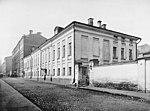
Hotel Lux (Люксъ) was a hotel in Moscow during the Soviet Union, housing many leading exiled and visiting Communists. During the Nazi era, exiles from all over Europe went there, particularly from Germany. A number of them became leading figures in German politics in the postwar era. Initial reports of the hotel were very good, although its problem with rats was mentioned as early as 1921. Communists from more than 50 countries came for congresses, for training or to work. By the 1930s, Joseph Stalin had come to regard the international character of the hotel with suspicion and its occupants as potential spies. His purges created an atmosphere of fear among the occupants, who were faced with mistrust, denunciations, and nightly arrests. The purges at the hotel peaked between 1936 and 1938. Germans who had fled Nazi Germany, seeking safety in the Soviet Union, were interrogated, arrested, tortured, and sent to forced labour camps. Most of the 178 leading German communists who were killed in Stalin's purges were residents of Hotel Lux.

Excerpt from the Wikipedia article Hotel Lux (License: CC BY-SA 3.0, Authors, Images).

Hotel Lux
Tverskaya Street, Moscow Tverskoy District

Geographical coordinates (GPS) Address External links Nearby Places
placeShow on map

Wikipedia: Hotel LuxContinue reading on Wikipedia

Geographical coordinates (GPS)

Latitude Longitude
N 55.763055555556 ° E 37.608611111111 °
placeShow on map

Address

Tverskaya Street 10
127238 Moscow, Tverskoy District
Moscow, Russia
mapOpen on Google Maps

linkWikiData (Q1676676)
linkOpenStreetMap (31560937)

Hotel Luxe Moscow
Hotel Luxe Moscow
Share experience

Nearby Places

Pushkinskaya (Moscow Metro)

Pushkinskaya (Russian: Пушкинская) is a station on Moscow Metro's Tagansko-Krasnopresnenskaya Line. Opened on 17 December 1975, along with Kuznetsky Most as the segment which linked the Zhdanovskaya and Krasnopresnenskaya Lines into one. Like its neighbour, the station was a column tri-vault type, which had not been seen in Moscow since the 1950s. Arguably the most beautiful station on the Line, the architects Vdovin and Bazhenov took every effort to make it appear to have a 'classical' 19th century setting. The central hall lighting is created with stylised 19th century chandeliers with two rows of plafonds appearing like candles, while the side platforms have candlesticks with similar plafonds. The columns, covered with 'Koelga' white marble are decorated with palm leaf reliefs and the grey marble walls are decorated with brass measured insertions based on the works of the great Russian poet Alexander Pushkin. The grey granite floor completes the appearance of the masterpiece. Architecturally the station put the final stop to the functionality economy design of the 1960s and went against Nikita Khrushchev's policy of struggle to avoid decorative 'extras', which left the stations of 1958–59 greatly altered in their design. The station's original vestibule, with its magnificent cessoned ceiling from anodized aluminium (architects Demchinskiy and Kollesnikov) is situated under Pushkinskaya Square of the Boulevard ring, the centre of Moscow's nightlife, and is linked with subways to the square and to Tverskaya Street. In 1979 it was combined with the Gorkovskaya (now Tverskaya) station of the Zamoskvoretskaya Line. The opposite end was decorated with a bust of the great poet himself (architect — Shumakov), however in 1987 a pathway was opened to the underground vestibule of the two escalator cascades of the Chekhovskaya station of the Serpukhovsko-Timiryazevskaya Line. The bust was moved into a combined vestibule built into the office building of the newspaper Izvestia on the Strastnoi Boulevard of the Boulevard ring. When transferring between the stations it is possible to bypass the vestibule via the lyre fenced stairs leading from the middle of the columns. The transfer point, was originally named for the three writers and poets (Alexander Pushkin, Maxim Gorky, Anton Chekhov). In 1991, the original street Ulitsa Gorkova was renamed Tverskaya, and hence the station was also given this name. The transfer point is one of the busiest in Moscow; Pushkinskaya receives a daily load of 46,770 via the vestibules, 170,000 to Tverskaya and 212,000 to the Chekhovskaya station.