place

Ballakermeen High School

1939 establishments in the Isle of ManBuildings and structures in Douglas, Isle of ManEducational institutions established in 1939Schools in the Isle of ManSecondary schools in the United Kingdom
Secondary schools on the Isle of Man

Ballakermeen High School is a coeducational comprehensive secondary school based on a single site in Douglas, on the Isle of Man. It is the second largest Isle of Man Government building after Noble's Hospital in Strang. On the start of the 2022/2023 academic year, a new head teacher was appointed, Mr Graeme Corrin, replacing Mrs Adrienne Burnnet, who was Head Teacher for 21 years.

Excerpt from the Wikipedia article Ballakermeen High School (License: CC BY-SA 3.0, Authors).

Ballakermeen High School
Saint Catherines Close, Douglas

Geographical coordinates (GPS) Address Website External links Nearby Places
placeShow on map

Wikipedia: Ballakermeen High SchoolContinue reading on Wikipedia

Geographical coordinates (GPS)

Latitude Longitude
N 54.1544 ° E -4.4933 °
placeShow on map

Address

Ballakermeen High School

Saint Catherines Close
IM1 4BE Douglas
Isle of Man
mapOpen on Google Maps

Website
bhs.sch.im

linkVisit website

linkWikiData (Q4851412)
linkOpenStreetMap (61562464)

Share experience

Nearby Places

Centre for Manx Studies

The Centre for Manx Studies (Manx: Laare-Studeyrys Manninagh) is a department of the School of Archaeology, Classics and Egyptology in the University of Liverpool whose focus is the study of the Isle of Man, the Manx language, and Manx culture and history. The primary functions of the Centre for Manx Studies are: to teach undergraduate and postgraduate students; to carry out archaeological, cultural, environmental and historical research of international significance in the Isle of Man; to further the international recognition of the Isle of Man in these subjects. In addition to postgraduate research degrees, the centre offers a full-time and a part-time master's degree in Manx Studies and a full-time Diploma in Manx Studies. Founded in 1992, the Centre for Manx Studies was managed by a committee which included representatives from the three partner organizations: the University of Liverpool, the Isle of Man Department of Education, and Manx National Heritage. Originally located near the Manx Museum in the capital city of Douglas, the Centre for Manx Studies relocated in September 2009 to a newly refurbished stable block at the Nunnery estate south of Douglas. In July 2015 the Centre for Manx Studies moved its base off the Isle of Man to the University of Liverpool's main campus: announcing this measure in April 2015, Fiona Beveridge - executive pro-vice-chancellor for Humanities and Social Sciences - stated: Given the withdrawal of support by the Manx Government, we have decided that we can no longer sustain the Centre in the Isle of Man. We remain committed to high quality archaeological research across the UK and Ireland and our work in this area on the Isle of Man, for example on Iron Age settlements and WW1 sites, will continue. The Isle of Man is an excellent base to teach archaeological techniques to students and we will continue to undertake field school activities on the island.

Bray Hill
Bray Hill

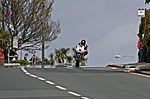
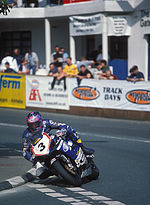
Bray Hill (Lowland Scots: Brae a slope) is a road in the Isle of Man. It was formerly a country lane known as the Great Hill during the time of the ownership of the Duke of Atholl, and was previously known as Siberia, originally a triangle-shaped parcel of land in the Murray Estate.Bray Hill is a steep downhill section of the TT course situated between the TT Grandstand and the 1st Milestone road-side marker on the Snaefell Mountain Course on the primary the A2 Douglas to Ramsey road in the town of Douglas in the Isle of Man.The Bray Hill section runs from St Ninian's Crossroads, where the A2 Glencrutchery Road (from the TT startline) meets the side streets of Ballanard Road and Ballaquayle Road on the A22, continuing to the base of the hill where it becomes the A2 Quarterbridge Road at a crossroad-junction with side streets named Tromode Road, Stoney Road, and Thorny Road. Bray Hill was part of the Highland Course and Four Inch Course used for the Gordon Bennett Trial and Tourist Trophy car races held between 1904 and 1922. For the 1934 and 1935 car races, the whole length of Bray Hill from its junction with Stoney Road was part of the Mannin Moar Course. The startline and refuelling area for the Isle of Man TT races was situated at the top of Bray Hill for the 1914 TT races, moving in 1920 to the Nobles Park area of the A2 Glencrutchery Road. Bray Hill is part of the Snaefell Mountain Course used since 1911 for the TT races and Manx Grand Prix since 1923. The A2 Bray Hill and A2 Quarterbridge Road were subjected to major road repairs and re-profiling during the winter of 1978/79 by the Isle of Man Highway Board. This followed two fatal accidents at the start of the 1978 Sidecar TT 'A' race involving sidecar crew of Mac Hobson/Kenny Birch on Bray Hill and Swiss sidecar competitor Ernst Trachsel on nearby Quarterbridge Road.In 2013, a rider lost control on the first lap of the Senior TT and his machine impacted with spectators near to the bottom of the hill, close to the junction, injuring eleven.

The Bowl (Douglas)

The King George V Bowl (commonly known as The Bowl) is a multi-use stadium in Douglas, Isle of Man, and the home of F.C. Isle of Man. With a capacity of 3,350, a third of which are under cover, and a viewing platform for disabled users, it is the largest stadium on the Island. The Bowl also serves as the home of the Isle of Man Football Association, Isle of Man official football team and Ellan Vannin football team. The highest attendance (3,327 spectators) was registered in the F.A. Inter League Cup Final on 28.04.12 against Jersey. Nicknamed "The Bernabowl" by local supporters in reference to the Santiago Bernabéu Stadium, The Bowl has been the home ground of F.C. Isle of Man since July 2020, the club shares the ground with nine local clubs for their winter training schedule and St Marys A.F.C. have taken up permanent residence, training and playing their league matches at the stadium. The Bowl was redeveloped at a cost of around £3.3 million, with then-Minister of Infrastructure David Cretney saying: "This is an exceptional facility at the heart of our Island of Sport. The previous, out of date Bowl has been transformed into a flagship sporting venue that will enable upcoming sports men and women to challenge the best visiting and local players." The pitch is a 65 mm (2.6 in) rubber infill 3G carpet system, the same as currently used at Manchester United's Trafford Training Centre. It is approved by the RFU and FIFA for rugby and football. There are also four 500 lux floodlights on 18-metre (59 ft) columns in each corner of the stadium. The Bowl is owned by Douglas Borough Council.