place

All Saints Church, Douglas

Buildings and structures in Douglas, Isle of ManChurch of England church buildings in EuropeChurches in the Isle of ManModernist architectureRegistered Buildings of the Isle of Man
All Saints Church, Douglas

All Saints Church, Douglas, Isle of Man, is a 1967 Modernist Anglican church which closed in May 2017.The building was listed as a Registered Building of the Isle of Man in 2001.

Excerpt from the Wikipedia article All Saints Church, Douglas (License: CC BY-SA 3.0, Authors, Images).

All Saints Church, Douglas
Alexander Drive, Douglas

Geographical coordinates (GPS) Address Website External links Nearby Places
placeShow on map

Wikipedia: All Saints Church, DouglasContinue reading on Wikipedia

Geographical coordinates (GPS)

Latitude Longitude
N 54.155965 ° E -4.48971 °
placeShow on map

Address

All Saints

Alexander Drive
Douglas
Isle of Man
mapOpen on Google Maps

Website
allsaintsdouglasiom.org

linkVisit website

linkWikiData (Q30325334)
linkOpenStreetMap (164658102)

All Saints Church, Douglas
Share experience

Nearby Places

Bray Hill
Bray Hill

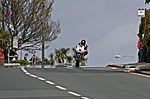
Bray Hill (Lowland Scots: Brae a slope) is a road in the Isle of Man. It was formerly a country lane known as the Great Hill during the time of the ownership of the Duke of Atholl, and was previously known as Siberia, originally a triangle-shaped parcel of land in the Murray Estate.Bray Hill is a steep downhill section of the TT course situated between the TT Grandstand and the 1st Milestone road-side marker on the Snaefell Mountain Course on the primary the A2 Douglas to Ramsey road in the town of Douglas in the Isle of Man.The Bray Hill section runs from St Ninian's Crossroads, where the A2 Glencrutchery Road (from the TT startline) meets the side streets of Ballanard Road and Ballaquayle Road on the A22, continuing to the base of the hill where it becomes the A2 Quarterbridge Road at a crossroad-junction with side streets named Tromode Road, Stoney Road, and Thorny Road. Bray Hill was part of the Highland Course and Four Inch Course used for the Gordon Bennett Trial and Tourist Trophy car races held between 1904 and 1922. For the 1934 and 1935 car races, the whole length of Bray Hill from its junction with Stoney Road was part of the Mannin Moar Course. The startline and refuelling area for the Isle of Man TT races was situated at the top of Bray Hill for the 1914 TT races, moving in 1920 to the Nobles Park area of the A2 Glencrutchery Road. Bray Hill is part of the Snaefell Mountain Course used since 1911 for the TT races and Manx Grand Prix since 1923. The A2 Bray Hill and A2 Quarterbridge Road were subjected to major road repairs and re-profiling during the winter of 1978/79 by the Isle of Man Highway Board. This followed two fatal accidents at the start of the 1978 Sidecar TT 'A' race involving sidecar crew of Mac Hobson/Kenny Birch on Bray Hill and Swiss sidecar competitor Ernst Trachsel on nearby Quarterbridge Road.In 2013, a rider lost control on the first lap of the Senior TT and his machine impacted with spectators near to the bottom of the hill, close to the junction, injuring eleven.

Centre for Manx Studies

The Centre for Manx Studies (Manx: Laare-Studeyrys Manninagh) is a department of the School of Archaeology, Classics and Egyptology in the University of Liverpool whose focus is the study of the Isle of Man, the Manx language, and Manx culture and history. The primary functions of the Centre for Manx Studies are: to teach undergraduate and postgraduate students; to carry out archaeological, cultural, environmental and historical research of international significance in the Isle of Man; to further the international recognition of the Isle of Man in these subjects. In addition to postgraduate research degrees, the centre offers a full-time and a part-time master's degree in Manx Studies and a full-time Diploma in Manx Studies. Founded in 1992, the Centre for Manx Studies was managed by a committee which included representatives from the three partner organizations: the University of Liverpool, the Isle of Man Department of Education, and Manx National Heritage. Originally located near the Manx Museum in the capital city of Douglas, the Centre for Manx Studies relocated in September 2009 to a newly refurbished stable block at the Nunnery estate south of Douglas. In July 2015 the Centre for Manx Studies moved its base off the Isle of Man to the University of Liverpool's main campus: announcing this measure in April 2015, Fiona Beveridge - executive pro-vice-chancellor for Humanities and Social Sciences - stated: Given the withdrawal of support by the Manx Government, we have decided that we can no longer sustain the Centre in the Isle of Man. We remain committed to high quality archaeological research across the UK and Ireland and our work in this area on the Isle of Man, for example on Iron Age settlements and WW1 sites, will continue. The Isle of Man is an excellent base to teach archaeological techniques to students and we will continue to undertake field school activities on the island.

Legislative Council of the Isle of Man

The Legislative Council (Manx: Yn Choonceil Slattyssagh) is the upper chamber of Tynwald, the legislature of the Isle of Man. The abbreviation "LegCo" is often used.It consists of eleven members (MLCs): Eight members elected by the House of Keys Three ex officio members: President of Tynwald, ex officio President of the Legislative Council (casting vote) Bishop of Sodor and Man Attorney General for the Isle of Man (non-voting)Historically, most or all elected MLCs were former MHKs, but this practice has now much reduced or ceased. Formerly, the Lieutenant Governor presided over the Legislative Council and over Tynwald Court (a joint session of the Council and the House of Keys). Now, however, the President of Tynwald, who is chosen by the whole Tynwald for a five-year term, is the ex officio President of the Legislative Council, and presides over both the Legislative Council and Tynwald Court, except that the Lieutenant Governor presides once a year on Tynwald Day. Furthermore, the Church of England Bishop of Sodor and Man and the Attorney General have seats on the Legislative Council. The Bishop is a voting member, the Attorney General is a non-voting member, and the President has the casting vote. The Council does not usually originate legislation; most of the time, it reviews draft legislation originating in the House of Keys. However, it is possible for legislation to originate in the Council: a recent example is the Equality Act 2017.